
Michael Carrick's Diagonals
A look at Manchester United With Michael Carrick, the impact of the concept of Diagonality, Overloads, Close proximity, Mainoo's return, Risk of central progression, Shots from outside the box.

“Free the line and the diagonal, draw the line instead of plotting a point, produce an imperceptible diagonal instead of clinging to an even elaborated or reformed vertical or horizontal.” — Gilles Deleuze and Felix Guattari, A Thousand Plateaus
“The ball moves faster than any player – especially on a diagonal.” A quote that is often attributed to Johan Cruyff and his Protégés, namely Pep Guardiola.
In football, the safest pass is usually the horizontal pass, because the out-of-possession team operates behind the ball. A vertical pass provides progression; however, it holds a big risk in itself, given the situation of how the receiver has to receive, the angles, and the time required to turn, the pressure on his back, the quality of his first touch, and the distribution of his teammates around to pounce on in case of a possession loss.
In general, ART/IST’s blog came with this immaculate definition:
“A horizontal line is restful. All is well.
A vertical line is towering. There is something above you and over you. There is something larger and more than you are.
A diagonal line is dramatic. Something is going to happen. Pay attention. Keep alert.”
In football, a diagonal pass aims to take the benefits of both a horizontal and a vertical pass. It retains the safety of the former while also providing progression of the latter. The question that remains to ask: how does a diagonal pass accelerate the play?
To answer this question, the passer, receiver, and defender are the ones to take into consideration. Body language usually reveals a percentage of actions and intentions that the opposition may make use of to defend themselves. Mastering the speed of execution (think of Lionel Messi), intention disguise (think of Sergio Busquets), and cunning movements tips the scales in favor of the ball holder. All these elements make the life of the passer and receiver easier as much as they harden it for the defender.
📏Diagonality
Receiving a diagonal pass diagonally means that the ball is in your field of vision, you’re in a half-turn and in a forward-facing direction, and it is heading to a space that will set you up for a good follow-up action. It enables the receiver to cushion the ball with one foot and then go with the other, or use the same foot for reception and forward driving.
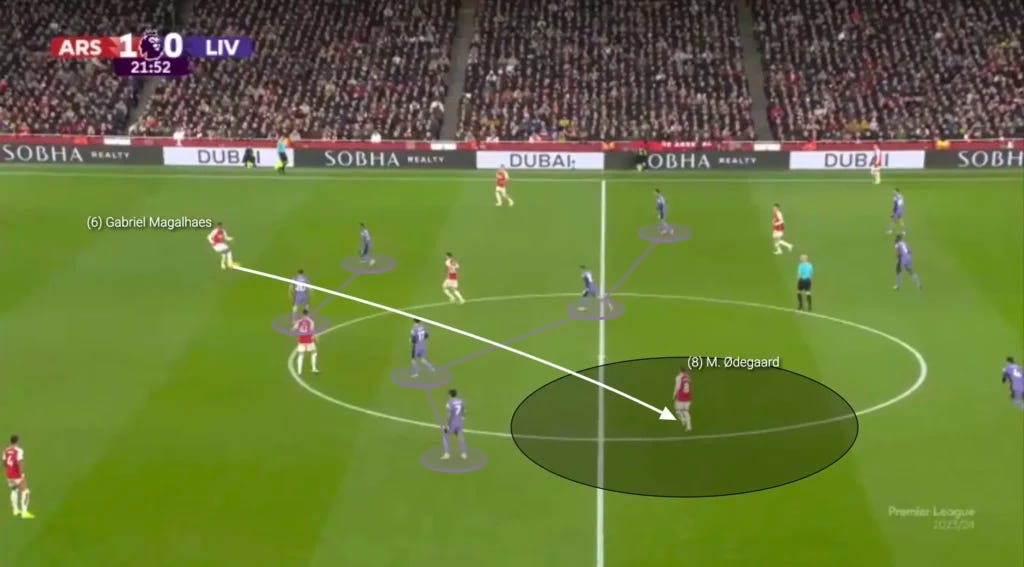
From a defender's perspective, a square stance would allow the receiver a 360-degree view of passing options. So, whatever he tries, the receiver will manage to find a getaway. Of course, the first touch of the receiver and the preparation prior to reception play a crucial role in keeping the sequence flowing and securing progression.
If he turns, then he limits and shrinks the field of vision and exposes his blindside.
The defender experiences a rollercoaster of decisions, and multiple questions pop up in his mind in a very short period of time, whether he should step out or retreat, and how he should accelerate and turn. If he steps out, then there is a danger lurking behind his back. If he retreats, the space ahead of him is vulnerable. He’s tied to reactivity, and the likelihood of making a decision before gathering information about the opposition and his teammates increases.
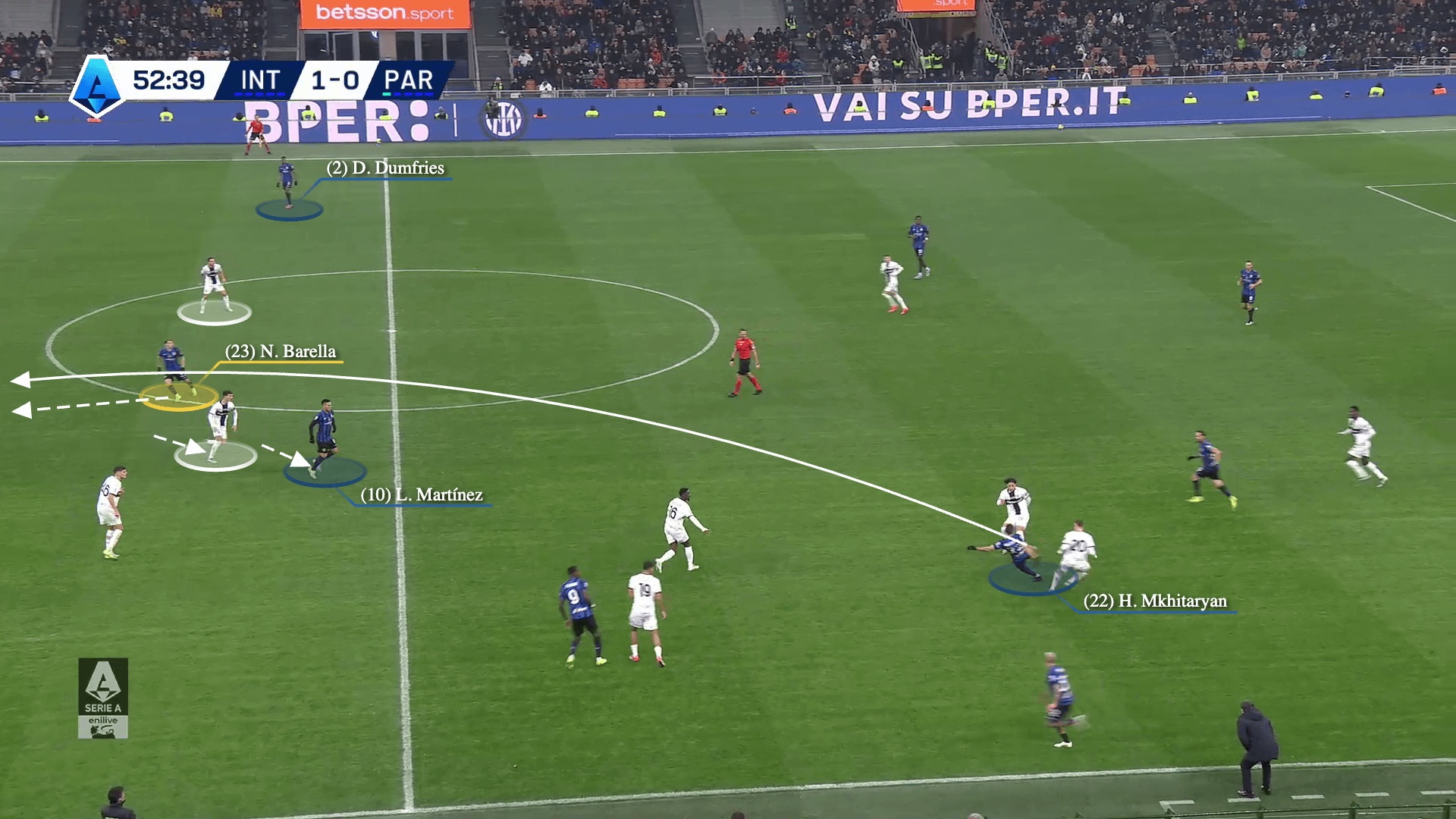
One of the most enjoyable teams in football was Barcelona’s Pep Guardiola. They were thinking diagonally in the center of the pitch. That shaped their body orientations to pass, receive, carry, dribble, and move. In the center, players are susceptible to 360 degrees of pressure. The quality of the players, the coaching, and the football landscape back then allowed that level of dominance and control.
The players were already in a half-turn stance, having a diagonal position to the ball to figure out the gaps between the players. Moving diagonally, rotating in the gaps, and their ability to play from first-time touches in small spaces paved the road for what looked like an easy infiltration from the center.
First touches were clean, setting the next action smoothly and opening the door for picking out a teammate diagonally in a pocket of space. Diagonal movements, actions, and connections contributed to the control Pep Guardiola’s team exerted at the heart of the opponent's defense.

Controlling the center of the pitch via diagonal perception yields a fork in the road. The receiver can play with the flow, enabling continuation or against the grain, without leaving the path of the goal, which forces defenders to hedge their bets and therefore creates gaps.
Pep Guardiola’s Barcelona was a beauty in motion. You would witness the diagonal actions of Xavi, Iniesta, and Messi, blended with diagonal darts and rotations from the half-spaces to the center and vice-versa, circulating the ball diagonally and creating situational rondos as the ball moves. That usually disrupted the opposition’s defensive integrity and schemes, creeping through and setting up the scenarios for the diagonal runs either from the outside to the inside or from the inside to the inside (diagonal half-space or central runs).
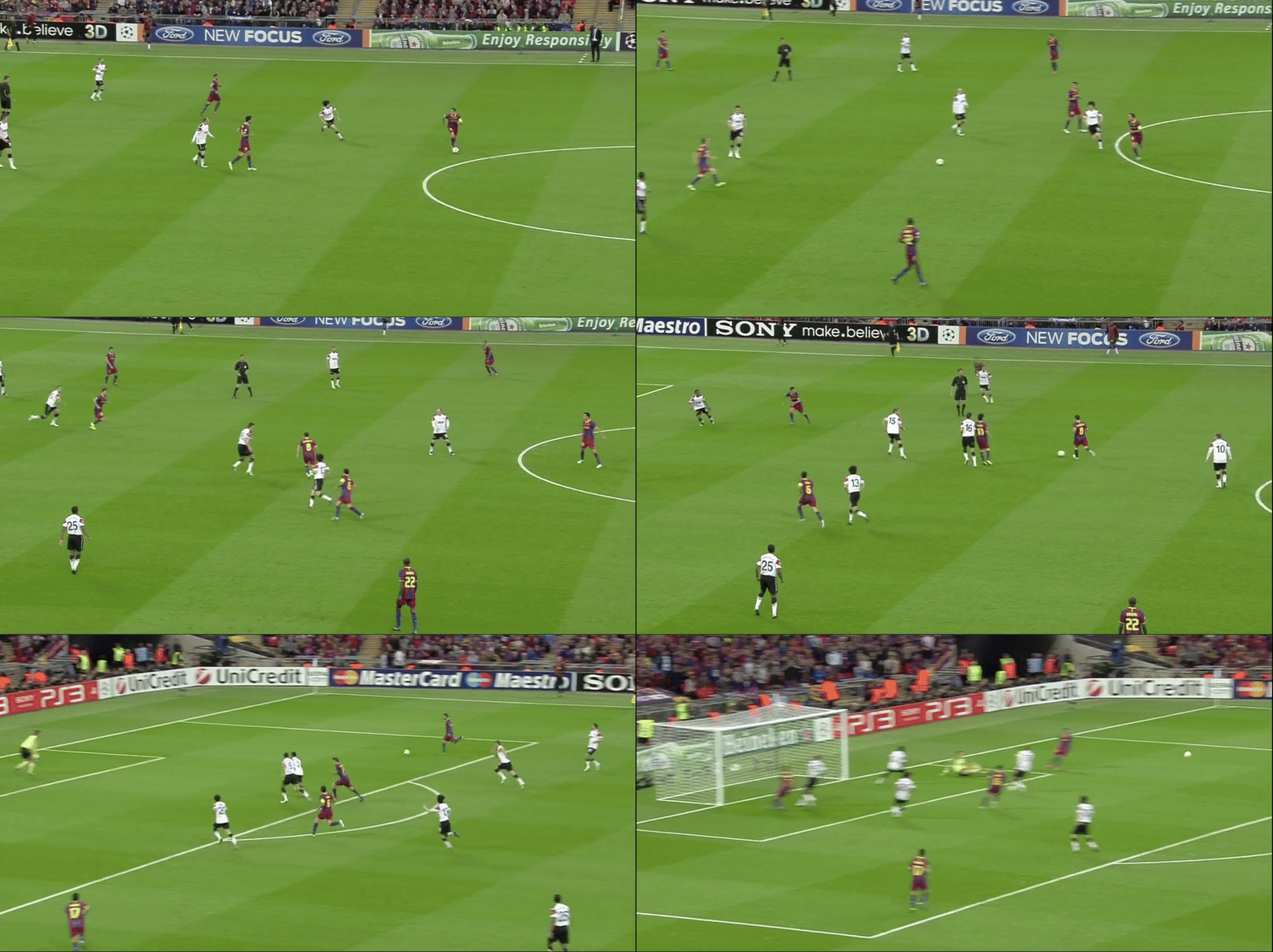
Diagonality is the kryptonite of zonal blocks. This type of defending revolves around players swinging across the pitch and dropping vertically to protect pre-assigned lanes and compact the pitch in both directions.
Quoting from the Spielverlagerung on the impact of diagonality on zonal blocks:
“Diagonality has forced all these zonal blocks to passivity and loss of pitch control. Any diagonal movement against these types of defends either trigger a role exchange (full-back hands you to center-back, six drops into the lane, etc.) or a collective drop.”
Barcelona’s Hansi Flick is a good instance to recall in this discussion.
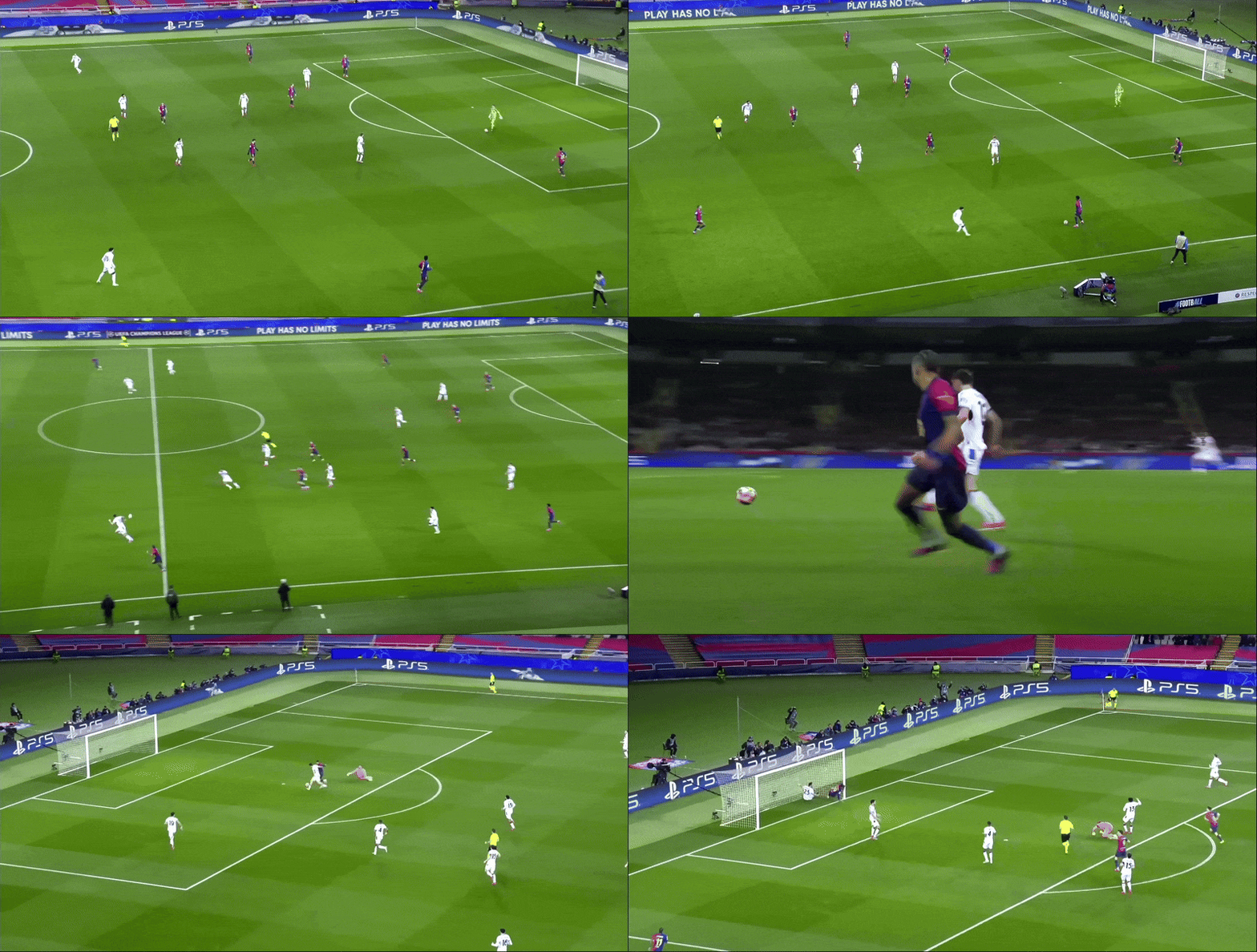
Usually, they would line up in a 4-2 or 3-2 behind the opposition, initiate the sequence via an inside-outside pass outside the block. In the meantime, the players at the heart of traffic vacate the middle of the park, via dummies, diagonal off-ball movements for the striker to diagonally dash deeper.
All this preparation serves the forward well in dropping deeper with a half-turn, in a space to receive the outside-inside pass and slide it from first-time touch to a wide player getting in behind from the flanks toward the inside of the pitch.
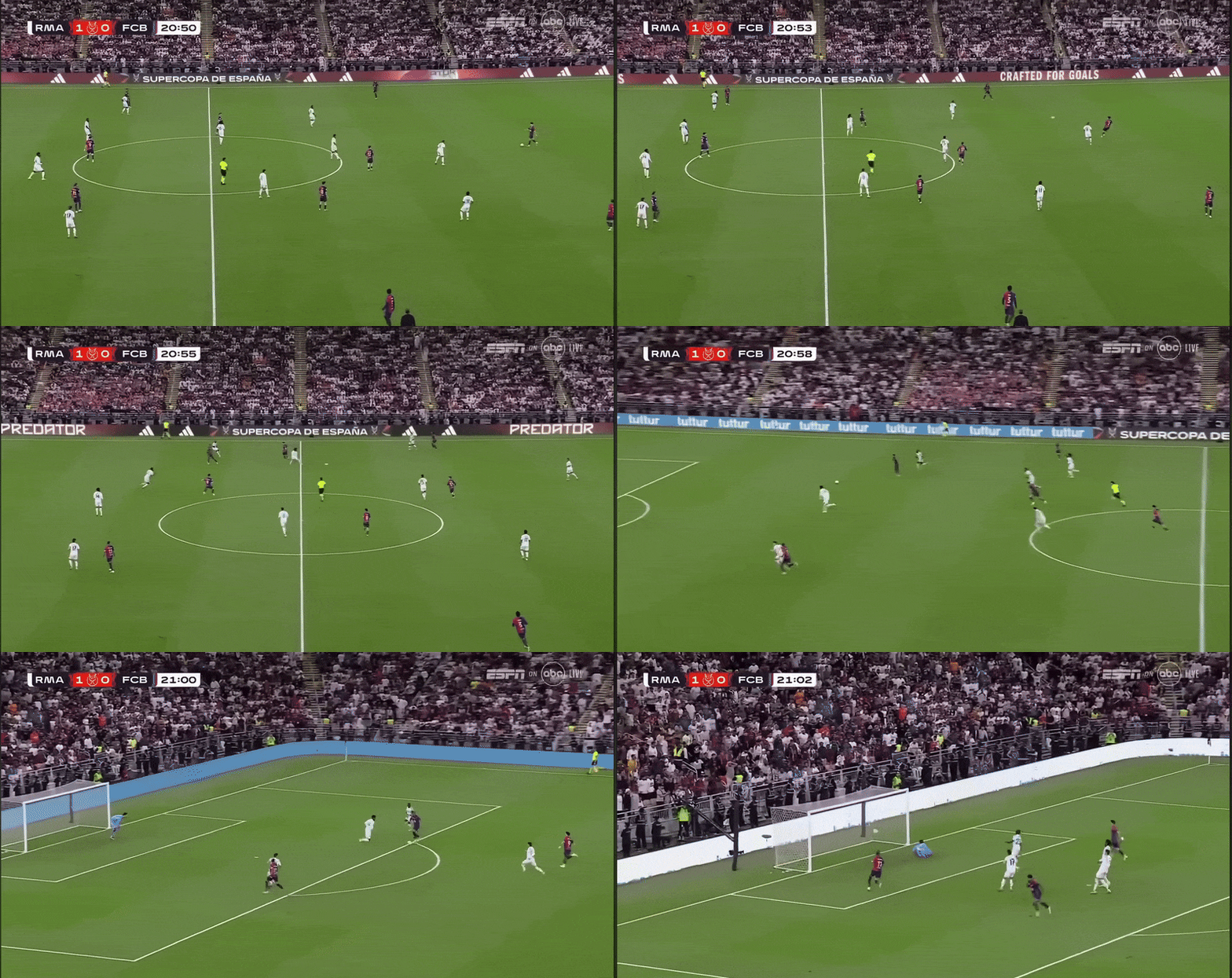
The attacking team draws the maximum possible of the advantages from diagonality, while the defending team (in a zonal block) suffers from the upper hand of the diagonality against the orthogonality.
A defender’s mission is to make it harder for the opposition to find a path toward the goal, toward a passing option, and cover his teammates. A lateral pass, carry, dribble, or movement cuts across the defender, which means the ball, the opponent, or both is in front of him. A vertical action travels along the pitch and toward the defender, and by default, it encourages direct involvement. A diagonal action maximises the benefits of the vertical and horizontal actions and throws the defender into an impasse where he has to consider his step-out, turn, lateral & vertical coverage at the same moment, and timing in relation to the opponent, the ball, and his teammates. In traditional circumstances, there is no escape from blindspots being exposed.
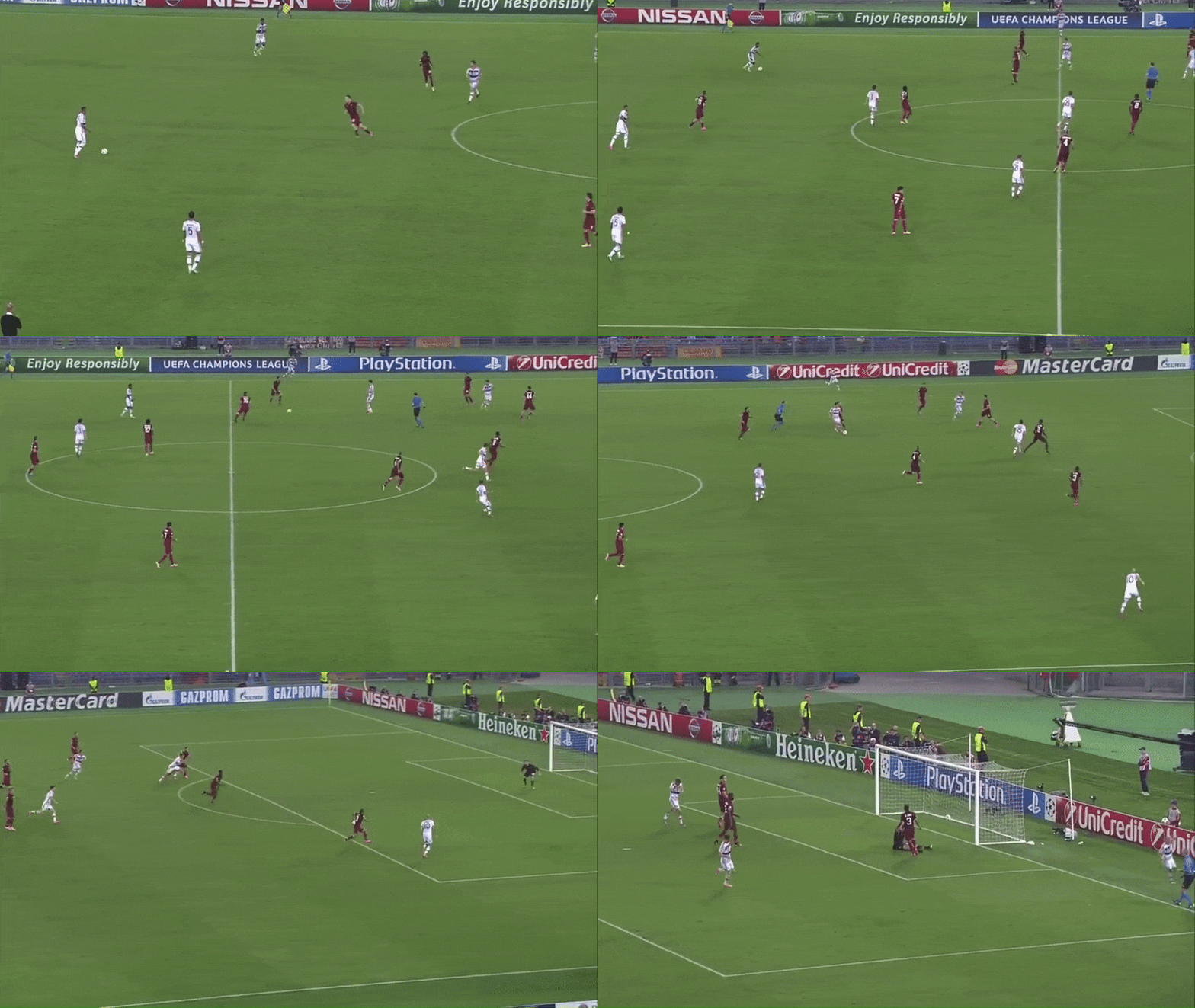
This is a good description extracted from the Spielverlagerung of how to trigger weaknesses in a zonal defense:
“Don’t close the space around the ball and there will be a free player on the half turn. Jump to him and the ball is getting in your back, either diagonally or in behind. Shift too much too early and the switch is coming. Do it too late and suffer running around. Trigger one step too late or too slow and you are out. Do it alone and you are not coming back either.”
A diagonal movement from Rodrygo delayed Valencia’s left back retreat and bought time for Dani Carvajal to receive Toni Kroos switch after Valencia’s medium block leaned totally toward the left side. In such a situation, the defender is bound to reactivity and suffers from a lack of informational cues. He runs toward the target, while he has no idea where the ball is going to land. Furthermore, he has to defend in a big space.
So, Carvajal goes against the momentum of the defender by taking a touch toward the inside. And, in the middle of the process, a swap in responsibilities (a man-marking switch) takes place between the center-back and the left-back, which takes time. As a consequence, the goal is inevitable.
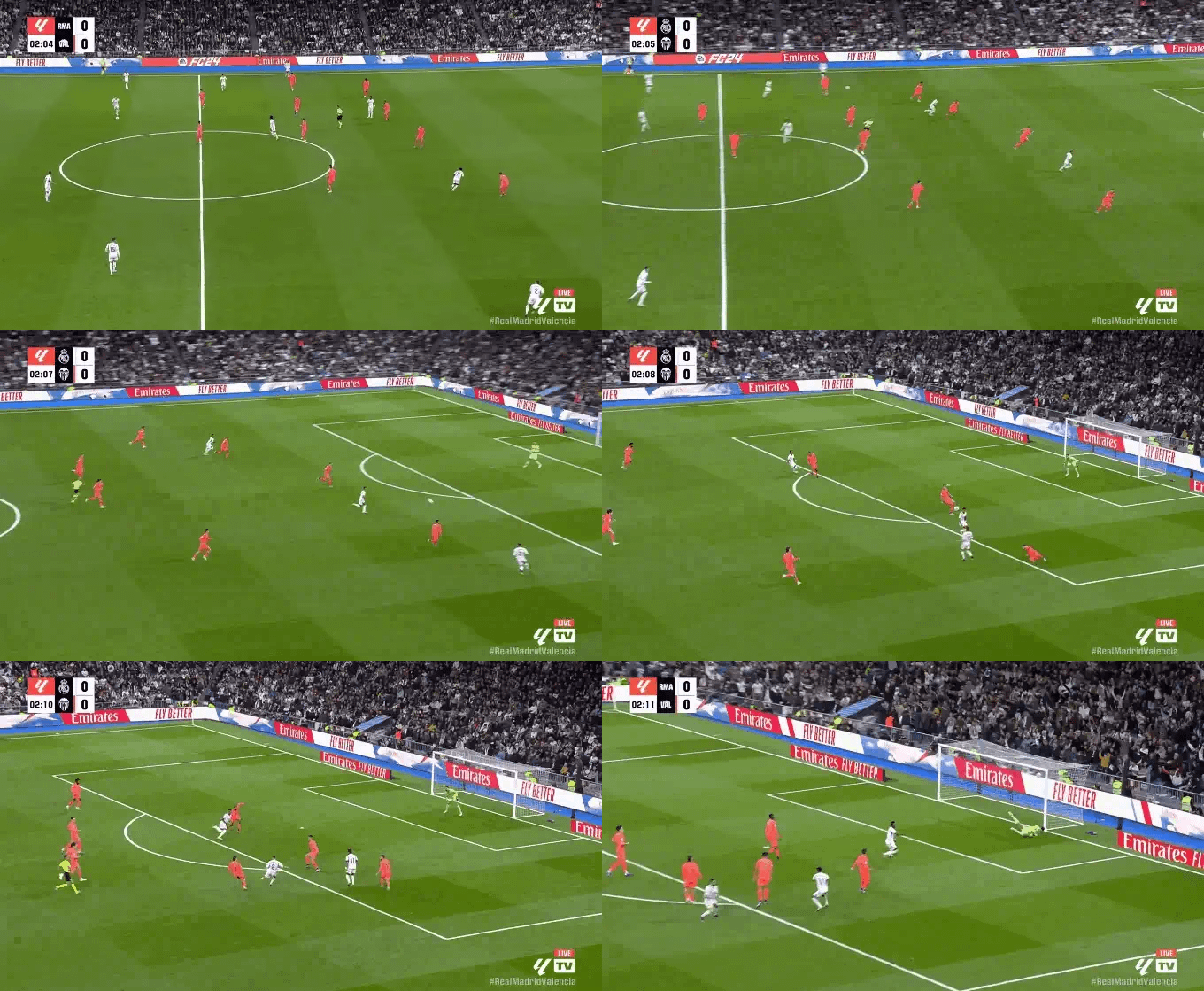
On the other end of the spectrum, diagonality provides answers against man-marking high pressing schemes, as well. No wonder Atalanta’s Gasperini faced all sorts of problems against teams of the likes of Barcelona’s Hansi Flick and Inter’s Simone Inzaghi.
The answer is simple. In a man-oriented approach, the reference is the man. The team out of possession imitates the in-possession team. Again, the defender here acts in reaction; he has to be at the right place and the right time. Nonetheless, it is not enough, because the player who has the ball is already one step ahead. The on-ball player knows his subsequent action. This lack of information tips the scales in favor of the in-possession team. Of course, a high level of execution is required against this type of defending.
In the Inter Simone Inzaghi: How To Score Without Dribbling, we discussed how Inzaghi, without having dribblers set Inter up to build from the back, progress and score many goals.
Diagonality in the movement, carrying, and passing was the main feature of their play. It paved the road for them to break through like a hot knife through butter. A central midfielder drops diagonally, interchanging positions with a center-back. A wide center-back becomes a situational fullback, while the wingback embarks on a sprint in behind like a winger after luring his man forward. The striker darts deeper to receive the out-in pass to lay the ball off or flick it. The receivers are on half-turn position, and passes are played from first-time touches. As a result, the play is accelerated.
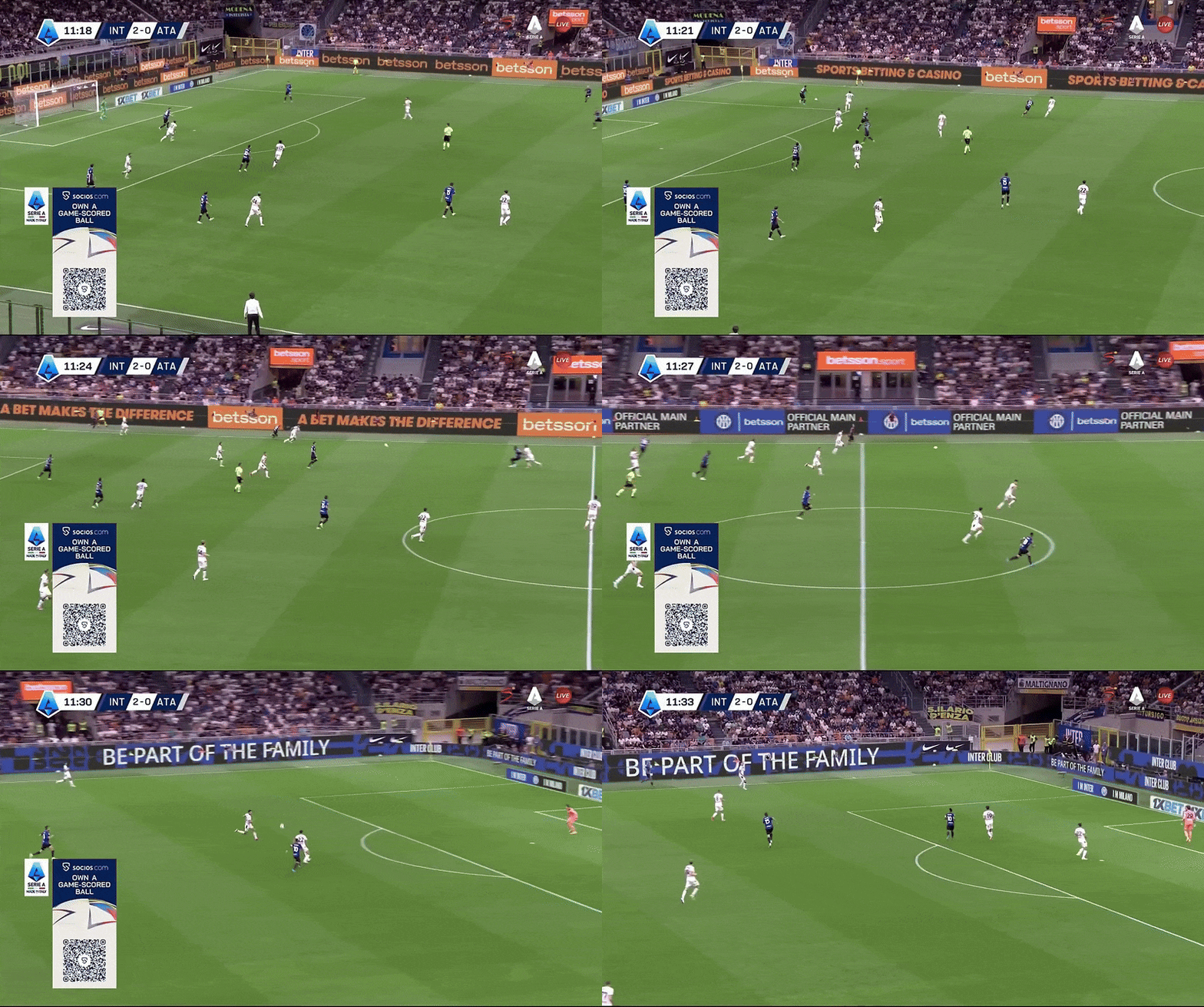
These diagonal connections offered the plateform for Inter to rotate, bait the opponents forward, create a spatial, temporal, and informational pressure to generate the situations for quick diagonal ball combinations. It is simply the affordances of the diagonality (body orientations, passing, carrying, dribbling angles, first time passes, etc) that put questions for the defending team to reconsider its jumps, teammates’ coordination, space and man defending, time for reaction, etc.
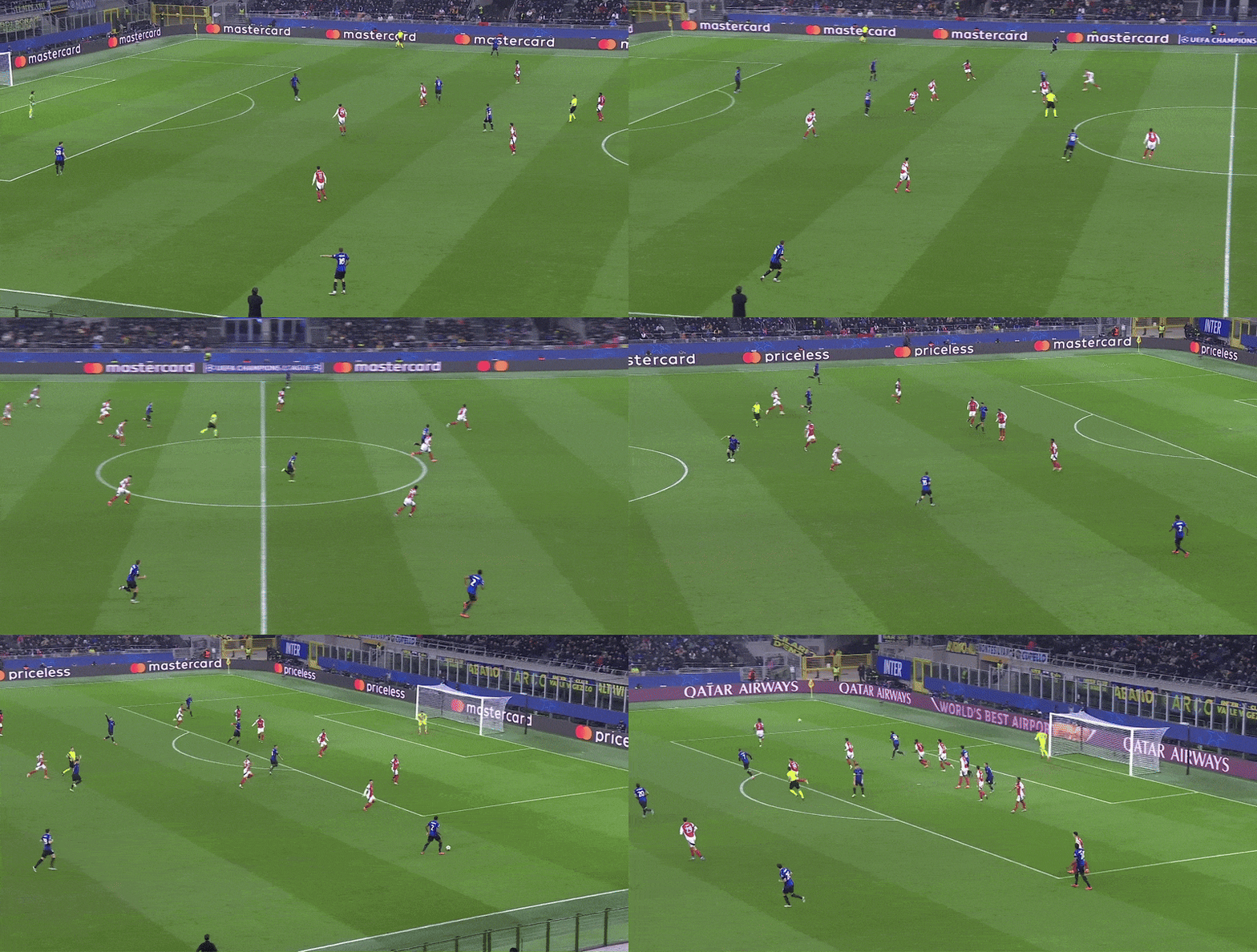
Taking these factors into account, the odds of making inaccurate decisions increase. Hence, the percentage of making mistakes increases, and the rate of conceding increases, as well.
Let’s talk Manchester United.
Before Michael Carrick took his place in the dugout as an interim head coach, diagonal play was a large feature in United’s in-possession sequences under his former teammate, Darren Fletcher.
Take this sequence, for instance, that led to Manchester United's equaliser against Burnley.
The opposition sits in a 5-2-3 medium block. United double pivots operate at different heights of the pitch, as the higher one distracts Ugochukwu, while the deeper one takes place between Mejbri and Broja and is on the same line diagonally with Lisandro Martinez and Bruno Fernandes. The Portuguese positions himself around Burnley's midfield line.
Diagonal passes accelerate the play as they merge between the progression of a vertical pass and the safety of a horizontal one, as previously mentioned.
In this scene, Lisandro Martinez’s diagonal pass cut through Burnley horizontally and vertically, giving the receiver a time advantage. Lisandro Martinez, Casemiro, and Bruno Fernandes are on the same line diagonally, whereas Casemiro and Bruno are the potential receivers, and they are already on the half-turn.
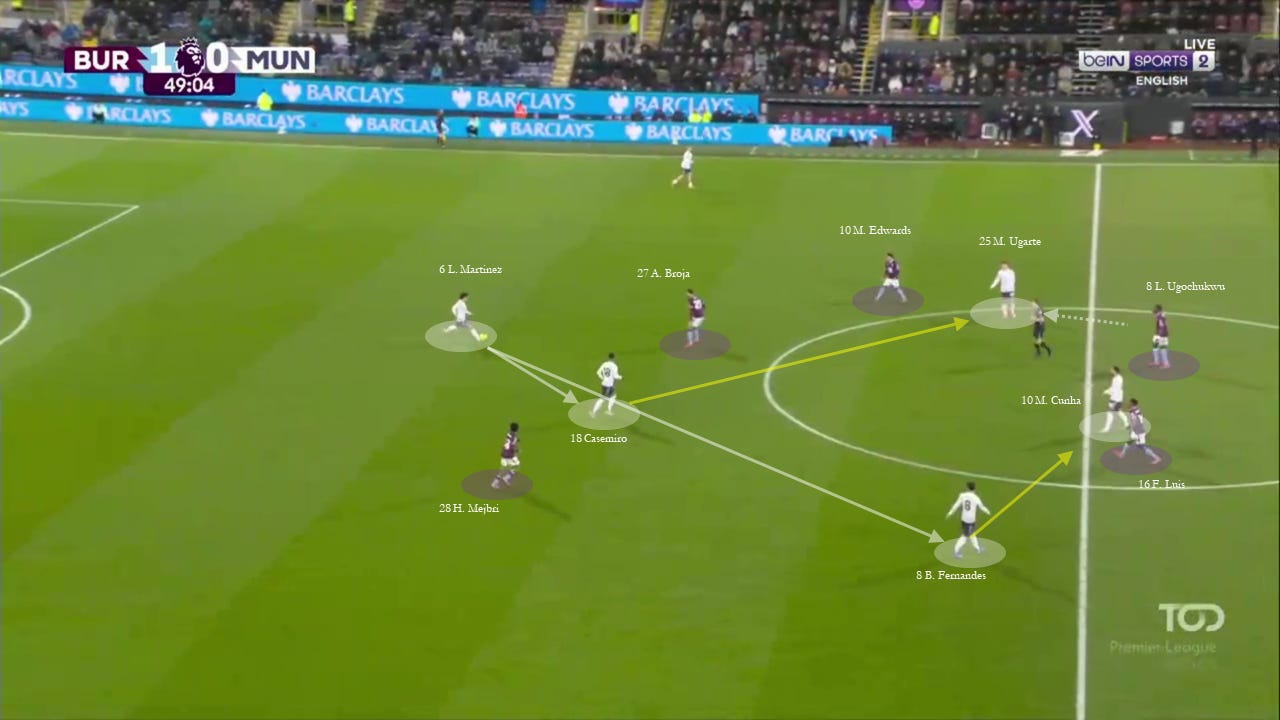
So, they aren’t forced to receive, turn, pass/carry. Receiving diagonally enables Bruno to collect and flick the ball into Cunha from first touch. The same occurs with the latter, as his open stance pre-receiving allows him to access the space diagonally. This specific body orientation is the main reason why Cunha takes the ball from first touch in the back of his presser and toward the space.
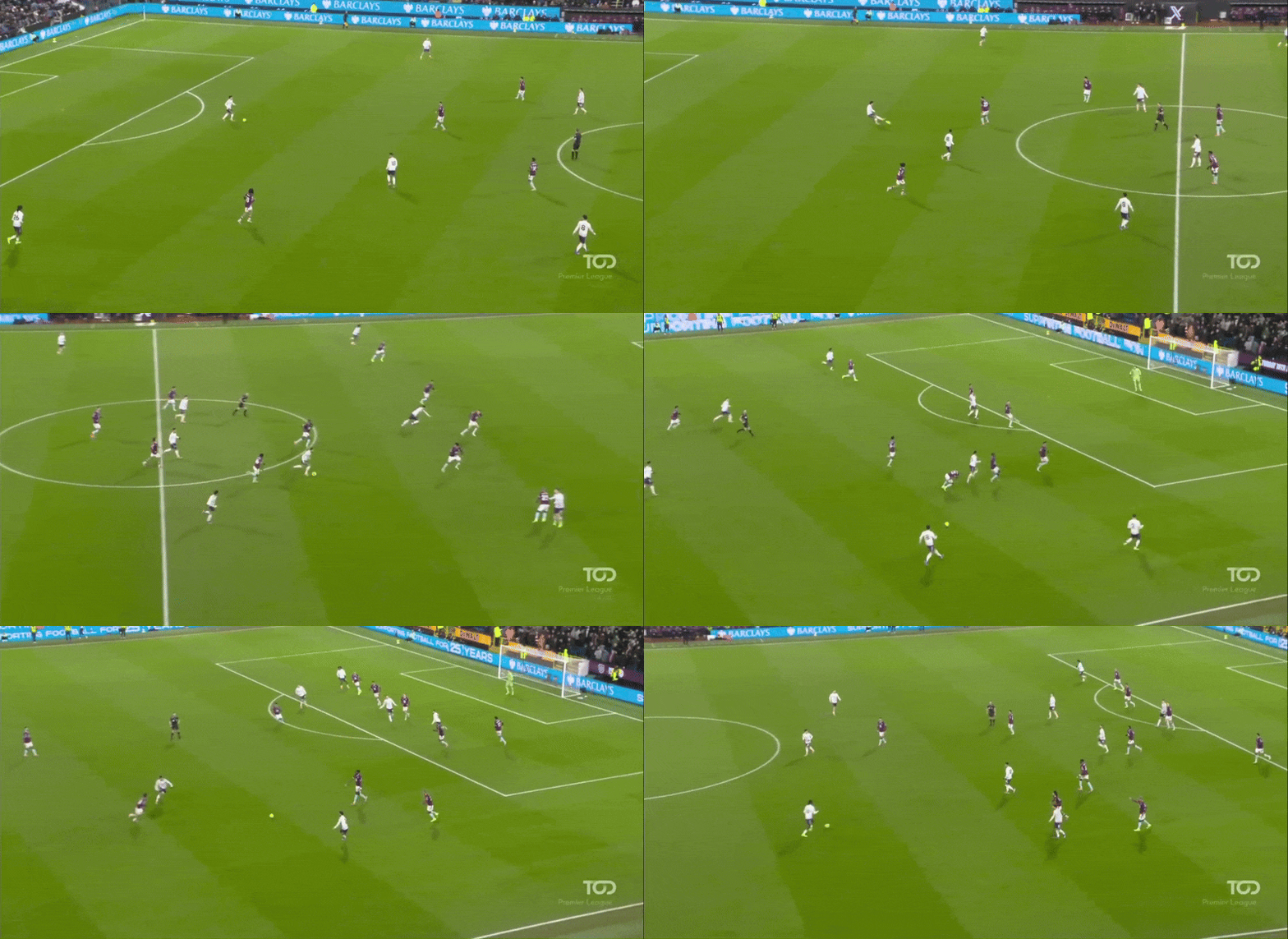
Similar advantages are drawn here from the concept of diagonality, enabling Manchester United to work the ball to the other side of the pitch.

A couple of outside-inside and inside-inside passes slice Burnley's lines open.
To elaborate, Casemiro is well aware of the space behind and in front of him and the direction of the pressure, by checking his shoulders. Dropping down the right half-space wins him a few meters to receive with his left foot and place the ball toward his right and pierce Burnley's defensive lines. The vertical jump of Ugochukwu and the lack of support behind him make the space on his sides vulnerable. Hence, the possibility to break the lines diagonally.
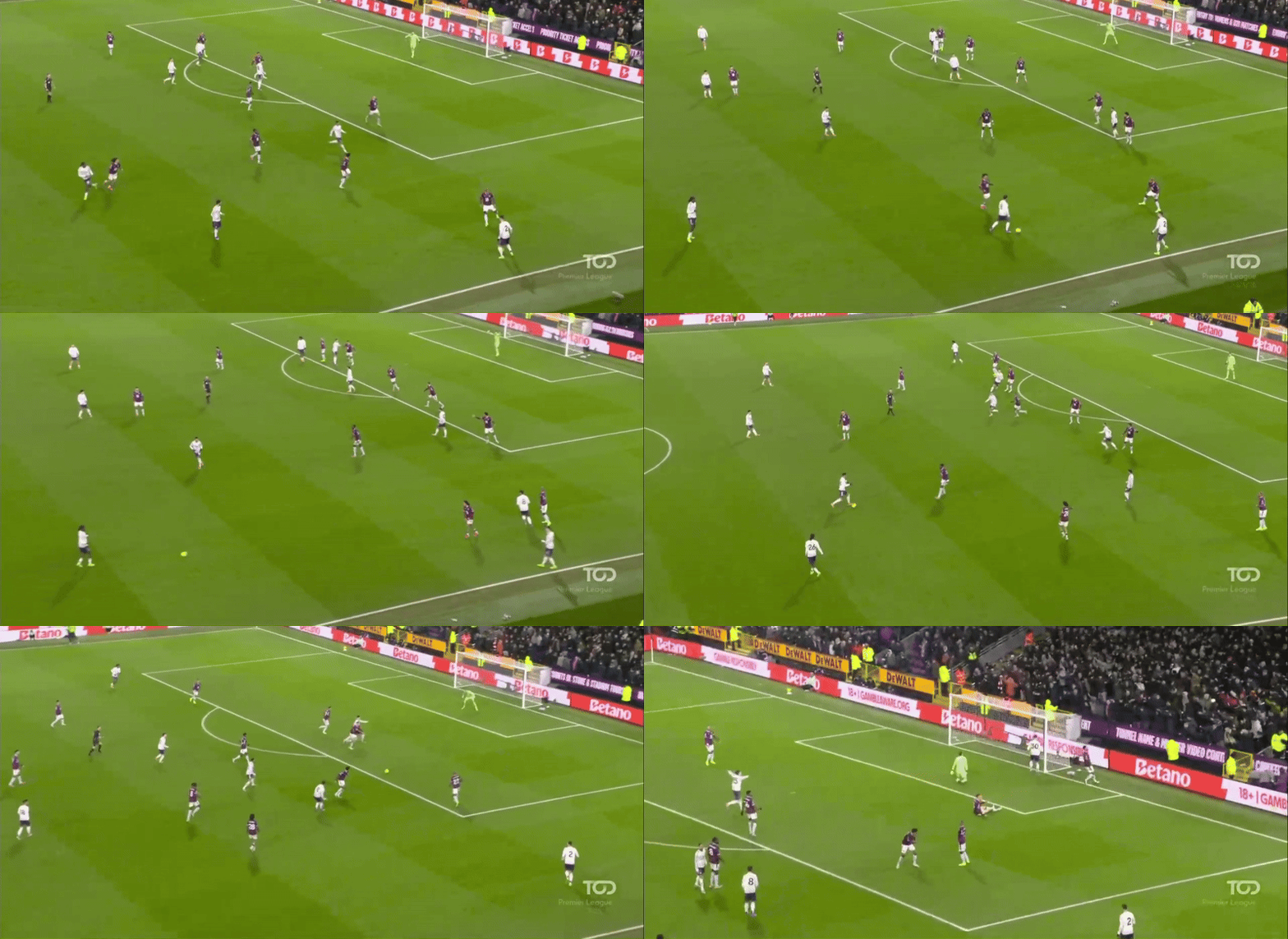
Upon receiving, Bruno has a large space to work with as wide and central pinners are pinning their markers. Moreover, his hips are already half-turned, which means less time to establish an optimal, diagonal vision toward the goal. Hence, he can perceive the space and options well, which impacts his decision-making positively, keeping the tempo of the attack flowing.
And finally, Benjamin Sesko’s goal depicts the following take:
“A diagonal ball travels farther and faster than a one-touch vertical while still landing on a forward-facing teammate—stability on receipt, dynamism on arrival.” — Spielverlagerung.
➜ Against High Presses
Michal Carrick brought back Roberto De Zerbi's days with Brighton in deep buildup. You would often witness Manchester United bait the opponent deeper to draw the benefit of the large spaces further up the pitch. United also relies on long balls to bypass high presses, as according to MyGamePlan, they rank 5th in the league in terms of second balls won after 2 seconds from an aerial duel (8.24%).
Going back to the short build-up, United are set up in a 4-2-4 shape with Bruno Fernandes and Bryan Mbeuno dropping out to drag the opposite center-backs forward and generate space behind for the wingers to attack.
The process goes through one of the pivots creates separation from his marker to bounce the pass off to the free center-back as the first step of the baiting.
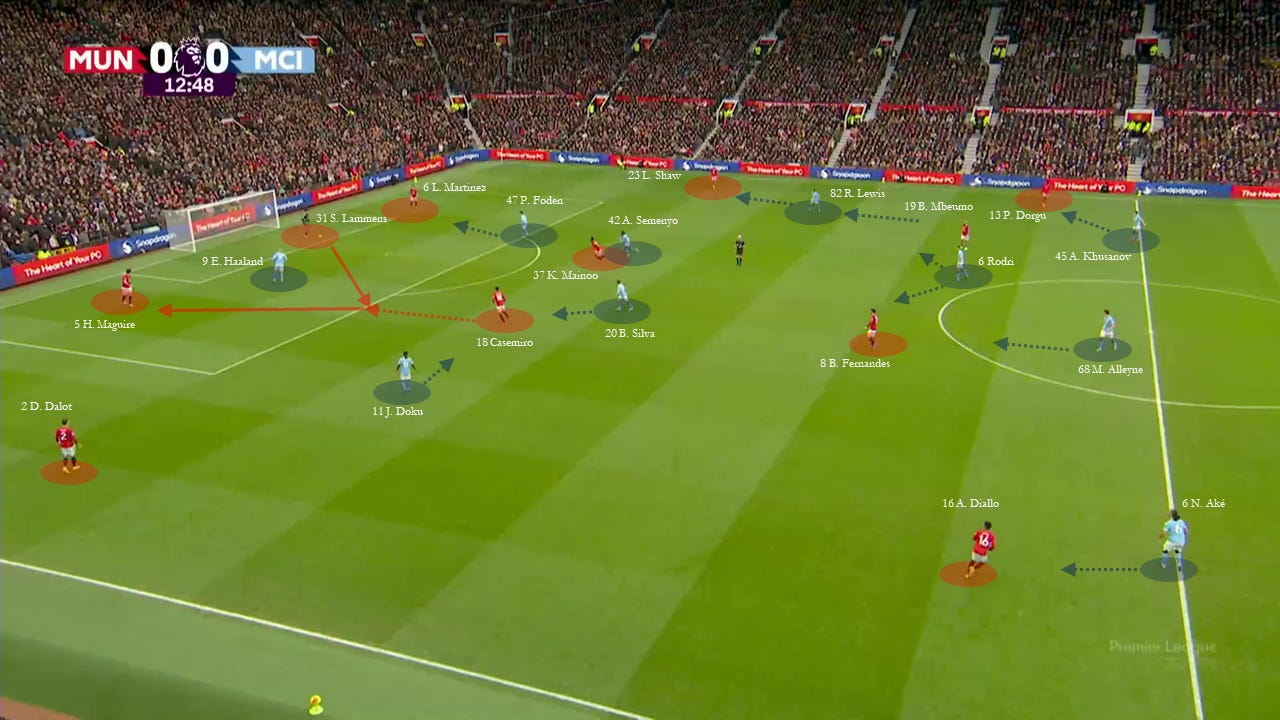
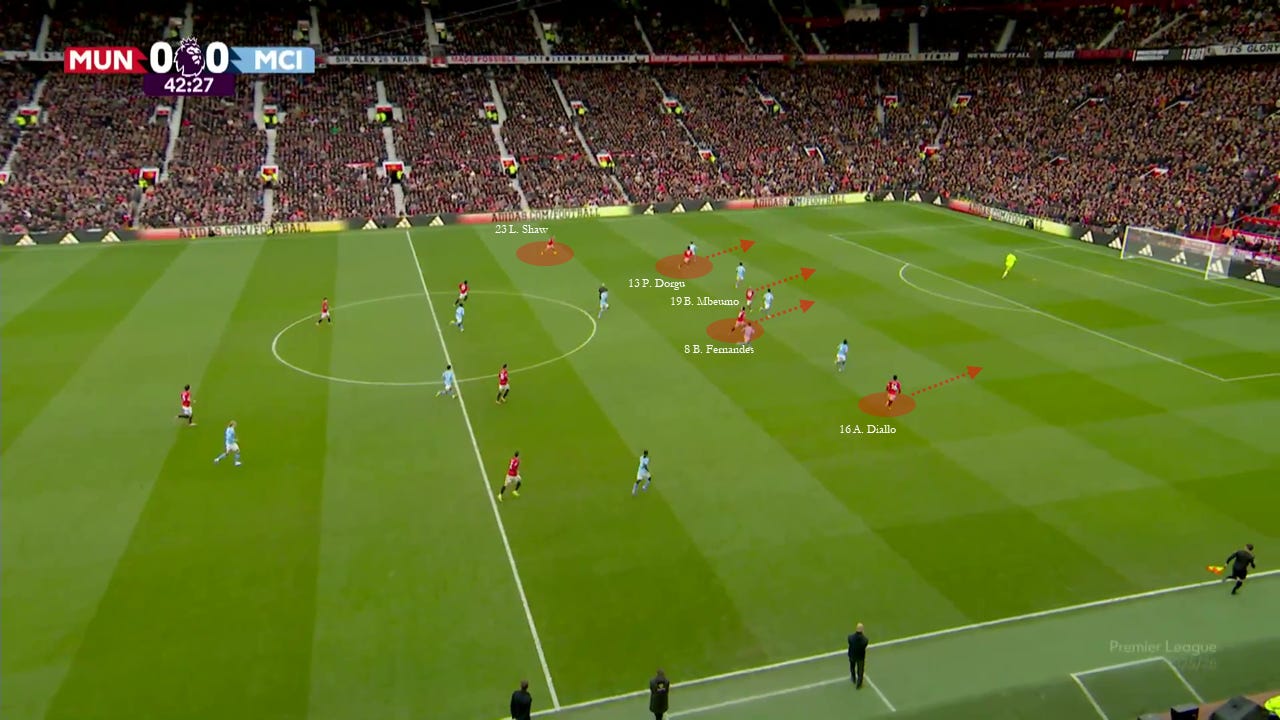
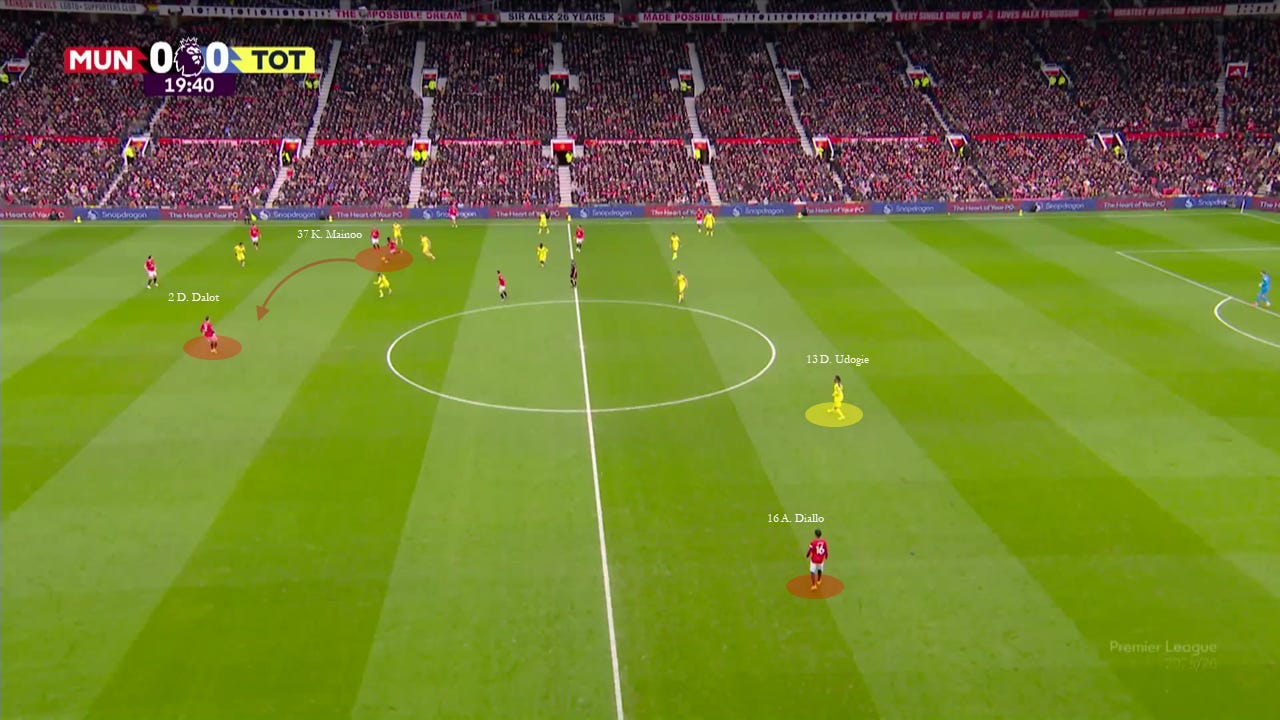
In the Manchester Derby, United exploited Manchester City's lateral shifting to cut through the Citizens. First, Dalot would push on to draw Doku’s attention and prevent him from disrupting Maguire on the ball. Everybody in the center shifted across. Moreover, Rodri had to drop and plug the gap in an anticipatory action to double up on Diallo with Aké in case of a long ball.
Maguire had a different road in mind to take. It is the safest, most progressive, and attack accelerator route, which is the diagonal pass. He went against City's momentum to find Mbeumo roaming freely.
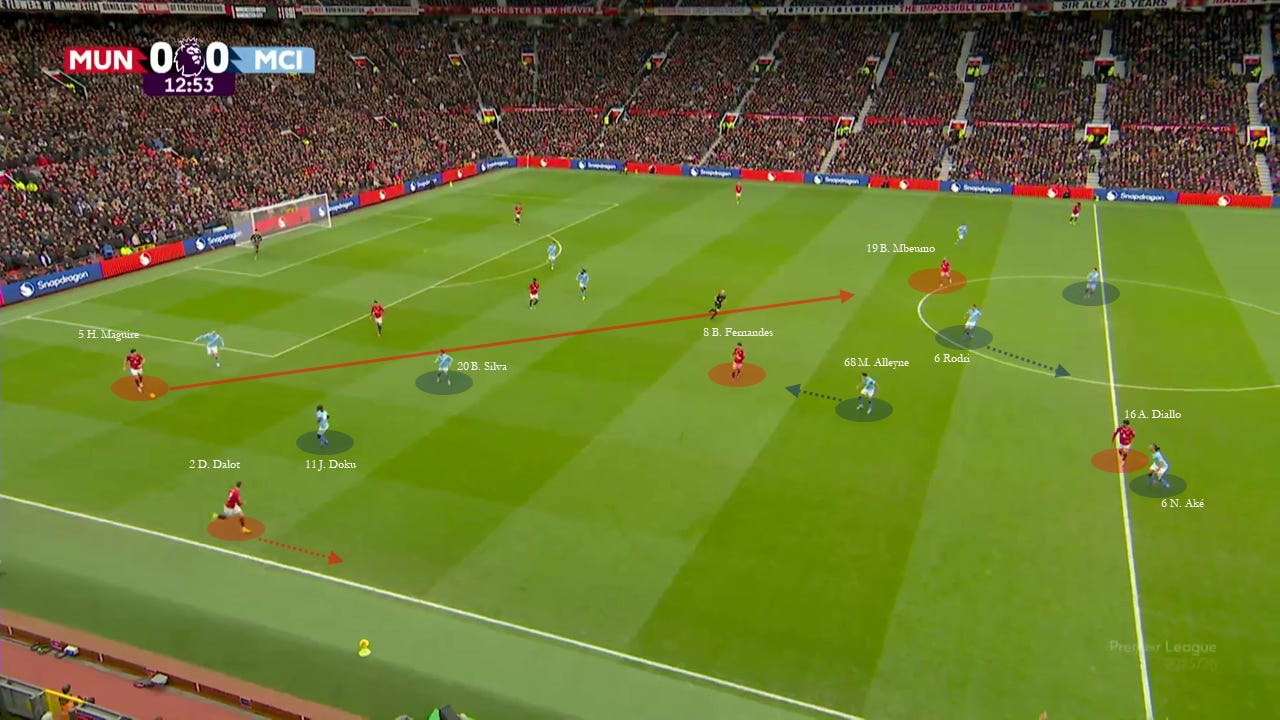
The Red Devils had multiple edges to address. The overload around the ball as City’s center-backs were hesitant to step up. Additionally, the second phase came to fruition thanks to Mbeumo and Fernandes’ half-turn body orientation, which allowed them to exchange passes from first-time touches. It’s also worth mentioning that Diallo, Dalot, and Dorgu (on the far side) were on their mark.
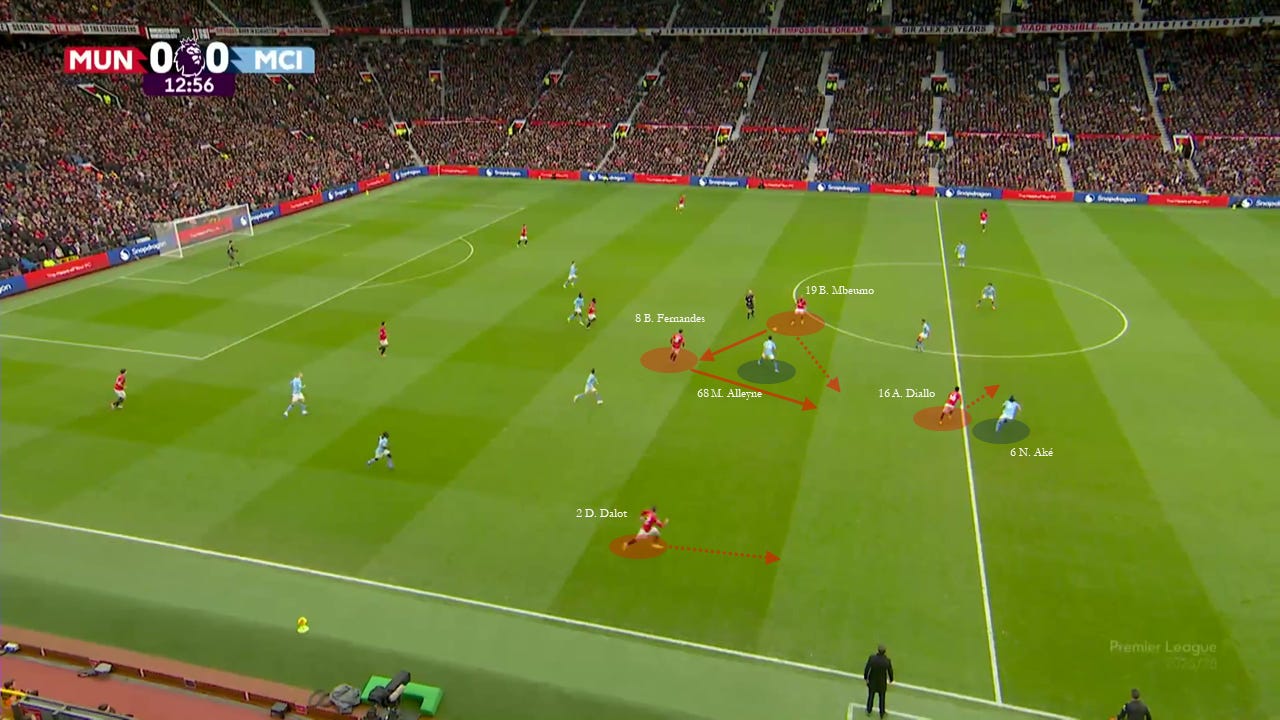
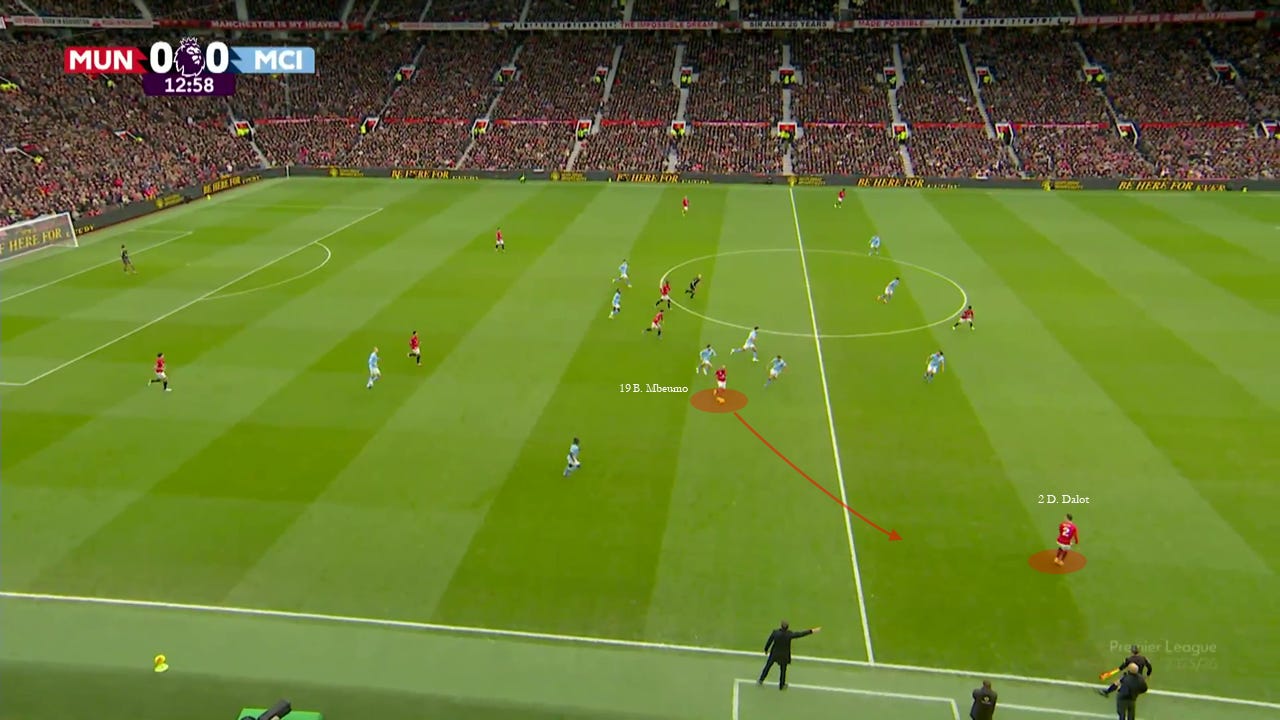
Diallo brought Aké inside with him, leaving room for Dalot to advance. However, committing excessively forward trapped Dalot offside.
It’s worth noting that Manchester City had a hard time when pressing high up the pitch throughout the season. Too many question marks for the Peps on the dugout. Having a line breaker like Lisandro Martinez just exacerbated the situation for Man City. United smartly played the game.
Here, Haaland would get closer to Casemiro with Cherki and Semenyo forcing the play backward. However, Maguire’s position at the edge of the box prevented that and anchored the Norwegian striker
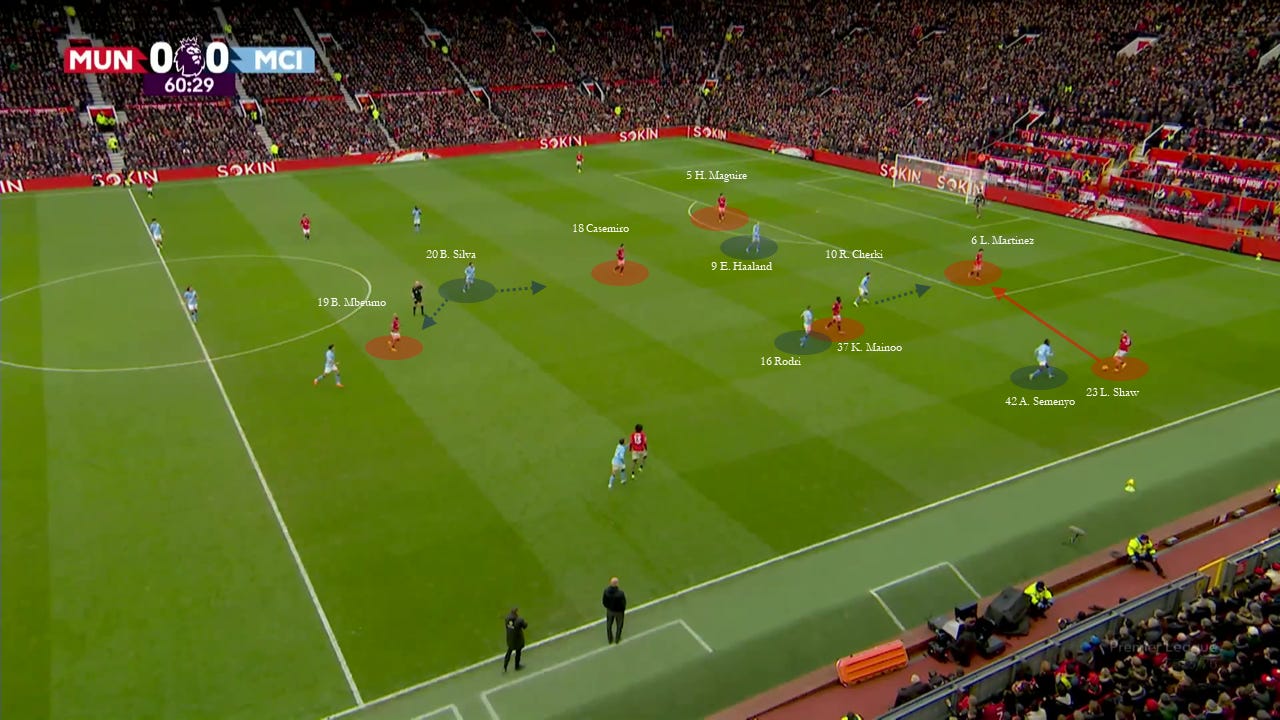
Cherki isn’t the intense presser to pose problems to Lisandro Martinez. As always, City were fixated on blocking off the vertical pass. They are locked on in a man-oriented press near the touchlines. So, Licha broke down City’s first line of pressure via a precise diagonal pass to Casemiro in space.
As previously mentioned, a diagonal pass guarantees that it lands in a forward-facing player. Casemiro, on the half-turn, prepared himself to slice through and find Bruno. Nonetheless, Bernardo Silva wasn’t Cherki to let that happen.
In fact, Carrick placed a greater emphasis on central progression. There is nothing in football that comes close to the value of attacking from the center, the fastest and most valuable way. However, the risk is also amplified. Here, the close proximity of Manchester United players allowed them to pounce on the loose ball and reset.
The placement of the players impacts the quality of Manchester United's diagonal play. Nowadays, most specifically, the 4-4-2 diamond shape has become a common structure to jump out into a man-oriented high press across the Premier League. It’s because of the narrow diamond that blocks off the central access and progression, and it eases the lateral shift to trap the opponent near the touchlines.
Against Manchester City and Fulham, Michael Carrick used a narrow pivot in order to expand the distances between Casemiro-Mainoo and the fullbacks. By doing so, the lateral shuffle of the opponent will take time.
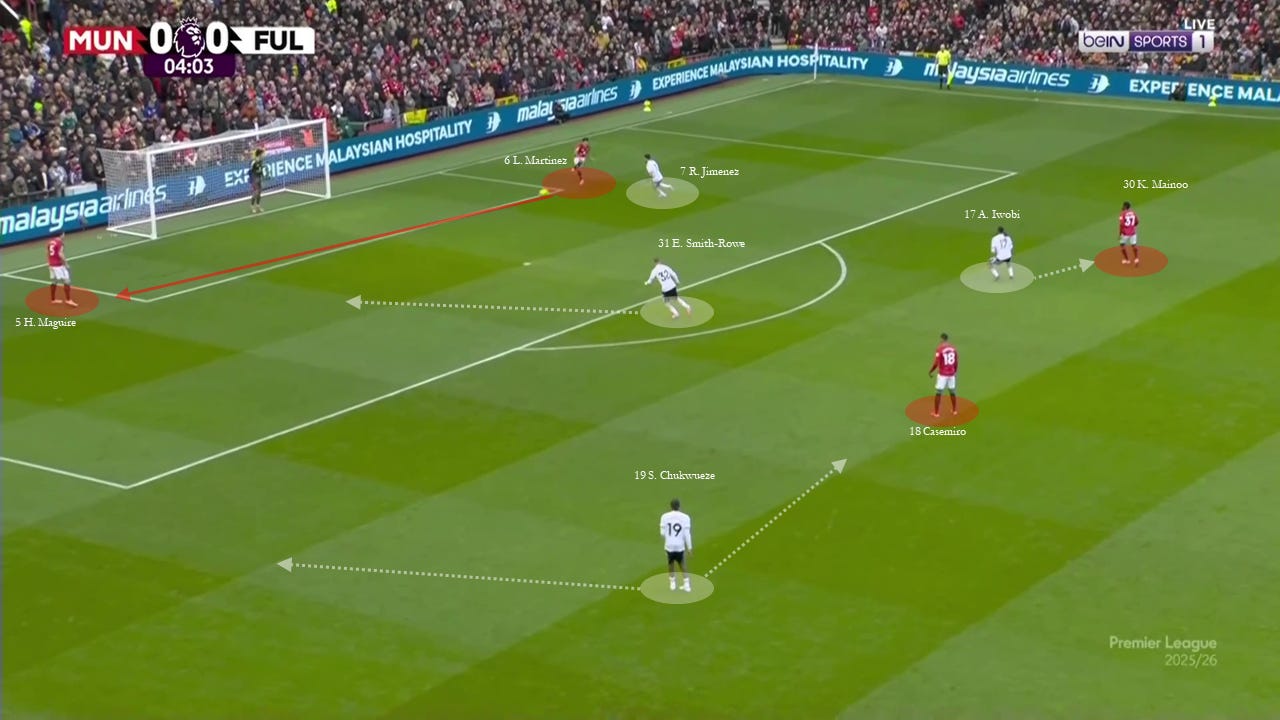
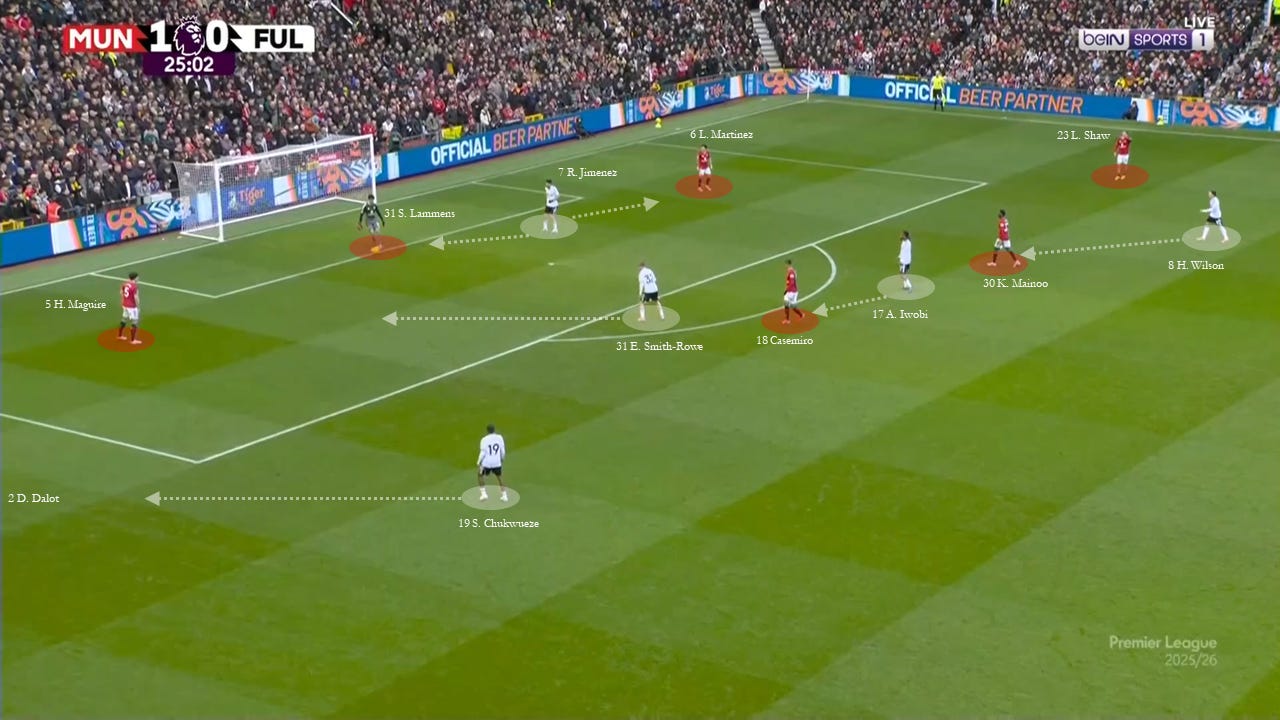
That’s noticeable in the way the Red Devils cut through Fulham in this sequence. As the ball lands at Maguire's feet, Chukwueze is aware that he cannot just rush his jump toward Dalot. He is cognizant of the necessity to wait for Iwobi to close off the distance with Casemiro and avoid Maguire's vertical access to the Brazilian.
Credit to Mainoo, who dummied his movement toward the left to draw Iwobi with him and delay his lateral shift.
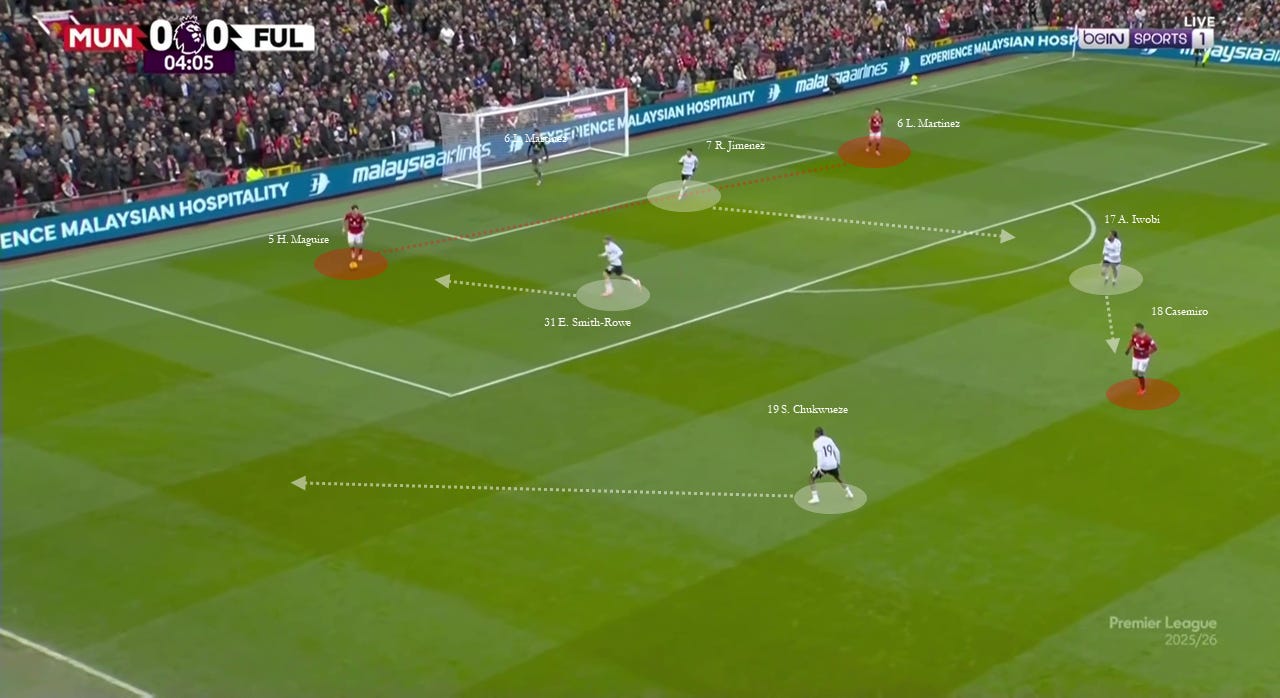
It’s a loss-loss situation for Fulham's high press.
Manchester United's positions are well-optimised. Dalot's deeper position gives him space and time. Lisandro Martinez and Harry Maguire splitting wide and being narrow to the byline widens the distance Jimenez has to cover to split the first line of the buildup and to drop in to mark United's far-side pivot.
Ahead, Harry Wilson cannot narrow inside because Matheus Cunha darts deep to overload the center. In the meantime, Casemiro pulls wide, forcing Iwobi to track him. All the processes contributed to clearing the space around Mainoo for Dalot to prod the diagonal pass. So, a 2v1 situation around Jimenez saw Casemiro access the free Lisandro Martínez on the opposite side, forcing Fulham into a retreat.
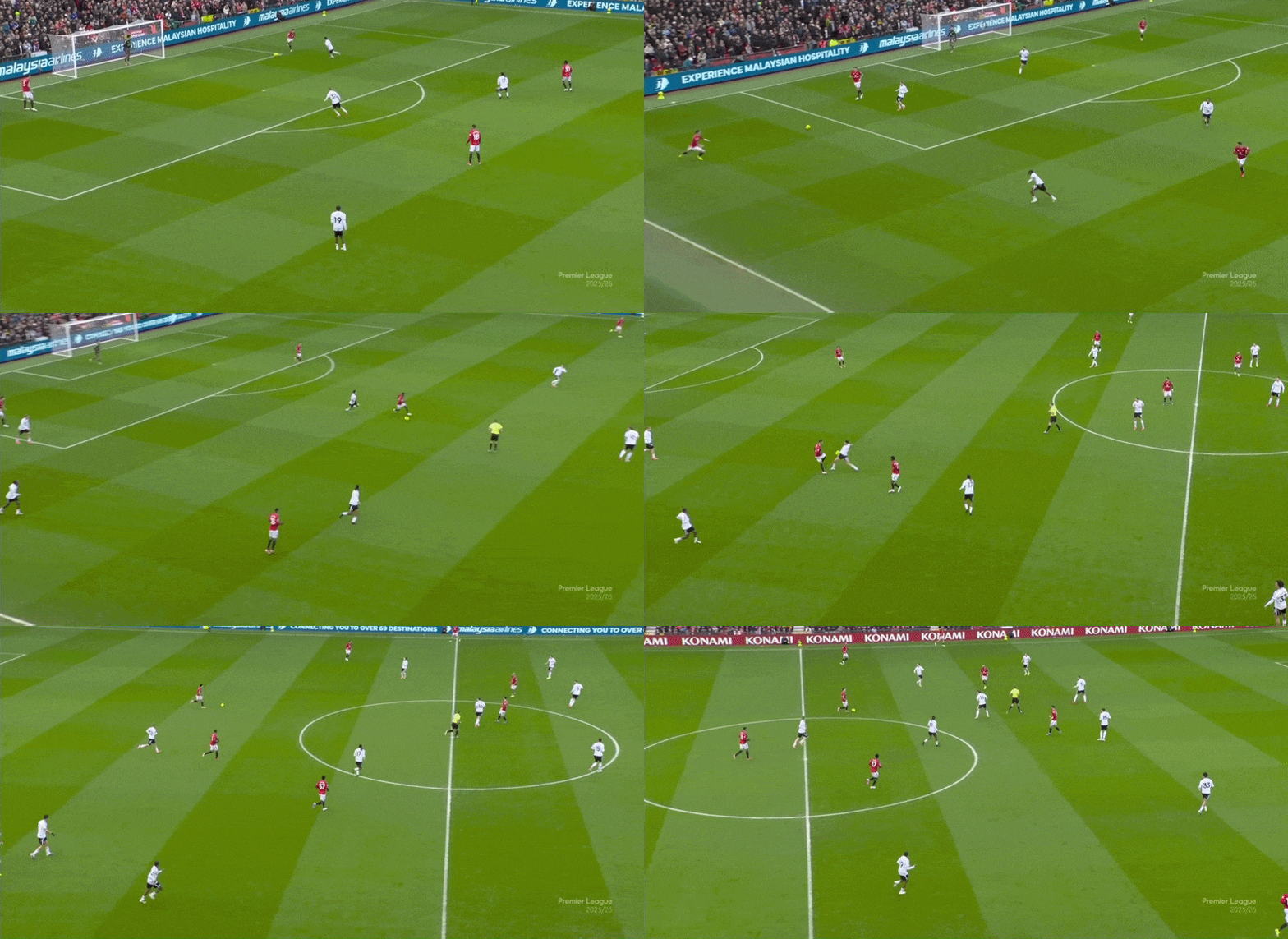
By default, the ball travels faster than the players. Marco Silva’s side here withdraws with the inability to react to United fast, safe, and forward —the definition of a diagonal pass— outside-inside, inside-inside, and inside-outside passing sequence.
The defender’s brain operates in a binary manner. It’s either the ball or the player. Iwobi's total focus on Lisandro Martinez drives him to lean toward the ballholder with a side-on stance that exposes his blindside. Hence, Mainoo is accessible in a large space and uncontested on the right.
Taking this expression from the spielverlagerung’s blog:
“Diagonal passes are the main accelerators of attacking play, whereas dribbles are mostly the main advantage creators of it.”
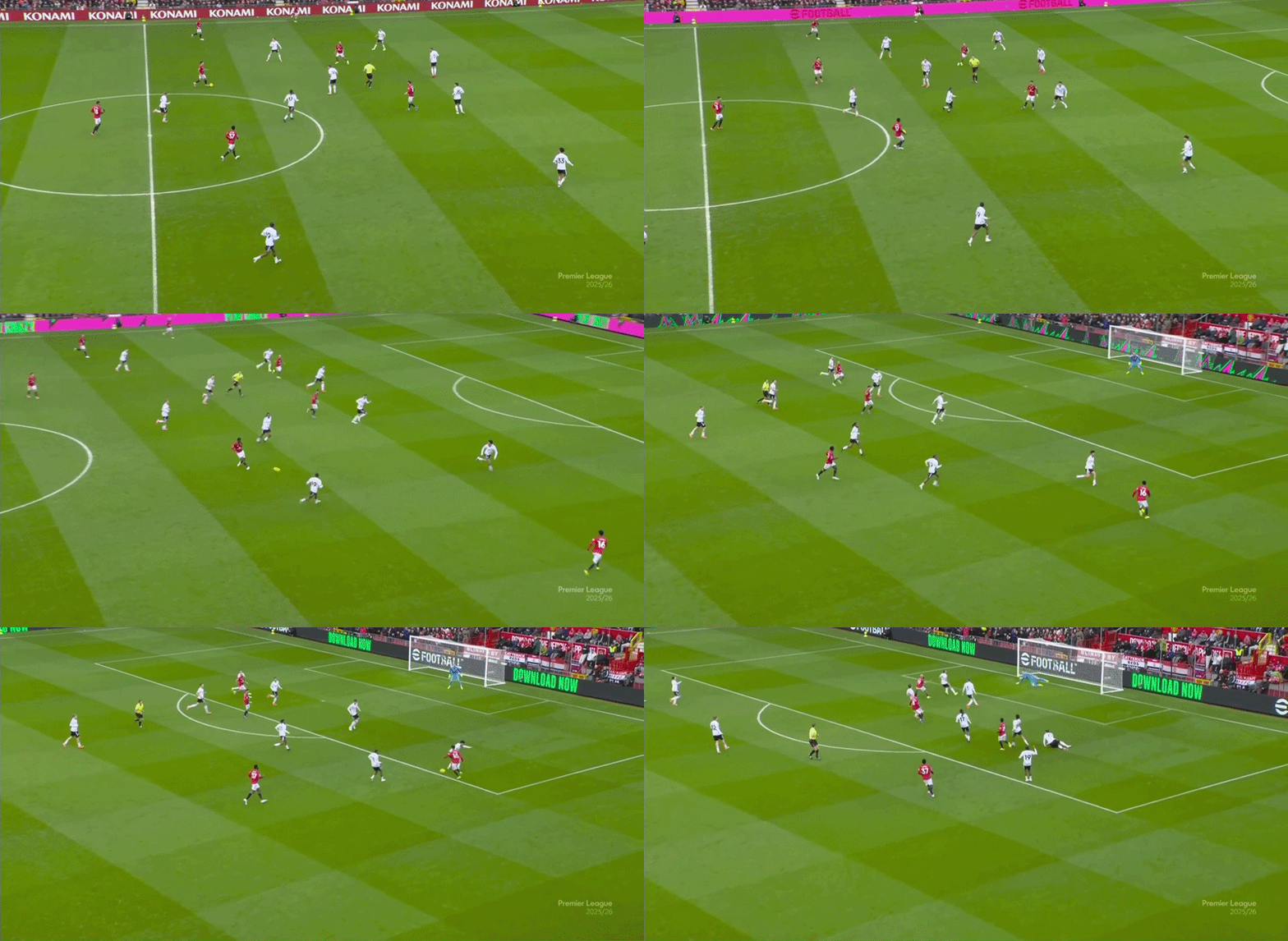
It’s perfectly fit Manchester United in this sequence from the start to the end. Amad Diallo is the last piece in the chain to take advantage of the diagonality. Robinson attempts to lure Amad outside and close him off near the byline. However, Diallo cutting in and driving at his opponent diagonally gives him the edge to choose between the directions he wants to go. The diagonal drive leaves the outside and inside routes accessible for Amad Diallo. Moreover, Quenca contributes largely to supplying Diallo with the space to cut in, as he wanted to make sure that Bruno is handed off to Andersen before fully committing to covering the space between him and Robinson.
Here is a similar situation where the diagonal pass appeared to be the solution.
The level of difficulty is high, and the risk is big because Fulham are locked on in good high-press starting positions, which enable them to go man-for-man on the United right side. Also, the slightly high position of Lisandro Martinez and Harry Maguire tightens up the distance between the backline and the midfield line. Hence, Jimenez can close off the passing lane between Dalot and Mainoo with Wilson narrowing inside without the need to worry about Cunha’s coming deep.
The diagonality in this sequence resides in Dalot taking a diagonal touch into space to generate a passing lane on the sides of Chukweze.
There isn’t a perfect system in football that negates weaknesses. Football is a game of mistakes. The coaches’ work is to minimize weaknesses as much as they can, or at least allow weaknesses that are hard to exploit. The hybrid press, previously explained, is a projection of this aspect. The flaws reside in the space between the pressing unit and the pinned backline, the space in behind, and the overload allowed on the far side. Aggressive jumps decrease the odds of these weaknesses being exposed.
Here, Diallo interchanges positions with Bruno and drops out. The gap between the lines is at a premium for Mbeumo to dash into and lay the ball off from first touch, even with the pressure on his back. Robinson focuses on the ball; Diallo is free to collect the second ball. Mainoo is close, so he can drive down the gap between the retreating pressing unit and the backline pushed rearward by Mbeumo’s run.

➜ Against medium blocks
As previously mentioned, zonal blocks are built around orthogonality, being compact horizontally and vertically. However, when diagonality emerges, it challenges this type of defending because it obliges the out-of-possession team to slide sideways and drop out or step up vertically at the same time. It’s impossible to do it the orthodox way. Manchester United’s Carrick proves that.
Against the best defending team in Europe, the Red Devils proceeded by pulling apart Arsenal in every possible direction. The players behind the block bait the front two, and the forwards test the center-backs via diagonal runs beyond. Inside the block, there is a whirlwind of rotations and position interchanges that throw Arsenal midfielders into a dilemma of defending the man, space, or both.
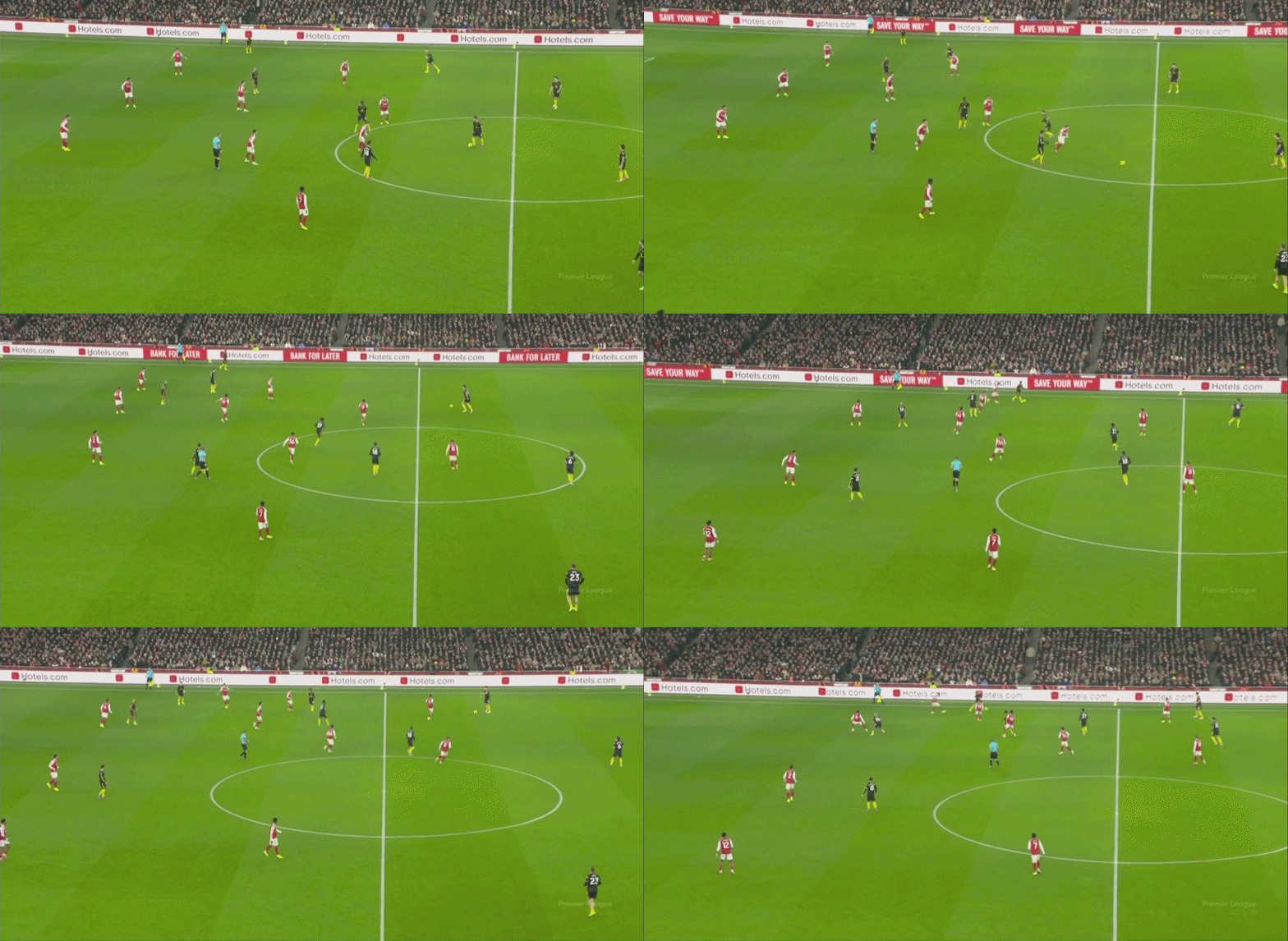
For instance, the Red Devils would go around Arsenal's medium block. Two birds were hit with one stone. Dalot withdrew and drew Hincapié with him. Also, he freed up the space for Mbeumo's diagonal run, which enlarged the distance between Saliba and Gabriel for Bruno to make use of.
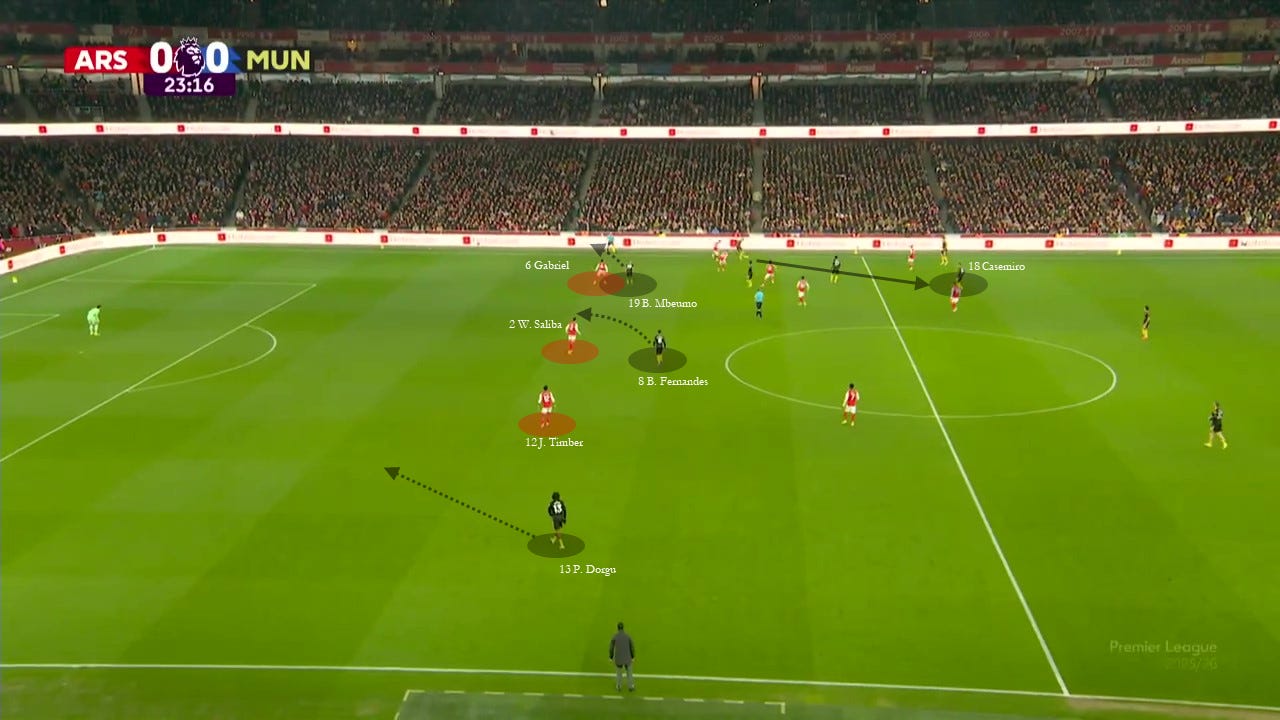
Dalot, with his diagonal touch toward the space, set a road for himself to escape the touchlines. At first glance, Dalot's backward pass might seem a trigger for Arsenal to press. However, it wasn’t a random pass; it was a backward diagonal pass. It was a “regress to progress” sequence. Let’s enumerate the advantages of Dalot’s diagonal backward pass:
The receiver, Casemiro, has choices to make: keep going backward, lure Arsenal out, and test their coordination in the transition, or come up with a forward solution.
Everything is in front of Casemiro’s vision; he’s on the half-turn and well set up to take action from first-time touch.
Enables progression, which is the most important thing in this sequence.
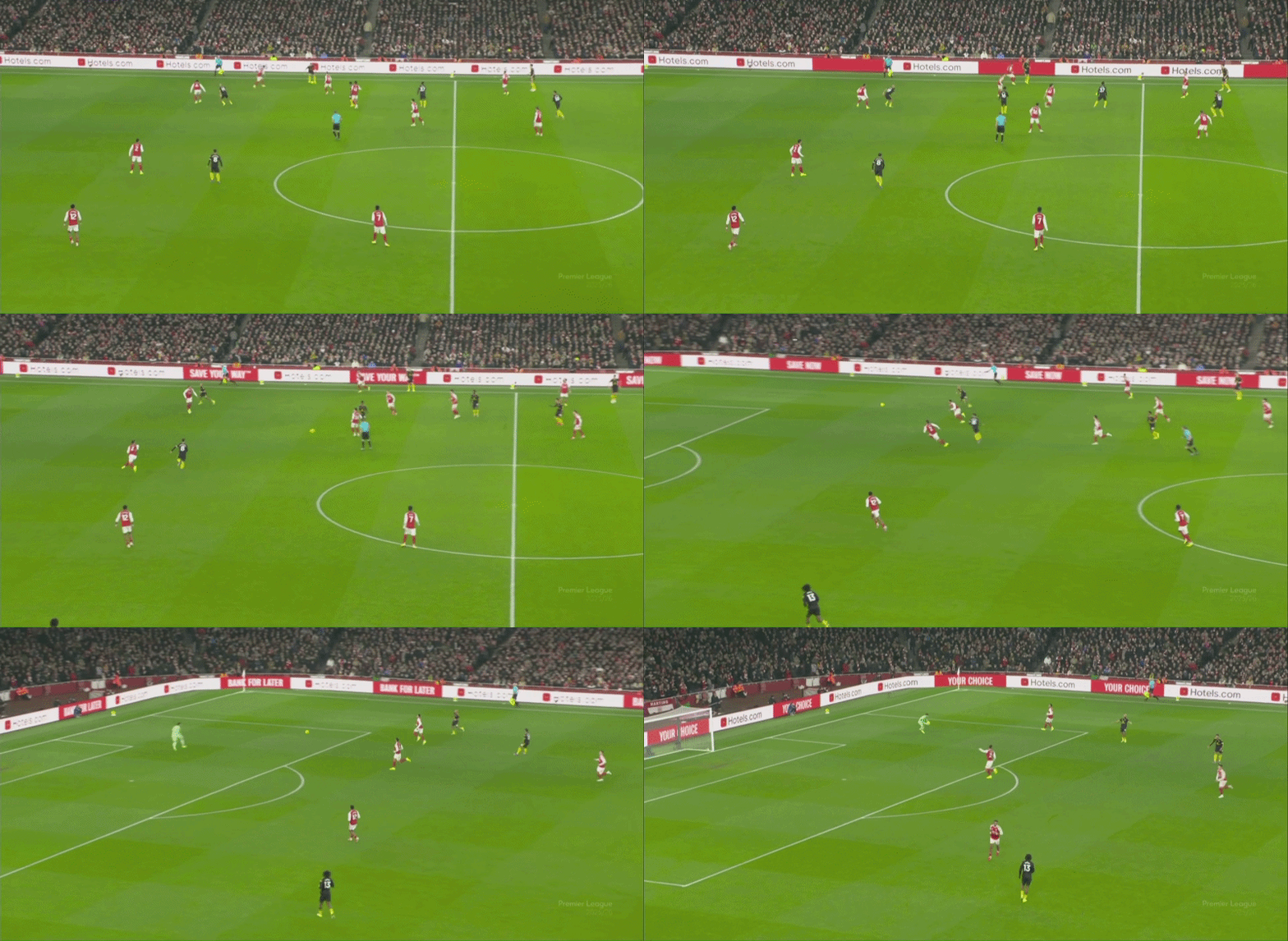
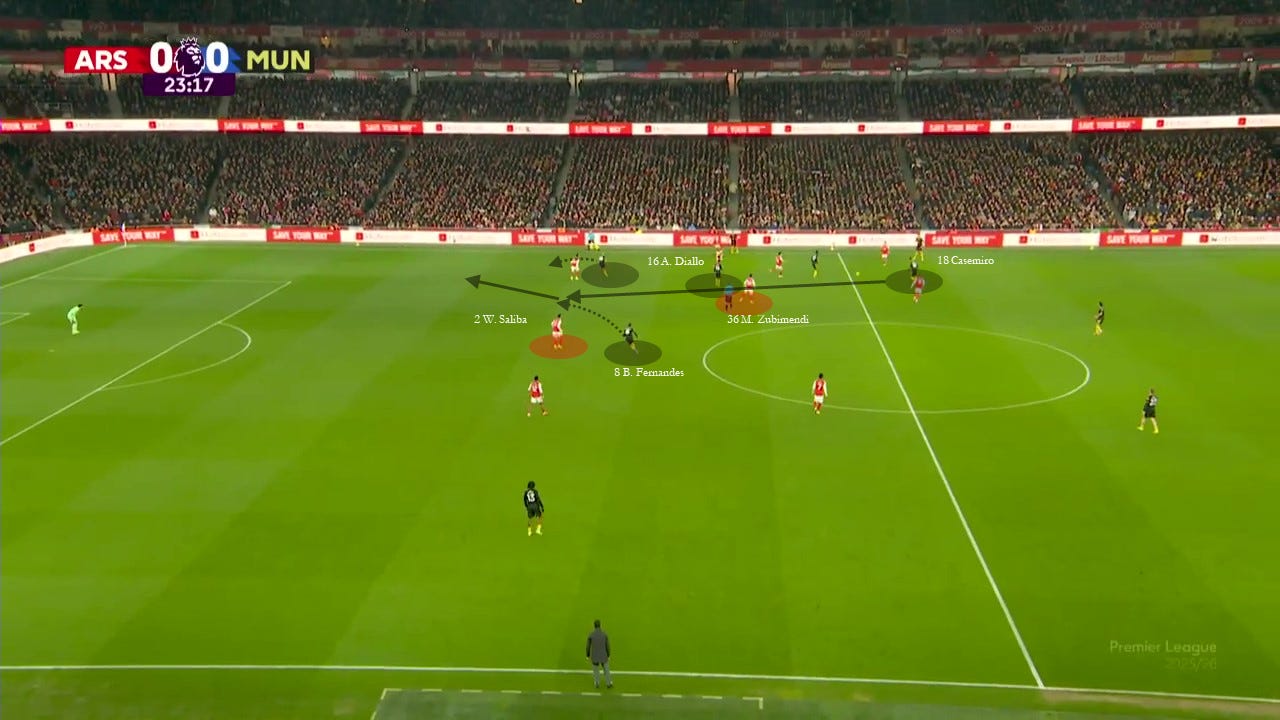
United players are well-positioned. Mainoo and Diallo anchor Rice and Zubimendi. Casemiro has multiple passing options to pick out. The Brazilian, Diallo and Bruno, form a diagonal arrangement, called in the vocabulary of relationism, Escadinhas, meaning “stairs”. It aims to progress the play from one altitude to the next. It accelerates the play and enables smooth cutting through the opponent.
Casemiro just slides the pass diagonally with Amad, letting the ball sail and break the lines to land to Bruno, whose hips are half-turned to prod it from first-time behind.
Diogo Dalot is a good example to escape pressure diagonally. He usually exploits the opponent's open gate and momentum to attack the space emerged on the sides. His first touch in such a situation is a diagonal nudge into space that allows him to skip past his marker. During this period, his opponent has to brake, spin, and track back.
It takes time, which was beneficial for Dalot here, going against Chukweze to cut in diagonally and pick out Mbeumo. A give-and-go from Dalot, with the usual rotations occurring between the lines, saw him carrying in a free road after skipping Iwobi. Andersen stepped out to stop him, but Mbeumo cut behind diagonally.
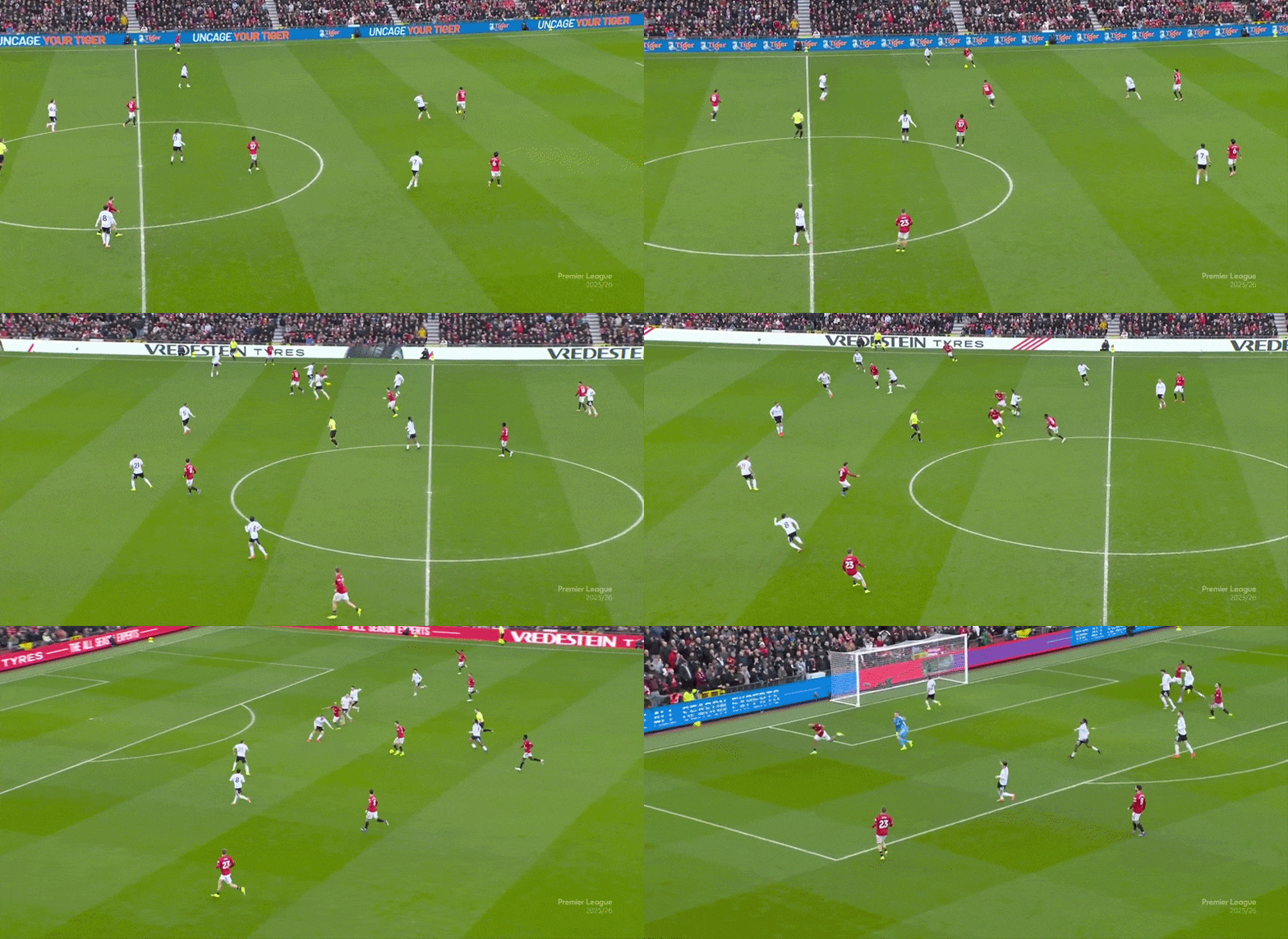
One of the two tasks or both for Fulham to fulfill: stop the pass, trap Mbeumo offside, or both. So, Mbeumo’s diagonal run put Fulham's backline to the test of adjusting their line synchronously with Andersen's step up and committing a runner to track depth. Without harmony and good communication, it’s hard work to track the run or to stop, or at least delay the pass.
From the Spielverlagerung:
“Diagonal runs do exactly that: they ask both positional questions at the same moment as they ask the individual about his communication and decision-making capacities.”
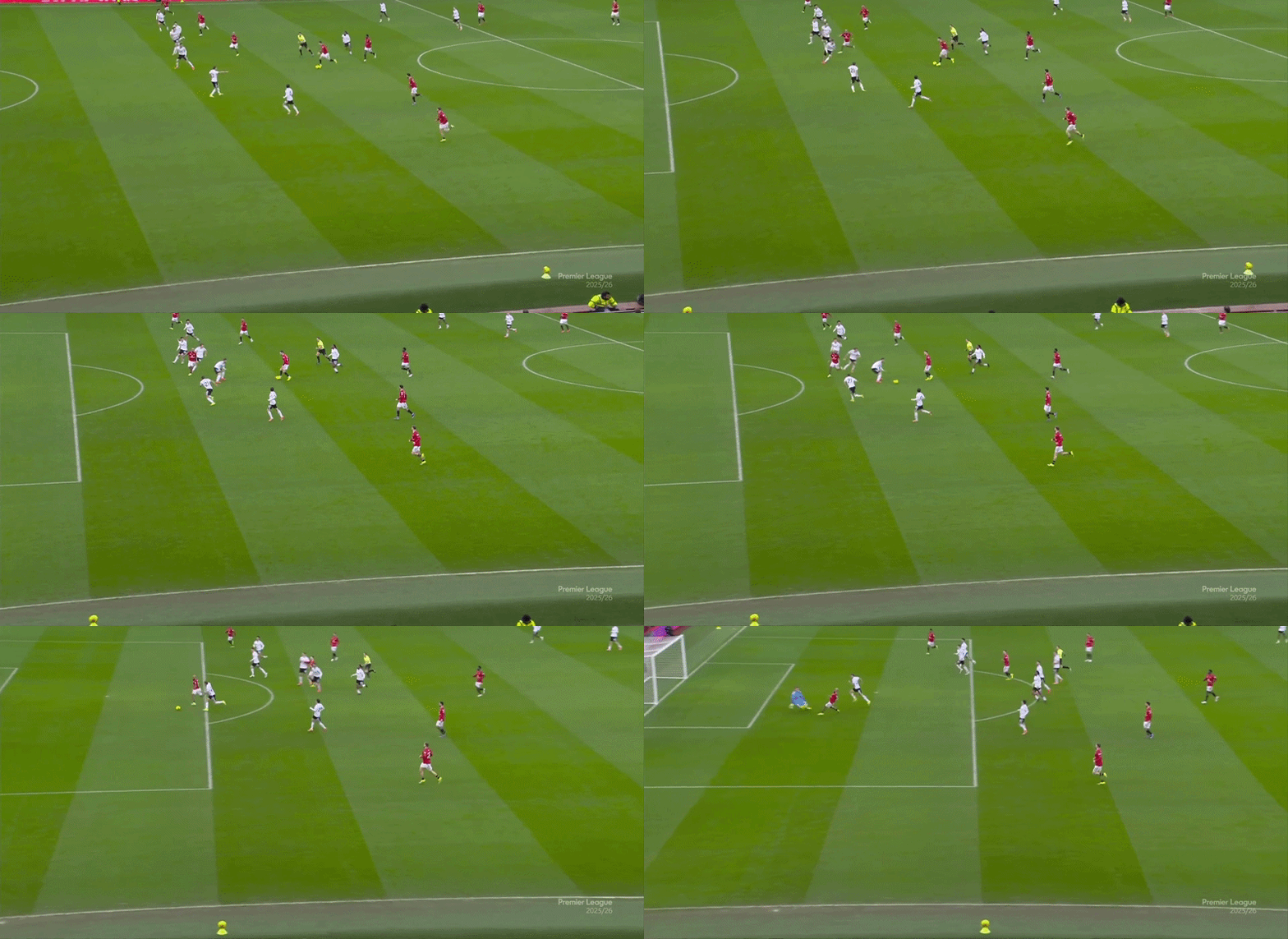
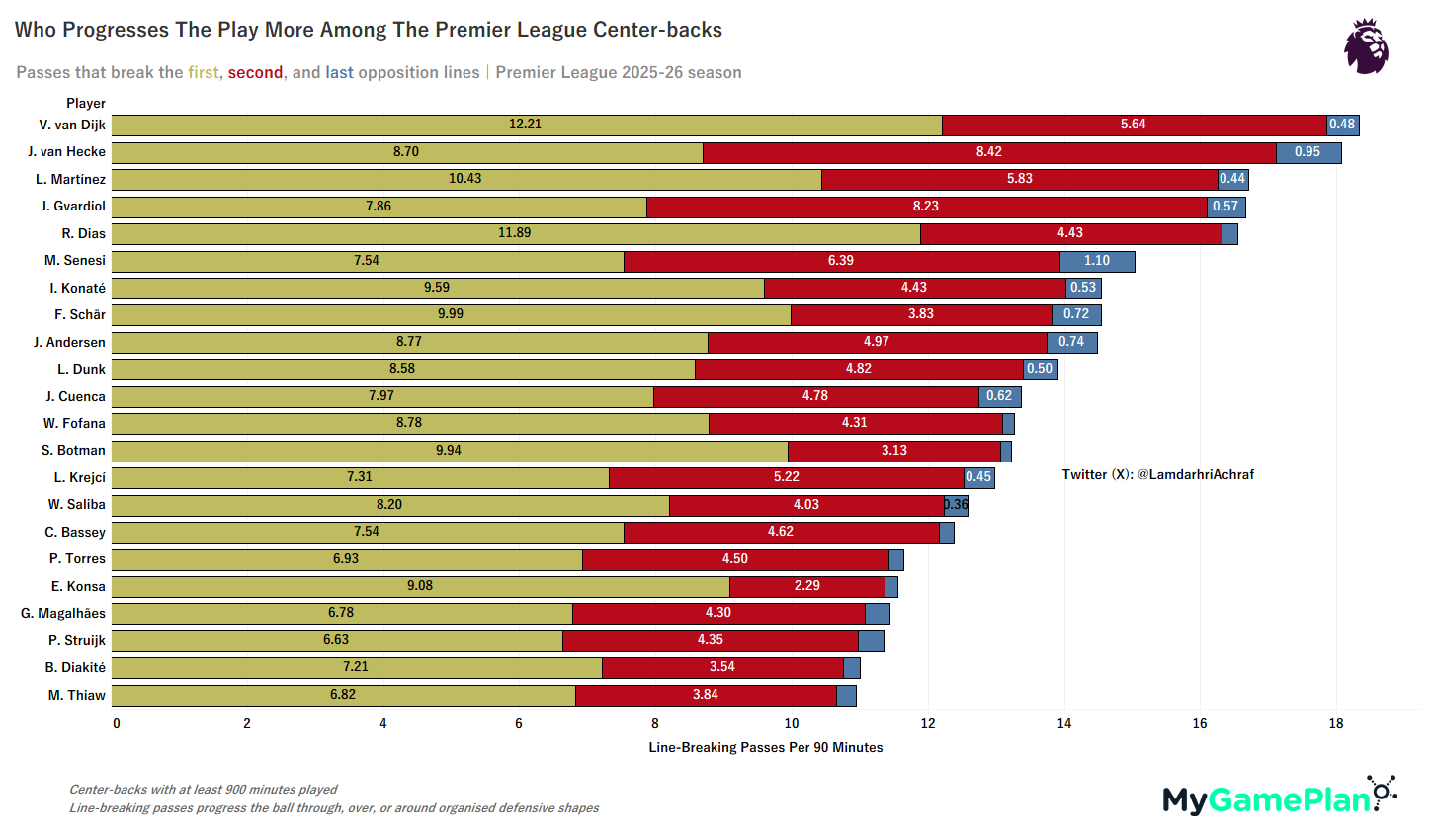
Lisandro Martinez is a world-class game-changer. Highly likely, United can’t zip through opponents with the frequency they do without his presence. Not just because his passes travel from height to the next one, but his deliveries are flat, released with precision, enable progression, and are easy to control. Additionally, he’s so cunning, and his intentions are well-disguised, making the piercing through sequences easier.
Here is how often he breaks the opponent’s lines:
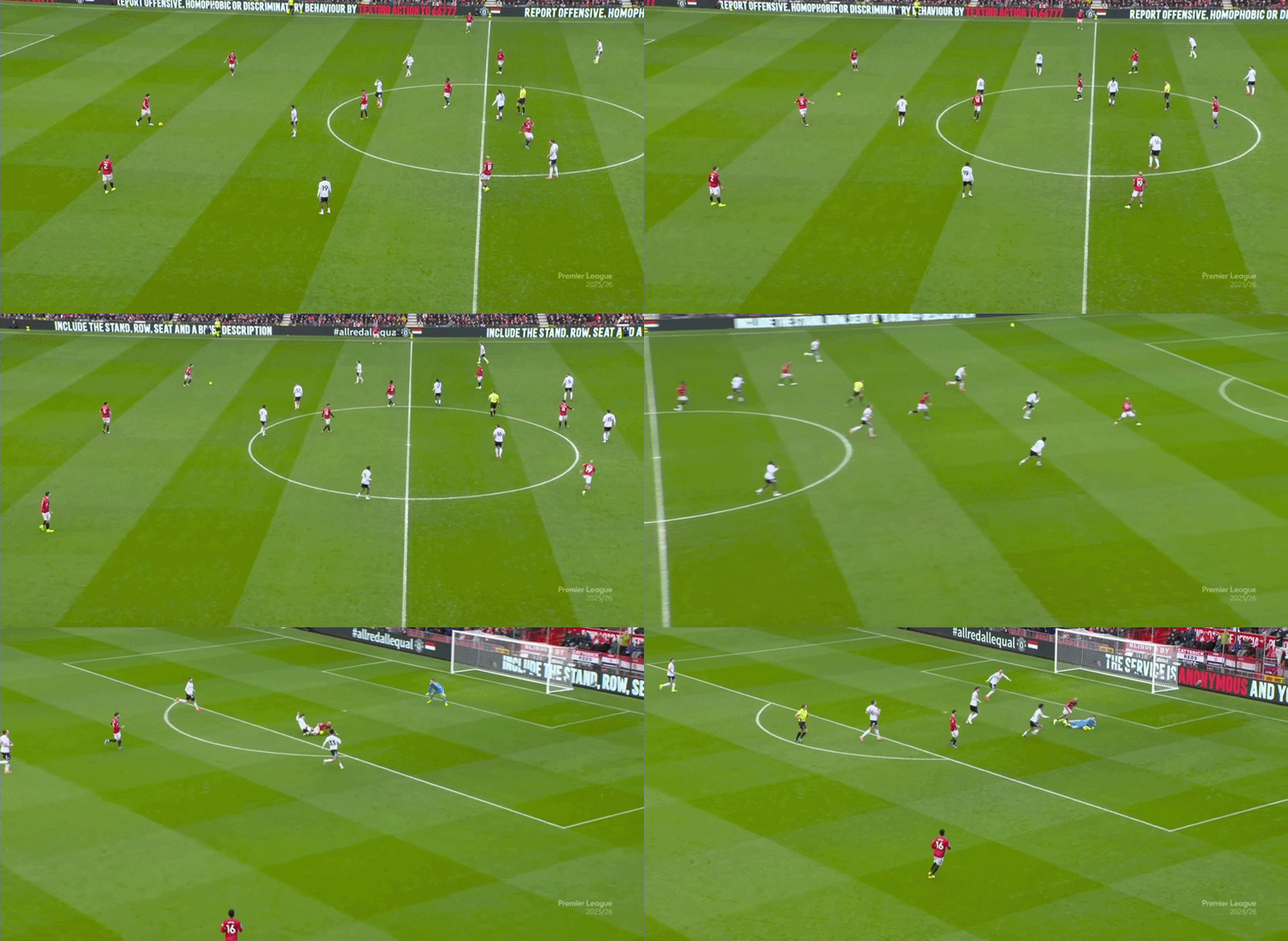
For Manchester United, there isn’t a problem for Michael Carrick for his team to rely on diagonal long passes landing behind the opposition backline when the opportunity presents itself. Diagonality has to be involved, of course, in the pass or in the movement or in both. And Man Utd has runners.
The same logic that explained how a diagonal pass challenges the orthogonality of zonal blocks applies to diagonal movements. Probably, it is faster and less risky, and it doesn’t require a duel because the ball isn’t involved at the start.
Take this example.
The central entry is closed off for Manchester United. Nevertheless, the players inside the block are prepared to receive the diagonal line-breaking pass, as indicated by their body language. Furthermore, the cogs inside lean toward the ball side, with Bruno and Cunha drawing the center-backs’ attention. Sander Berge covers the diagonal lane and Casemiro, while Diallo ties Robinson on the far side.
Fulham is indeed well prepared to defend those passes in behind. However, they are ready to react only to what is in front of their vision field.
Enter Mbeumo. He starts his diagonal run from the blindside of Berge, then passes by Quenca’s to access the promised land. When you have Lisandro Martinez as your pass supplier, you just run and let the pass find you. Such a diagonal run increases the defender's recovery time, and as a result, high chances for taking a shot from high-quality positions.
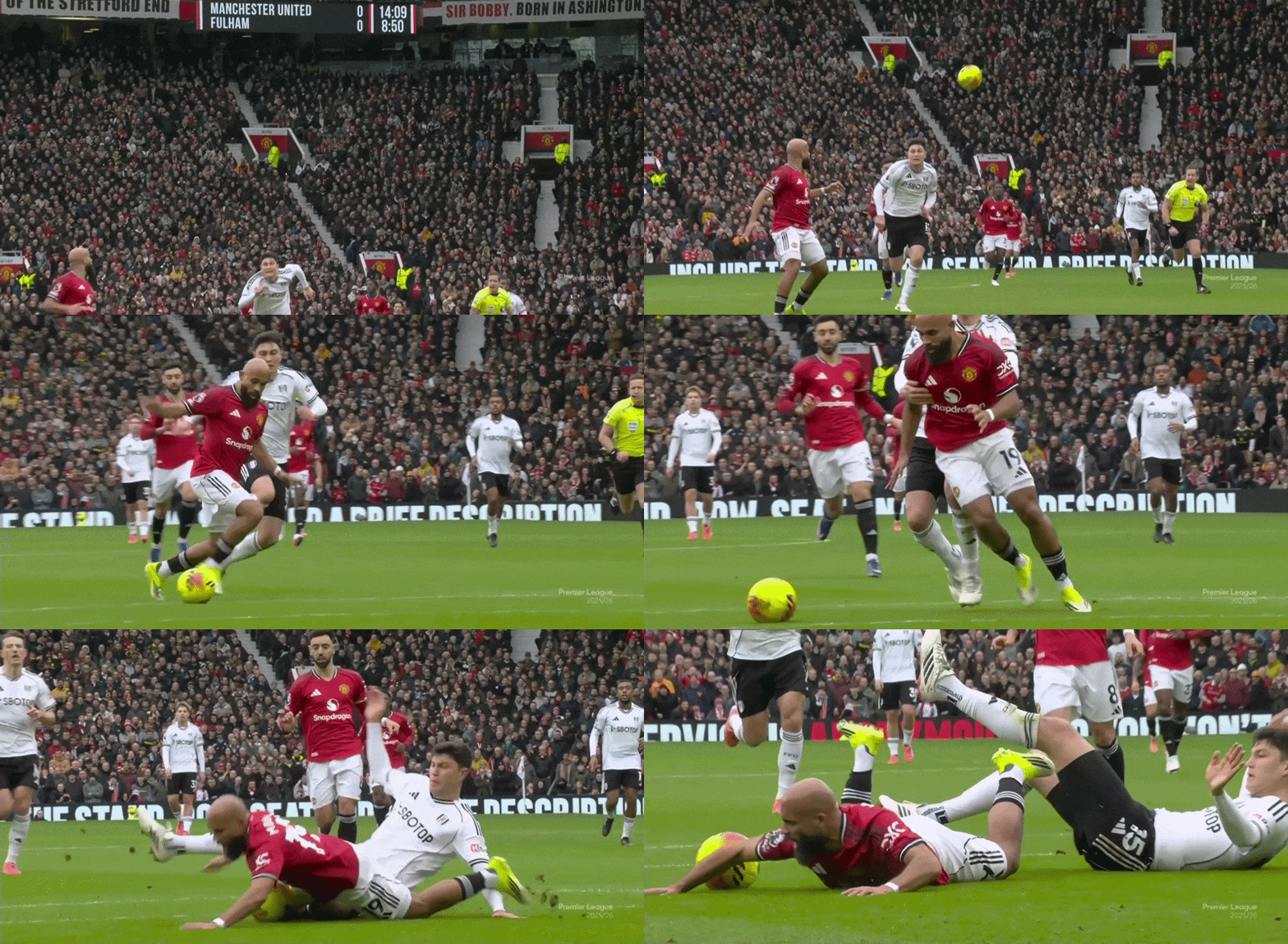
However, Mbeumo’s intentions didn’t match the execution. He aimed to cut diagonally from first-time touch-control to create an angle and space to shoot. However, he ended up stamping on the ball, giving Quenca the chance to recover and tackle.
Under Carrick, Mbeumo operates as a false nine. He and Bruno usually take positions between the lines, around the opponent’s center-backs, and on the blindside of the double pivots and wide midfielders. Additionally, they have the freedom to roam synchronously, testing the defenders’ coordination. Not only that, but they also have the edge of exploiting the blind spots of the midfield line, offering an available passing option for the players outside the shape. Moreover, Mainoo and Casemiro tend to operate at different heights, with one of them advancing to reinforce the central overload and the other manipulating the opposition’s first line via challenging lateral movements.
These proceedings serve one goal: to guarantee time on the ball for the player who’s supposed to break lines.
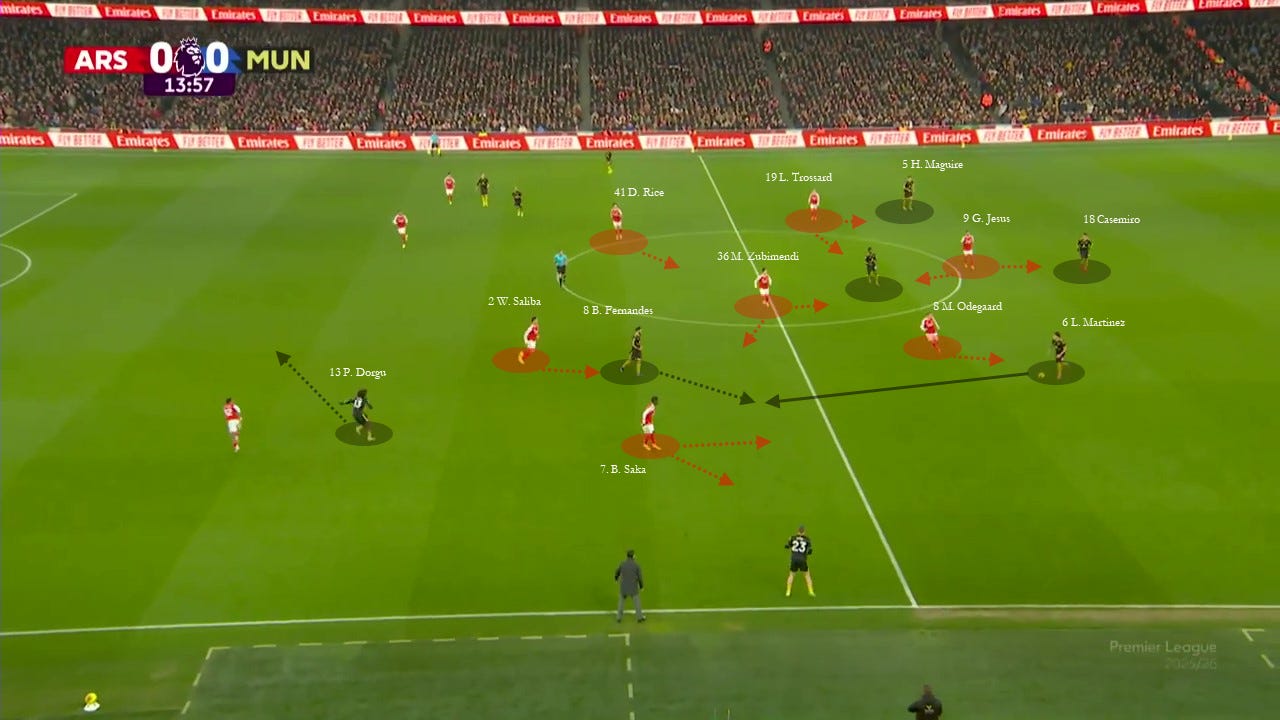
In this scene, Maguire entices Jesus to jump on and waves his hands for Mainoo to shift toward the right to move Odegaard with him. Hence, Lisandro Martinez can pick out his pass through and forward comfortably.
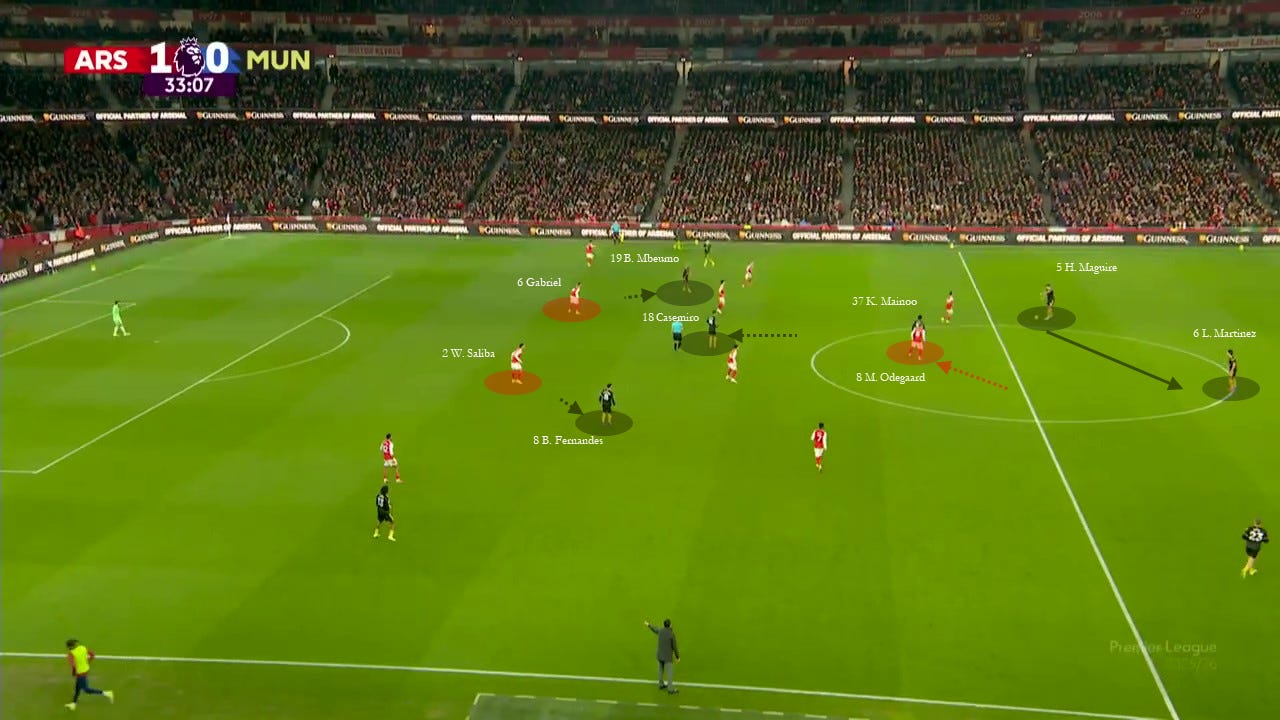
In the meantime, Man Utd players shuffle diagonally backward toward the left side to encourage Arsenal’s lateral swinging. Here comes the advantage of Mbeumo and Bruno’s positions around Gabriel and Saliba, and behind the pivots. They force the pair to only focus on them, with Bruno sucks in Zubimendi's attention. Returning to midfield, Mainoo and Casemiro diagonally overload Rice. An inside-inside combination drives Arsenal to immediately retreat.
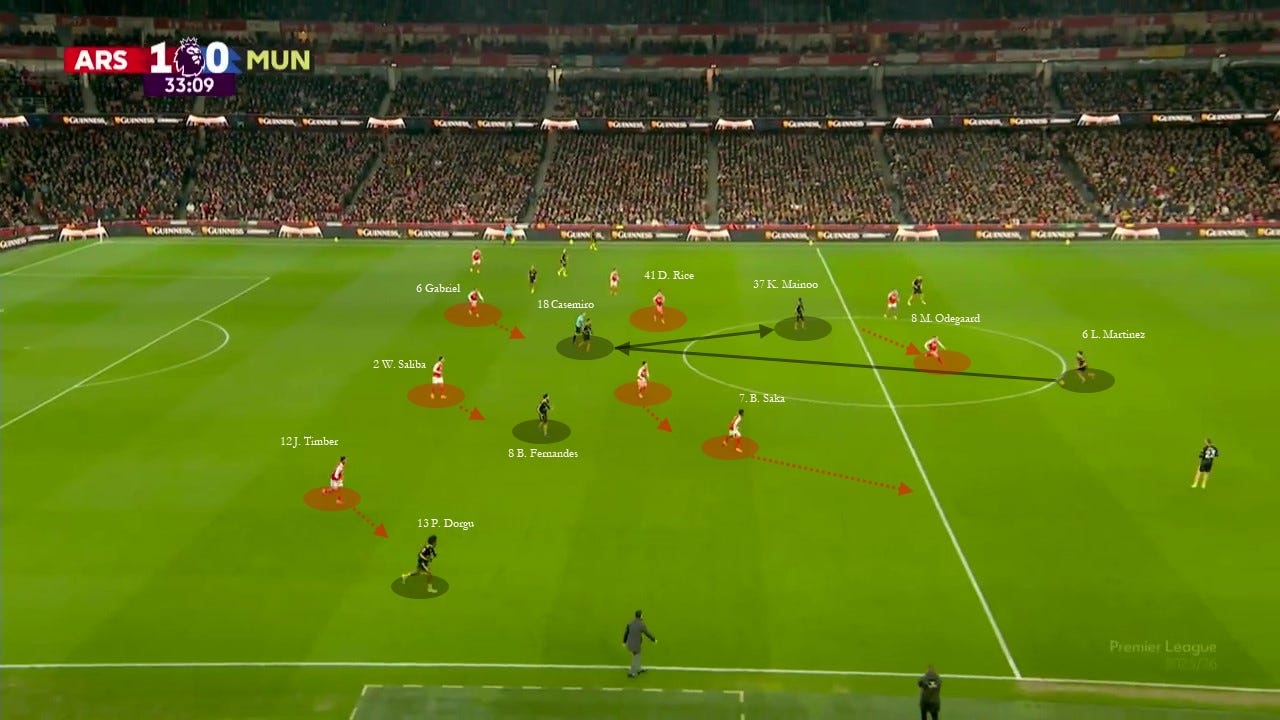
Mainoo has plenty of space to work with. Mbeumo experiences Bruno’s left side occurrences on the right half-space, taking an optimal position between Gabriel and Trossard.
The great minds in the Spielverlagerung tell us:
“For positions in the half-spaces, however, the fields of view are not vertical, but diagonally tiled towards goal. A player in the half-space has as many options as the central player, but doesn’t have to turn away from the center and play to the side, instead maintaining a diagonal, goal-facing view of the field in his passing game. The half-space player retains all the central options yet keeps his body open to the pitch, eliminating the awkward half-turns that plague true wingers. “Wrong-footed” or inverted players especially benefit: the demanding actions (dribble, through-ball, shot) now fall to their preferred foot, while the easy set-up touches (receive, wall-pass, lay-off) stay on the weaker side.”
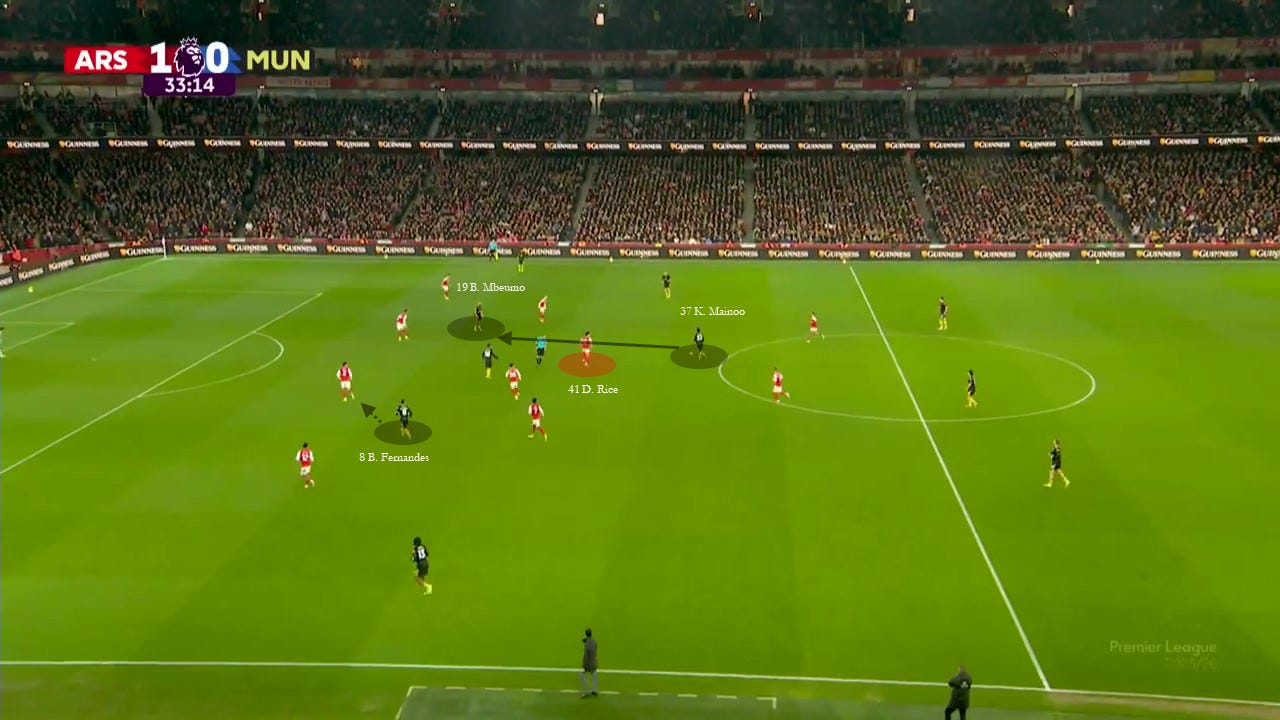
For Mbeumo, he has Casemiro and Bruno attacking the gaps across Arsenal's backline. The trio is arranged diagonally, so the ballholder has two potential receivers. The Cameroonian adopts an open stance, letting the pass run diagonally across his body to his less-preferred foot without the need to add extra-efforts. First-time actions are guaranteed because of the affordances of diagonality and the position in the half-space.
From Licha to Bruno, Manchester United attacked at an accelerated forward tempo, with a significant quality in decisions and execution. The sequence went through the center and the halfspaces, zigzaging via diagonal routes, the most valuable zones in the pitch that allow, with the appropriate body orientation, a qualitative penetration.
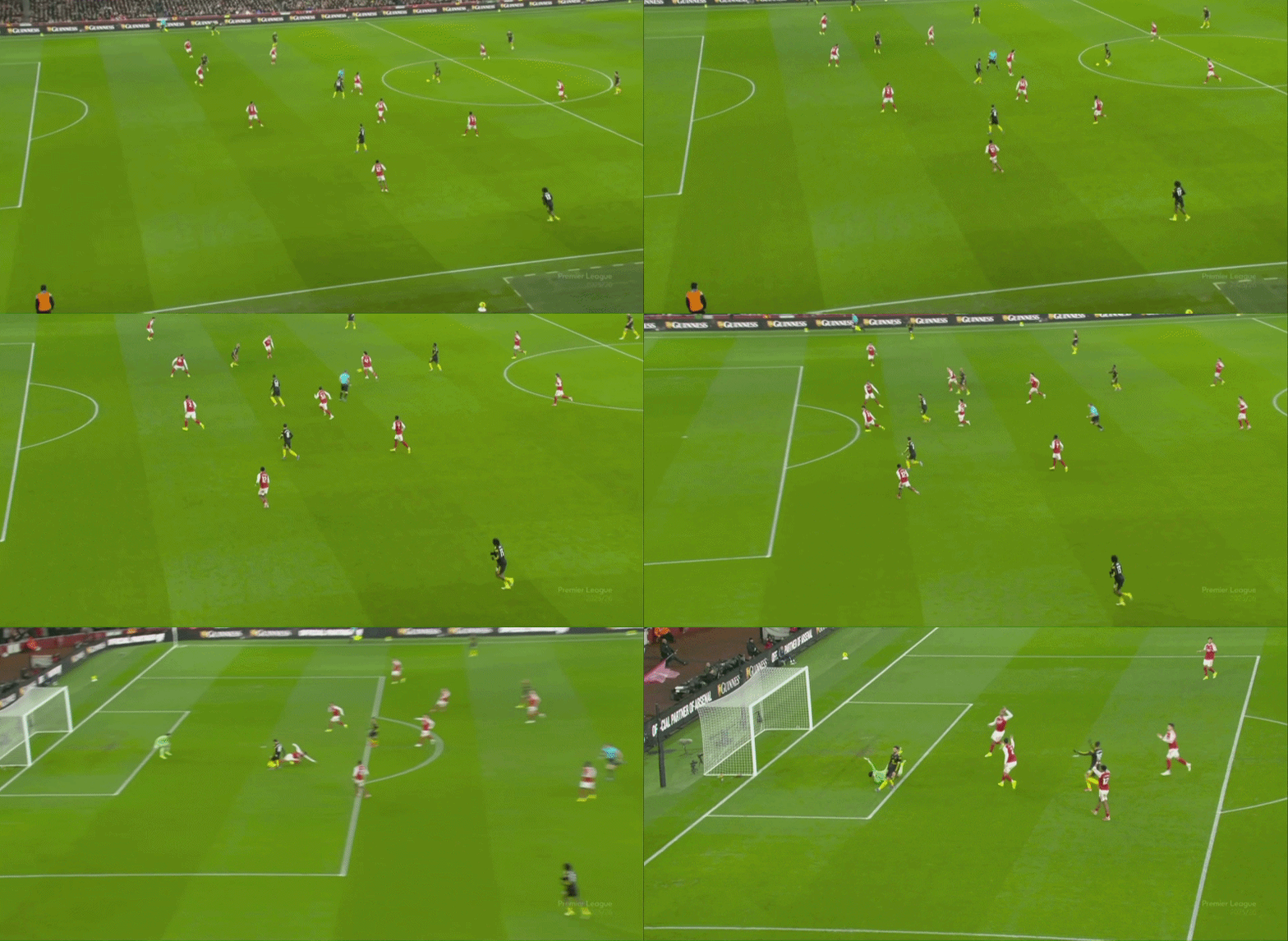
Alternatively, Mbeumo has the chance to shoot or find Dorgu on the left side.
In a zonal defense, a straight jump or a horizontal shift isn’t sufficient to neutralise a diagonal pass heading toward a receiver, because the pass travels faster and breaks lines simultaneously.
Here, Saka dropping, Rice swinging across, Timber being ready to head toward Dorgu, and Saliba covering depth only offer Arsenal good coverage of their right side. Nonetheless, Bruno is a well-prepared receiver in terms of body shape, position, and movement, supplied with orbiting options on his left to access the right. There, United generate a 2v1 situation, where Mbeumo drags Hincapié, leaving room for Dalot near the flanks.
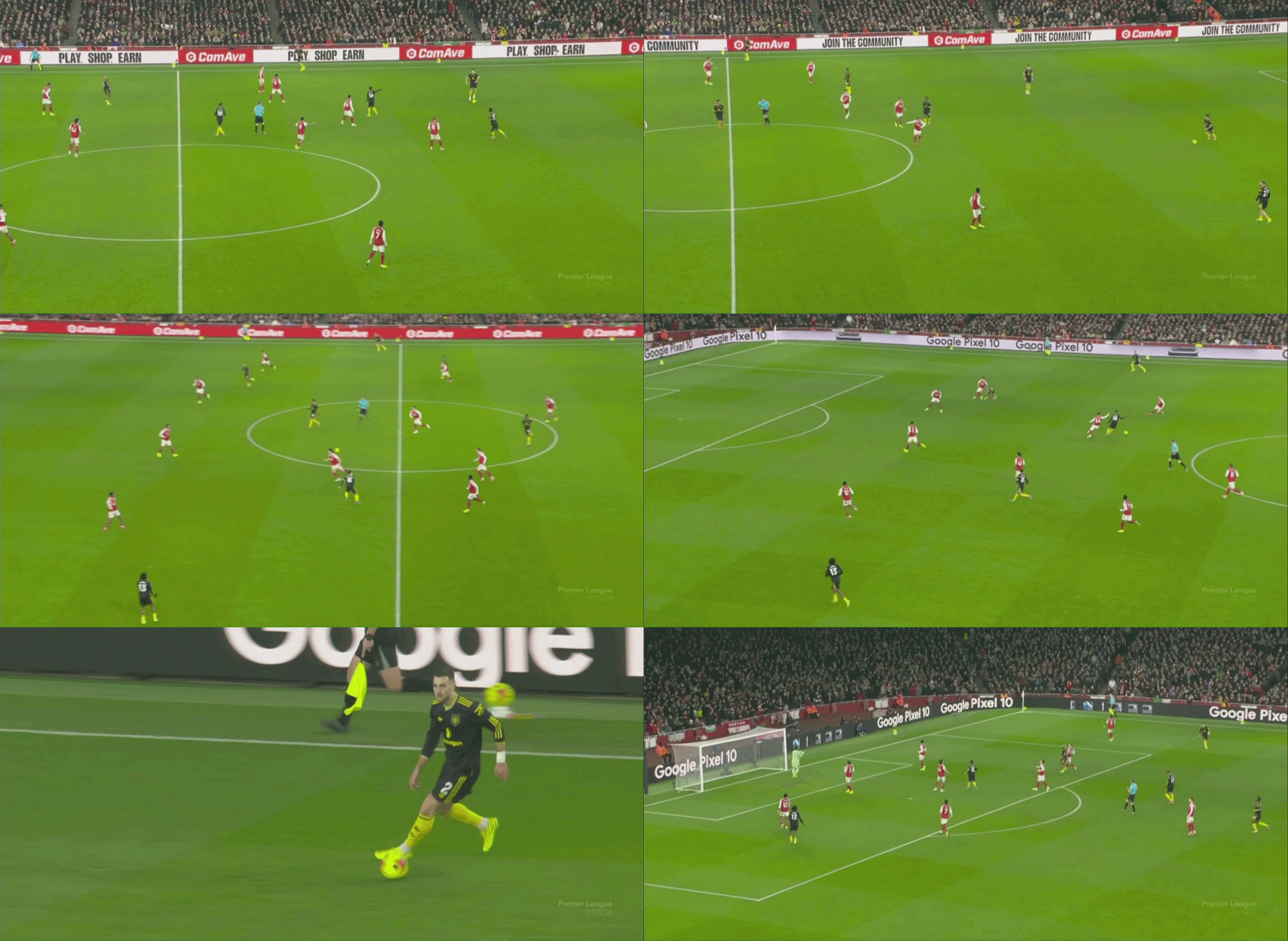
➜ Against low blocks
Diagonality may be a deceptive concept because of how zonal blocks fall into a state of disorder and passivity when applied by the book.
In the Premier League, teams are more physical and compact, center-backs are quick in their reactions, the center is clogged, and opponents are ready to counterattack.
Anthony Gordon gives his opinion about the current state of the Premier League:
“I think in the Premier League, it’s become more physical than I ever known it to be. It’s like a basketball game sometimes. It’s so relentless physically. There’s not much control. It’s just a running game. It’s sometimes about duels. Who wins duels, wins the game. Or moments.”
Some teams embrace the current situation, others have elements of control to balance between being direct, quick, and slowing down the tempo, and others are risk-averse.
With Michael Carrick, the atmosphere felt different in the way United attacks opponents. Even if things are not fully attuned, the difference is tangible.
Before the West Ham game, Michael Carrick expressed his stance on the versatility of his attackers and from where he wants his team to break down his opponents:
“I mean, it’s not a total free-for-all, where you can kind of go and decide, it’s a little bit of where you end up.
Bruno is that type where he understands the different roles and plays them particularly well. And Bryan has done very similar. So has Matheus [Cunha], as well, playing sometimes through the middle and sometimes off the left.”
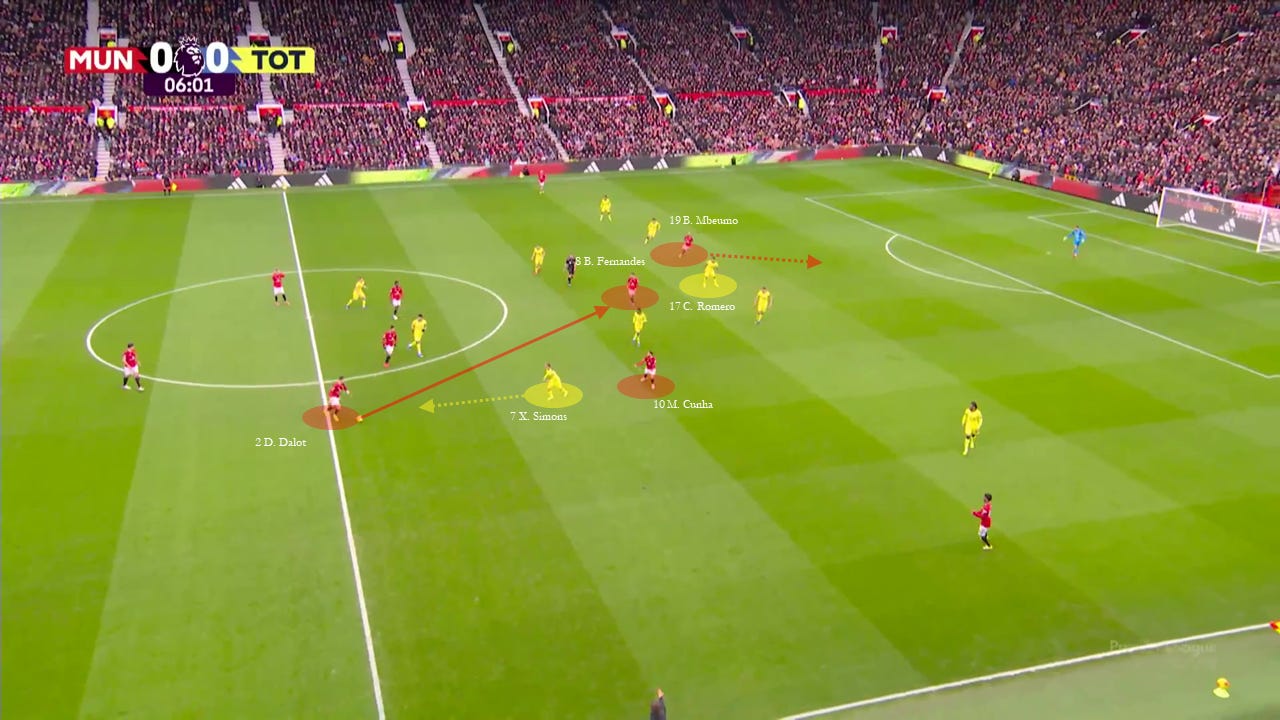
The sixth minute against Tottenham saw the Red Devils slice through the Spurs’ 5-2-3 low block. Central and half-space diagonals are the blueprints. As usual, Manchester United is slightly tilted to the left, with gaps appearing in the center and on the right.
At first glance, Tottenham looks narrow in both directions. However, are they diagonally compact?
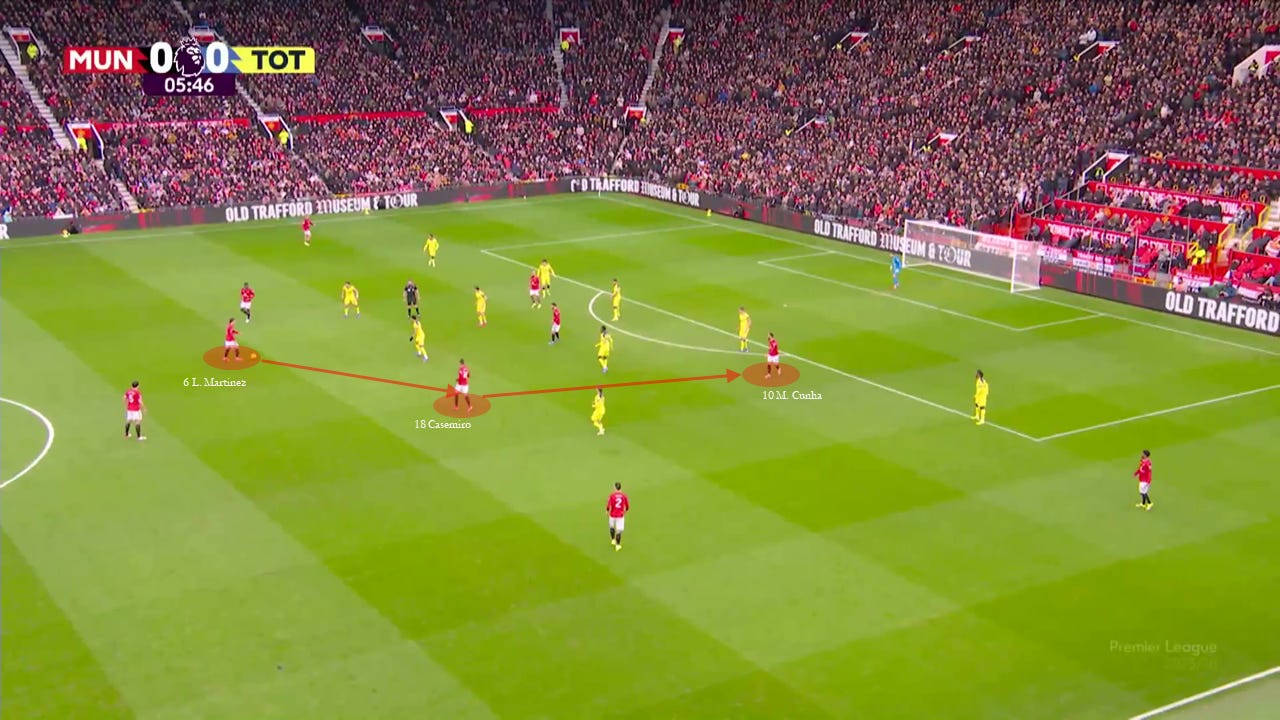
Casemiro implicitly says no. Xavi Simons attempts to slide horizontally. He may close off the right side. But Casemiro still has passing options ahead to pick out.
His half-turn position puts him in a situation where he lets the ball run across his body and nudges it in the same direction toward Cunha.
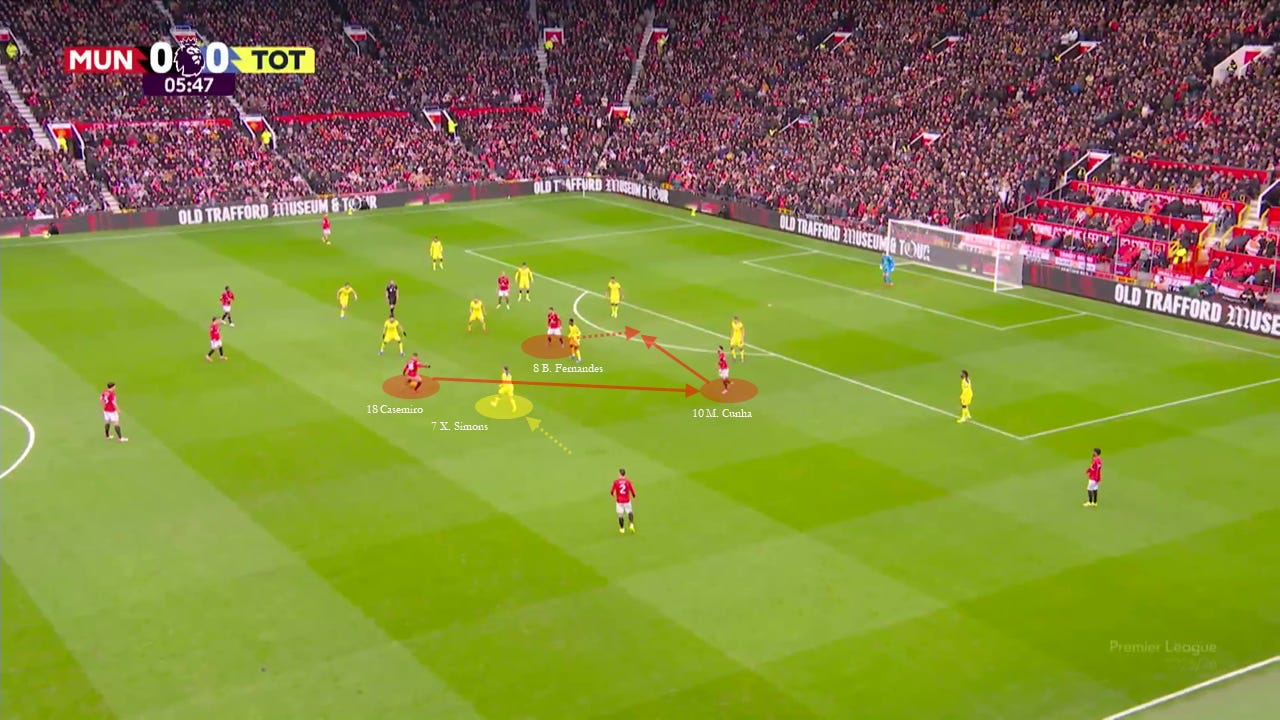
The same goes for Van De Ven. Diagonality negates the straight jumps’ effect. Cunha has space to work with, a better perception, and is well-positioned and oriented. Bruno is on the blindside of his marker and on his way to make use of Van De Ven's blind spots. The gaps are there for the taking.
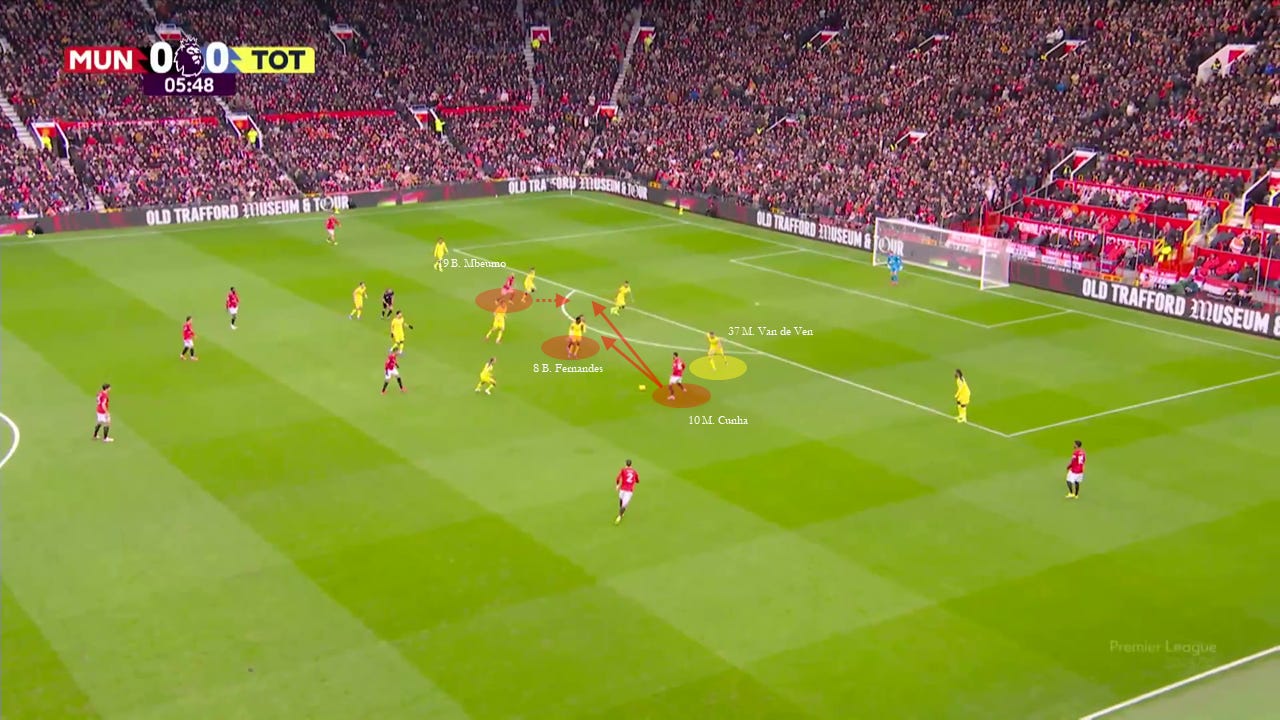
Here is another sequence in which Fulham expected United to work the ball wide to Amad Diallo (out of shot), and then Dalot went against their momentum diagonally to break into the gaps inside. Casemiro already checked his shoulders, locating the source of pressure and teammate behind his back.
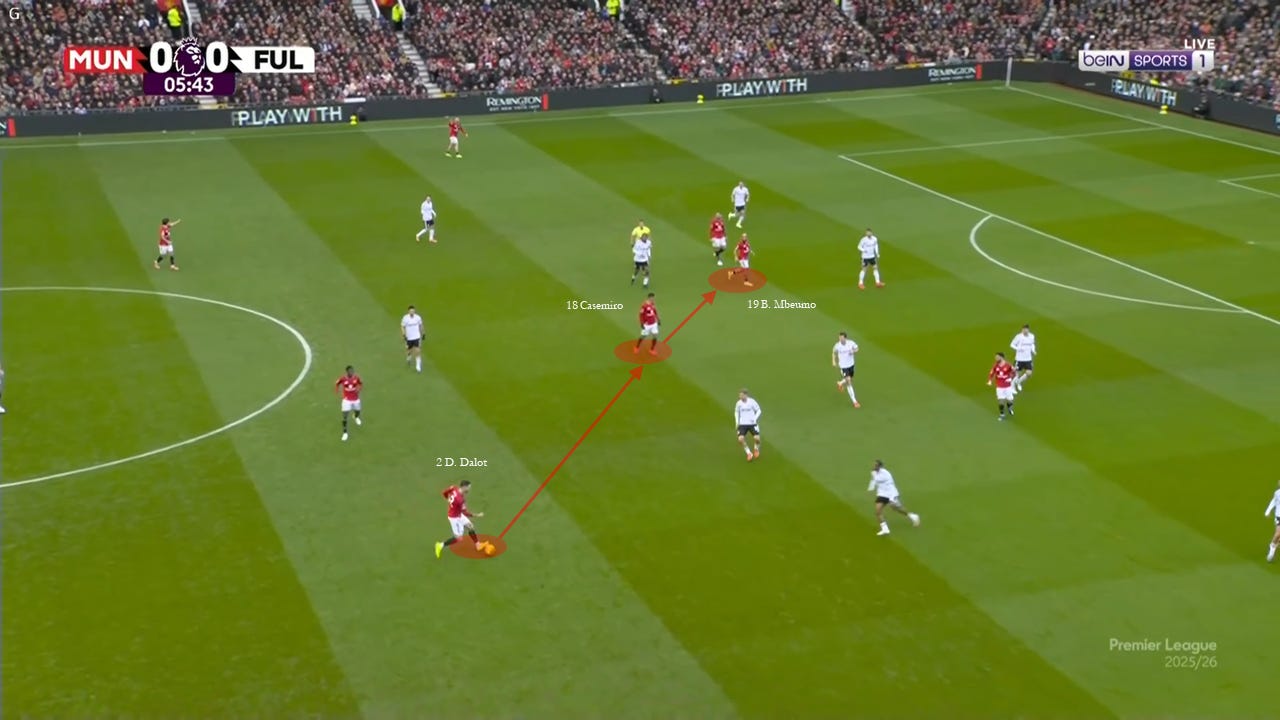
Iwobi passed through the same experience as Xavi Simons. He was already late, and his left side was open. Manchester United Escadinhas (stairs) with Casemiro as a wall between the ball and Iwobi allowed it to progress from one altitude (Dalot) to the next one (Mbeumo).
The body orientations and the first-time diagonal passes accelerated the tempo of the attack.
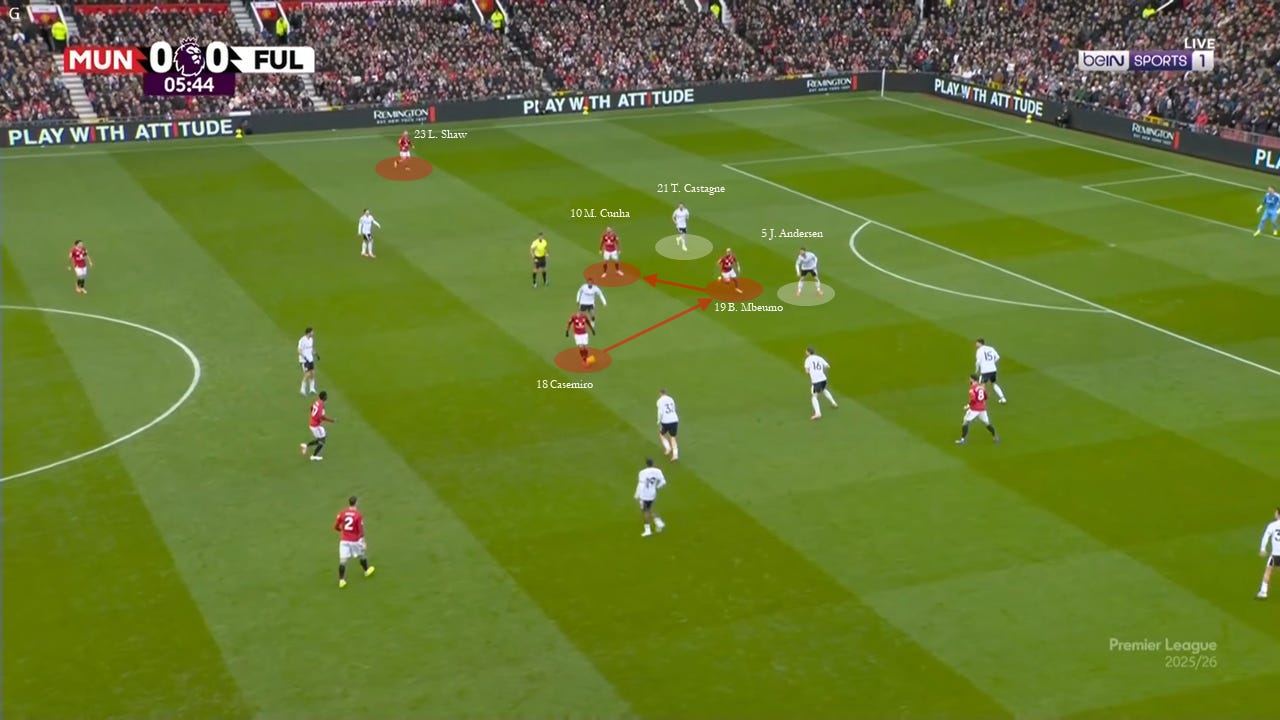
Only if Mbeumo got his lay-off correctly to Cunha, Luke Shaw was alone on the left side to develop the attack.
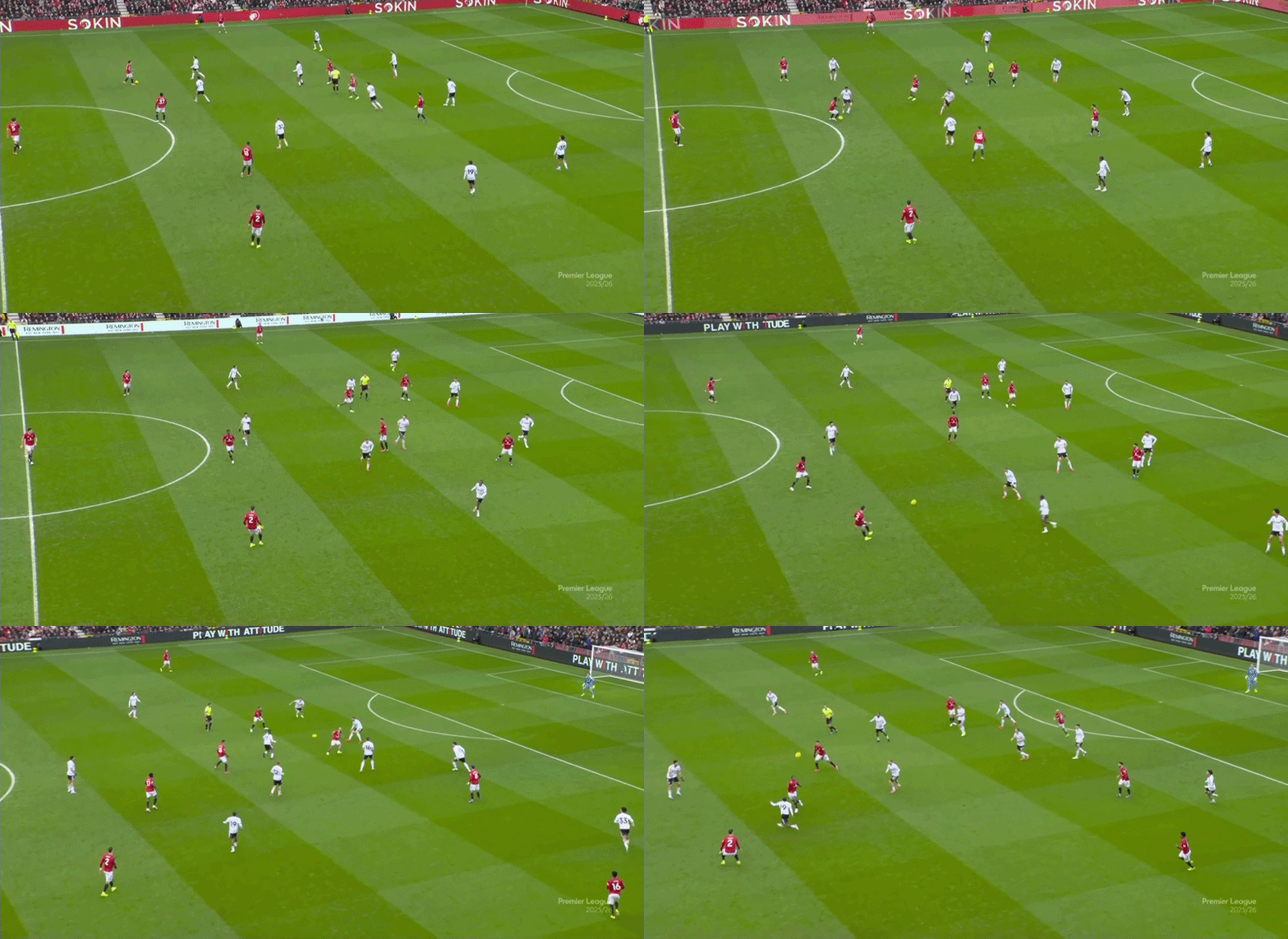
Against Arsenal, we saw some of the baiting, selling a lie to the Gunners, luring them out of their positions, and striking the space behind. Similar dynamics repeat themselves, entice a forward movement and lateral shift, then commit a diagonal run against the direction of the block. It renders Arsenal passive here.
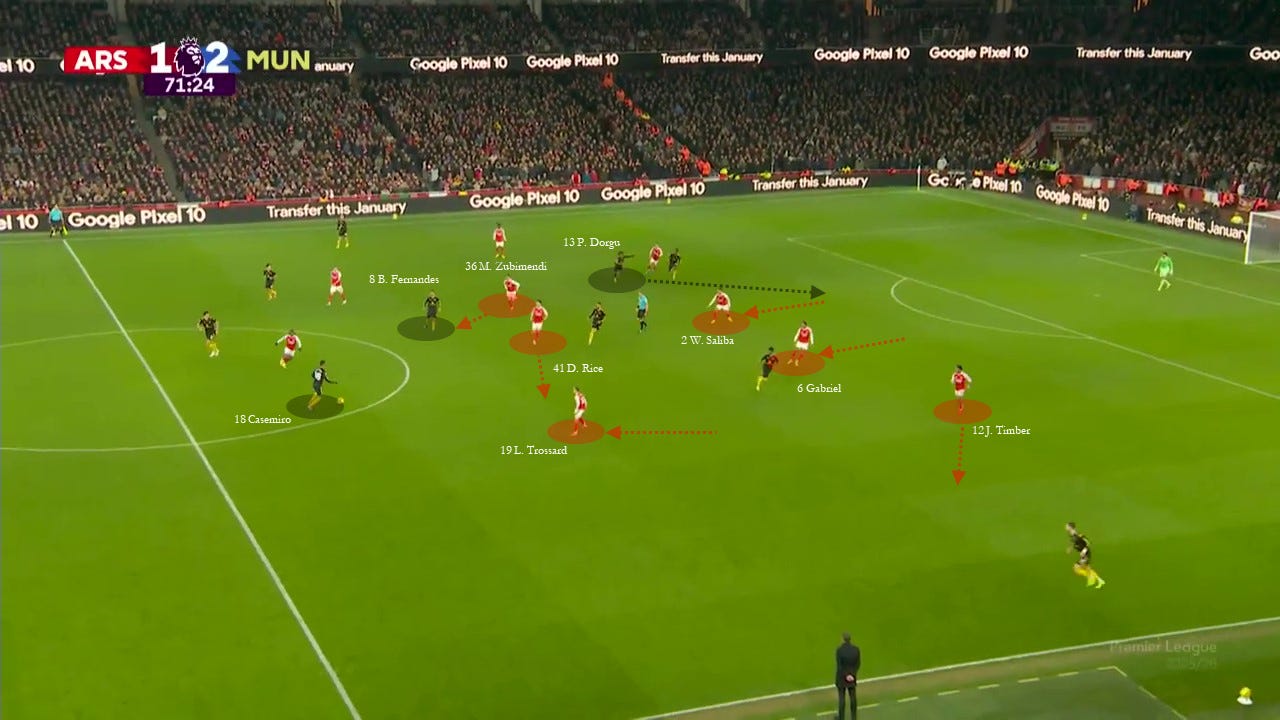
Casemiro adjusts his stance and turns his hips, while Dorgu comes late from behind, targeting Saliba’s blindside. Mainoo contributes to Dorgu’s galloping diagonally behind by drawing Ben White’s attention. Additionally, it’s also because Ben White was overconfident that Saliba would deal with Dorgu (Watch his movement toward the left (Arsenal right side), preparing for a reset), but the latter disappointed White. The reason is simple: Saliba couldn’t focus on the ball and the player at the same time.
White had to change his direction to ward off Mainoo's attempt to capitalize on Dorgu’s backheel pass.

From the Spielverlagerung blog about Diagonality:
“If a player looks diagonally from the half-space towards goal (or from the spaces near the goal or the wing), he sees a lot more space and thus has, in theory, not only more options, but also significantly more space to work with which in turn makes either the success ratio or the value of these actions increases. This will lead to an improved perception which leads to improve decision making which leads to the chance to break two defensive lines, the horizontal and the vertical one, at once, preserve the dynamic of the attack and increase the speed of the attack without having to increase the speed of the execution itself.”
In this scene, Mainoo operates diagonally down the left half-space. He’s unpressurized with a good field of vision, in a safe position, as he cannot bother thinking of the consequences of a possession loss, and can access all the directions around him.
Meanwhile, Bruno punishes the space behind from the blindside of Quenca. Remember when we mentioned that Mbeumo’s diagonal run in behind tested the communication of Fulham’s backline and then their decision-making in closing him off and trapping him offside. The same applies to Bruno, as his run presents a positional problem and the issue of miscommunication across the defensive line.
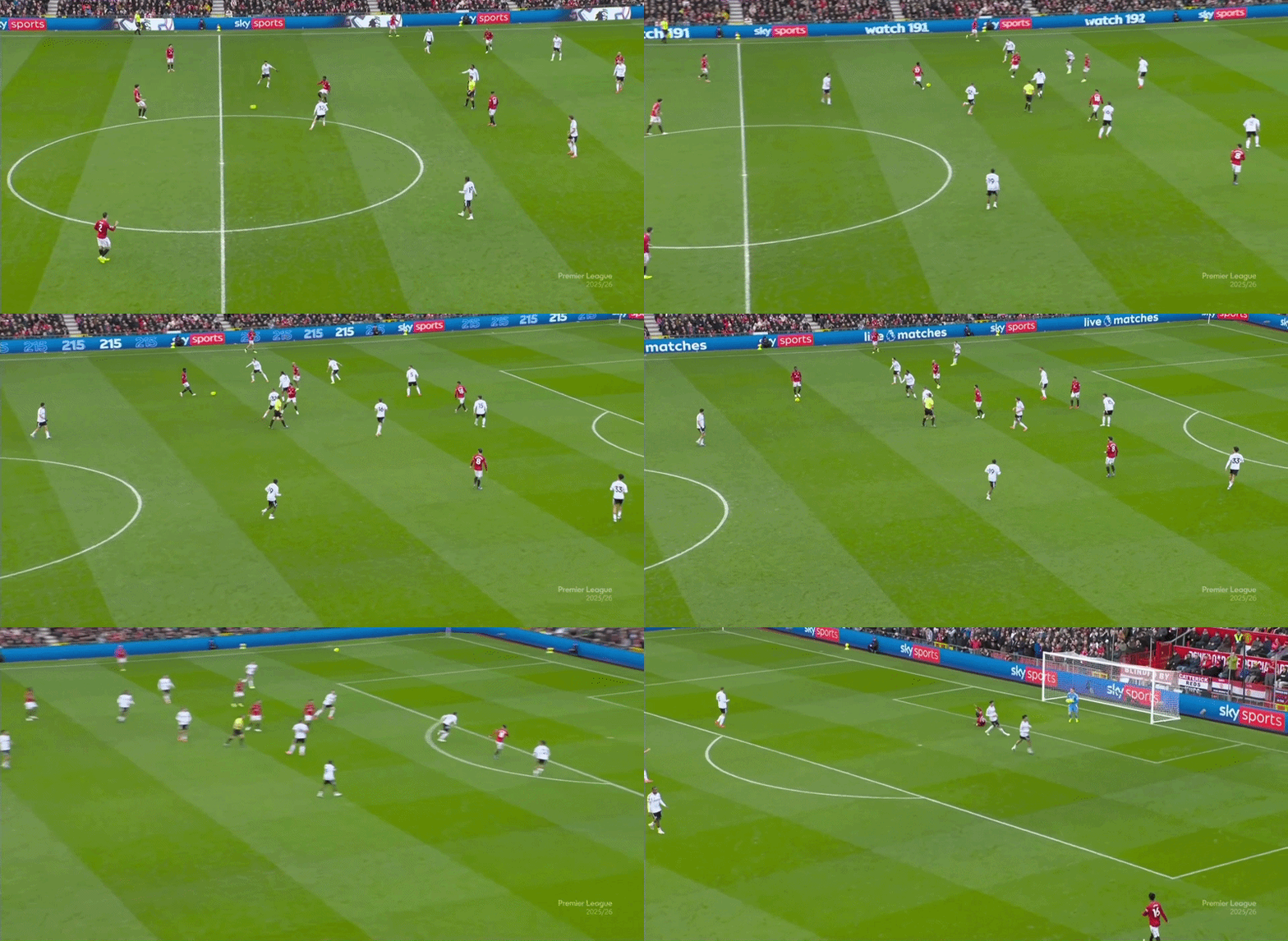
👉 Overloads
Starting with the passing maps, it is clear that Manchester United prefers to lean to one side, overload it, operate in close proximity, and isolate the far side wide player to target him via switches. With no 1v1 specialist on the left side, the Red Devils usually tend to generate these isolation moments for Amad Diallo on the right.
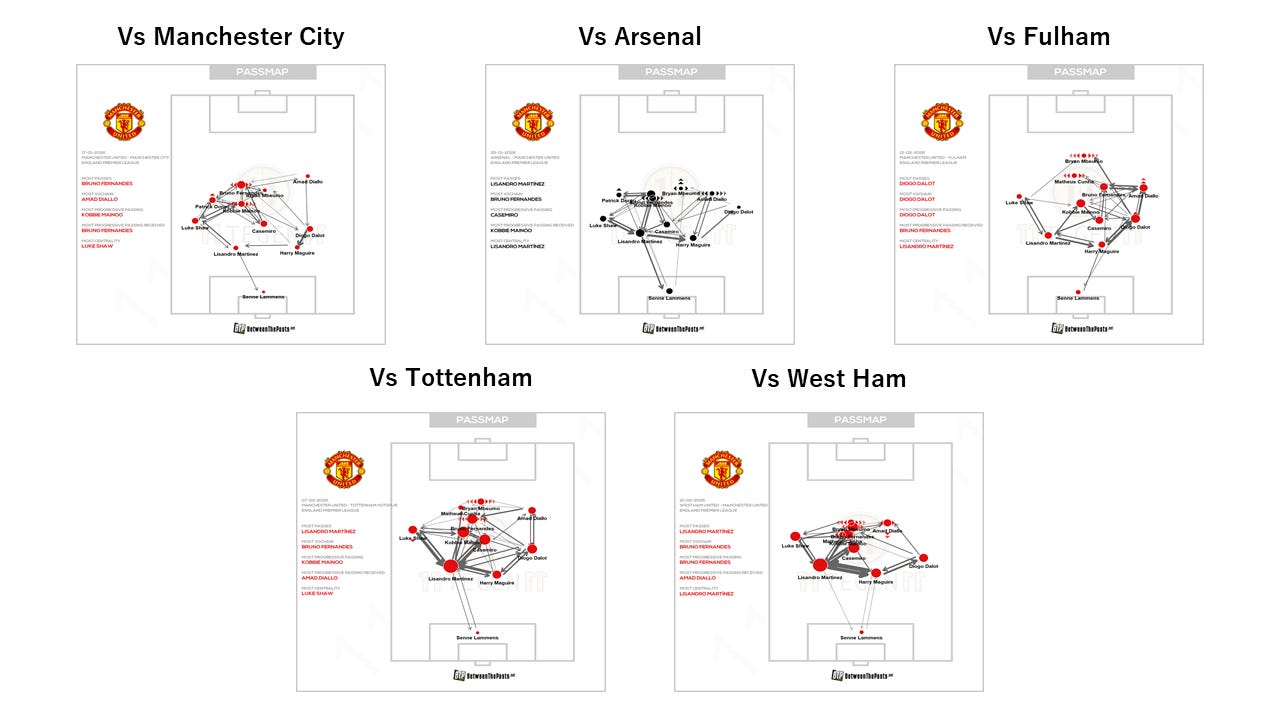
Moreover, Man Utd’s overloads serve them in working the ball out on the overloaded side, making use of the proximity of the players and passes from first-time touches to escape traffic.
It’s more about moving the opponent to arrive with advantages in a certain area. Casemiro and Mainoo here skew toward the right side, operating close to Maguire and Dalot, and outnumbering Rodri down the right half-space. It seems like a drill of a rondo exercise in training. Everything is kept to one-touch play to get out of this congested area.
Semenyo attempts to close off Mainoo, attacking his blind spot, but the latter has already done his exercises in terms of scanning and assessing the optimal options around to opt for after ball reception. Mainoo brakes for a short amount of time, exploiting Semenyo's momentum to skip past him into the space he came from.
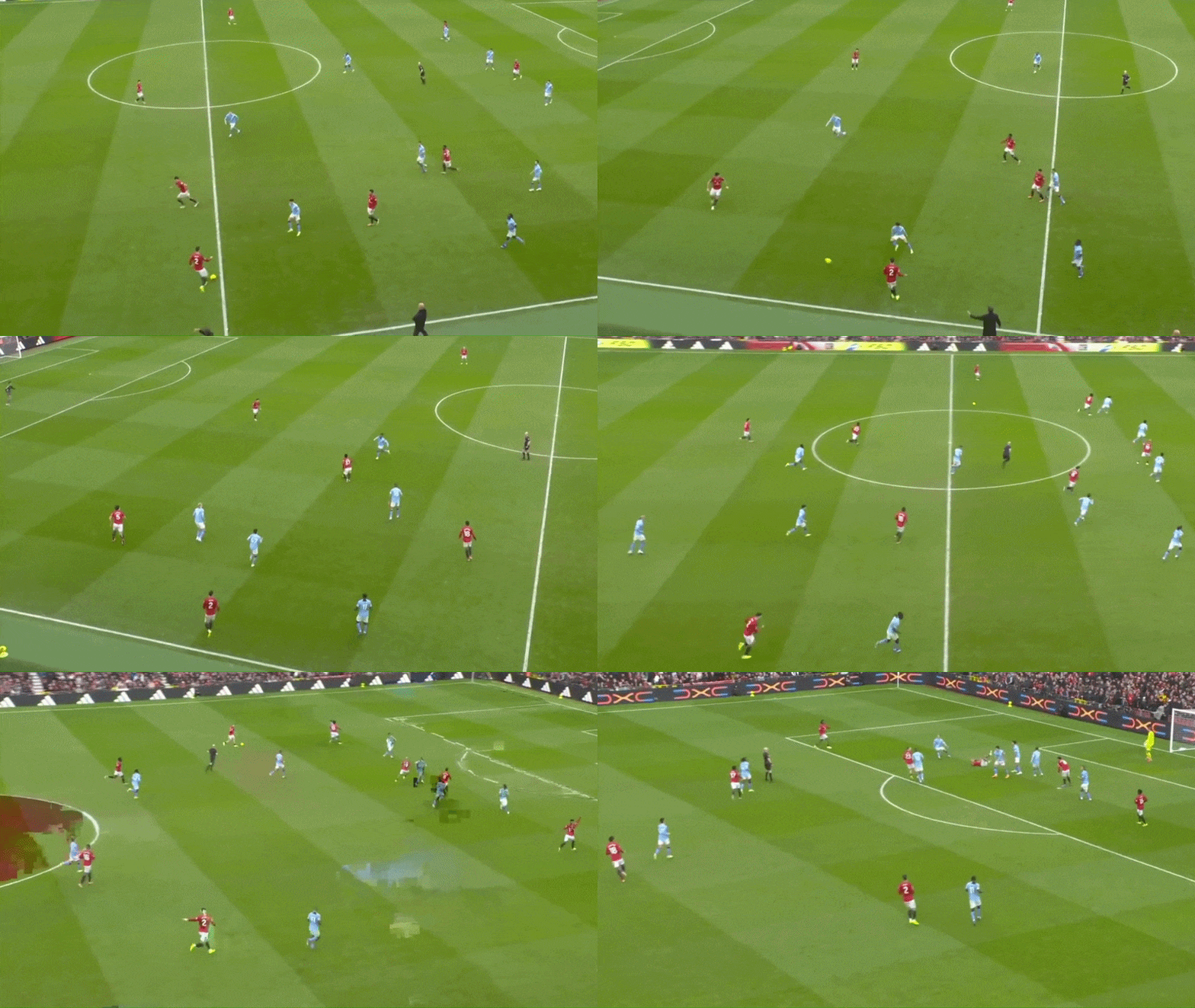
On the left side, Luke Shaw and Patrick Dorgu overload Rico Lewis, while the latter, with Mbeumo, Bruno, and Diallo, drag City’s backline toward their goals and creep into the gaps. As a result, Shaw has space to scamper forward and pick out one of his teammates.
United has the qualitative superiority on the right and has elite long-range passers to destroy opponents via the “overload to isolate” patterns.
Probably, Man Utd finds difficulties in dismantling the sternest low blocks by pushing them deep and sneaking out from an emergent gap. Nonetheless, Carrick’s side showed signs of being able to lure these blocks out and then wait for the right moment to capitalise on the vulnerability that appears within the move.
Here, the quality of Lisandro Martinez rises to the occasion by disguising his intentions and selling a lie to break down the first line of Fulham’s block. Meanwhile, Mainoo comes short, Dalot cuts in diagonally to distract Chukweze, and Mbeumo, with Bruno drives Robinson inside. Hence, Mainoo can switch to pick out Amad in space.
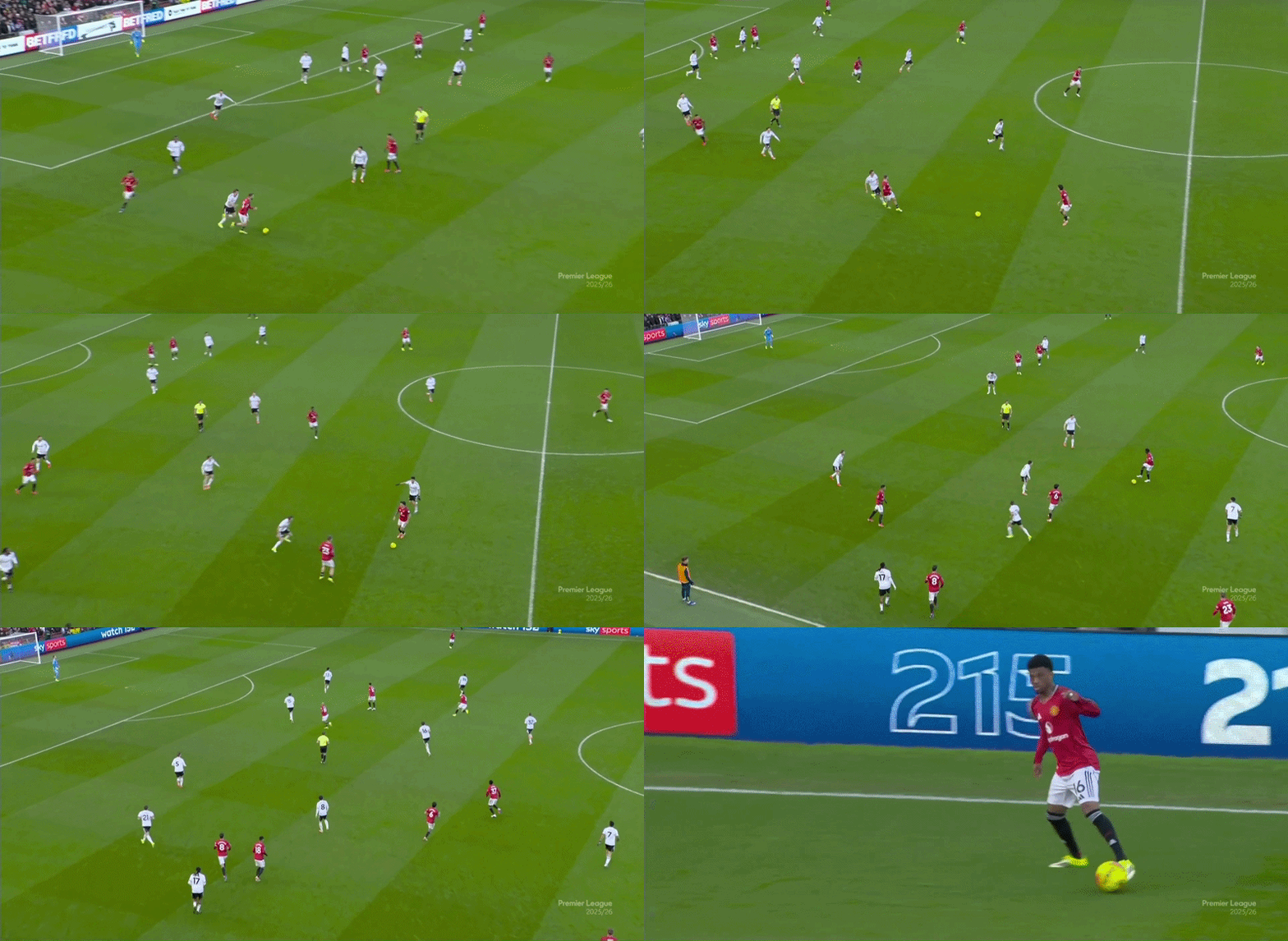
It’s true that Fulham shuffles across quickly. And that’s because Mainoo’s switch is hit with a significant bend and toward the back. Nevertheless, United’s rotations, close proximity, diagonal combinations, and overload on the right pave the road for Dalot to proceed with a shot.

It’s not all about tilting toward the ball side to free up the far side of the pitch. It’s more about deceiving and forcing the opposition to move to a designated area, pulling them out of their shape, and then changing the direction of the play.
Mbeumo, Mainoo, and Licha against West Ham set up the trap on the ball side. On the far side, Bruno Fernandes obliges Diouf to drift infield. Hence, Diallo roams in free space near the flanks.
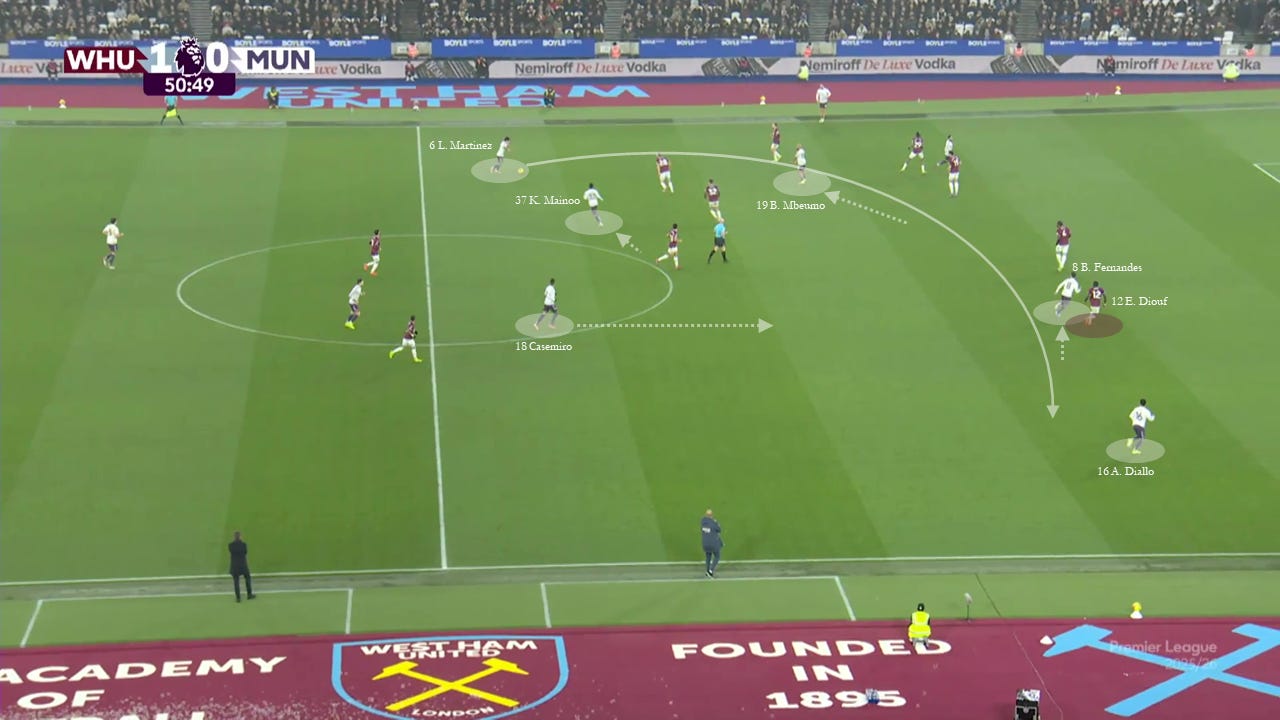
Here is the situation as the ball lands at Diallo’s feet: Bruno pins Disasi at the edge of the box, and Diof pulls wide. Thus, the space between the West Ham pair is stretched for Casemiro to dash into.
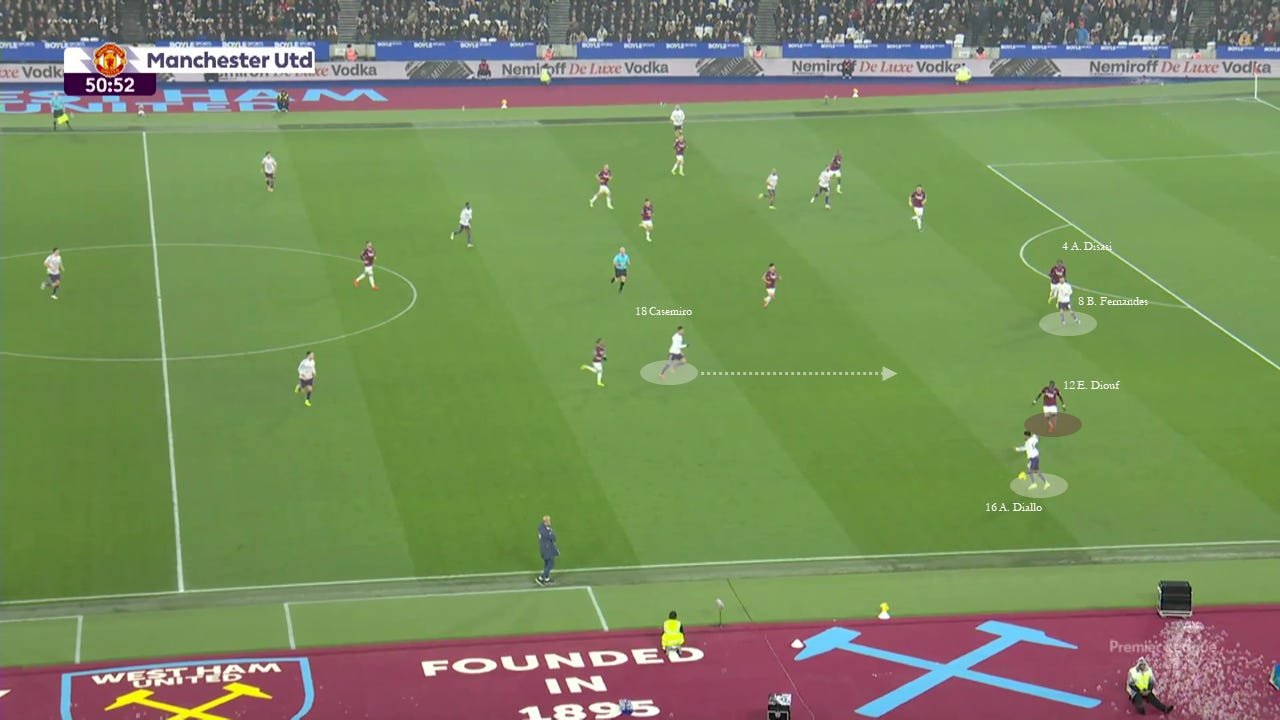
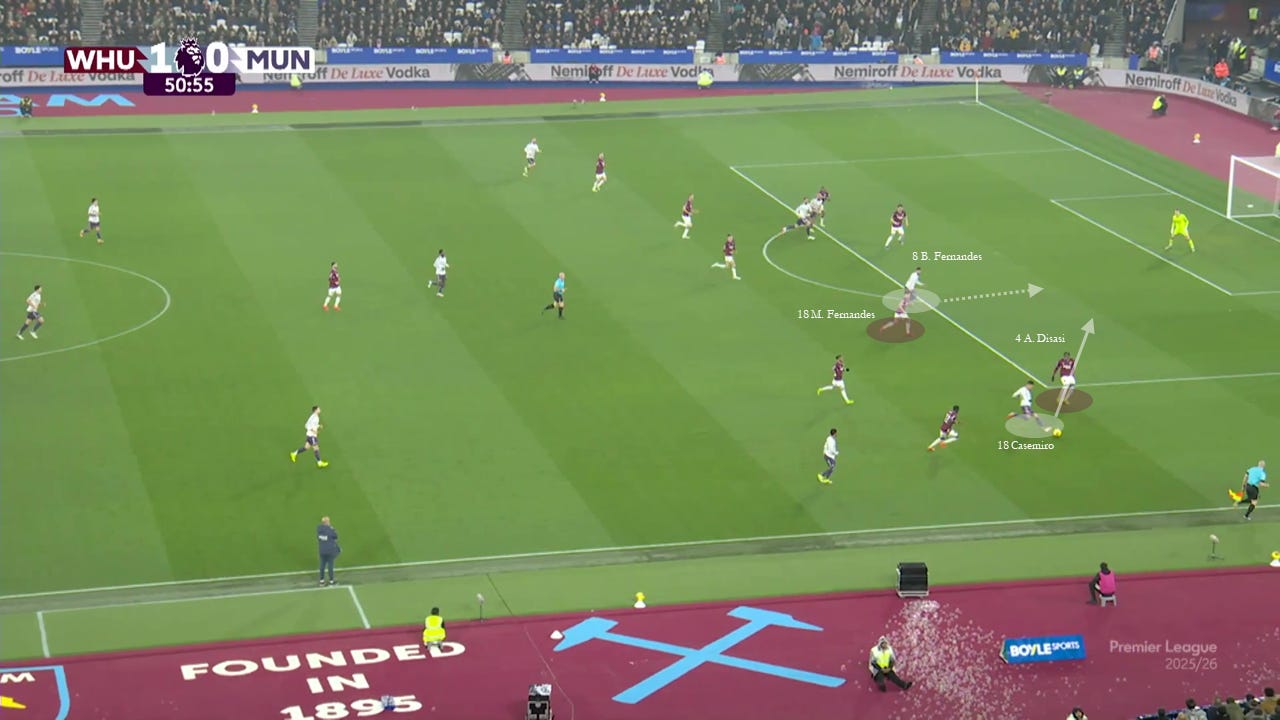
That encourages a role exchange across the backline to take charge of Casemiro. Disasi shifts across, and Mateus Fernandes drops to plug the gap and shut down his compatriot.
Kobbie Mainoo, Lisandro Martinez, and Casemiro are essential in connecting both sides of the pitch and linking attack and defense.
After the sacking of Ruben Amorim, Kobbie Mainoo’s career with Manchester United revived after he was considering an exit under the management of the Portuguese.
Michael Carrick worked with Mainoo in his early days, and he is already aware of what the 20-year-old can bring to the table:
“Basically as a midfielder you try to connect the team, whether that’s with the ball or without the ball. He (Mainoo) certainly takes the ball, we all realise that he will take the ball everywhere and connect the whole team.”
“He isn’t always going to be the one that has the final action, but he certainly starts a lot of our moves.”
Kobbie Mainoo is a carry-first mindset midfielder who breaks lines by driving at opponents with the ability to retain possession. Even if he’s not at the level of the likes of Casemiro and Lisandro Martinez, for instance, he has the passing quality in his repertoire.
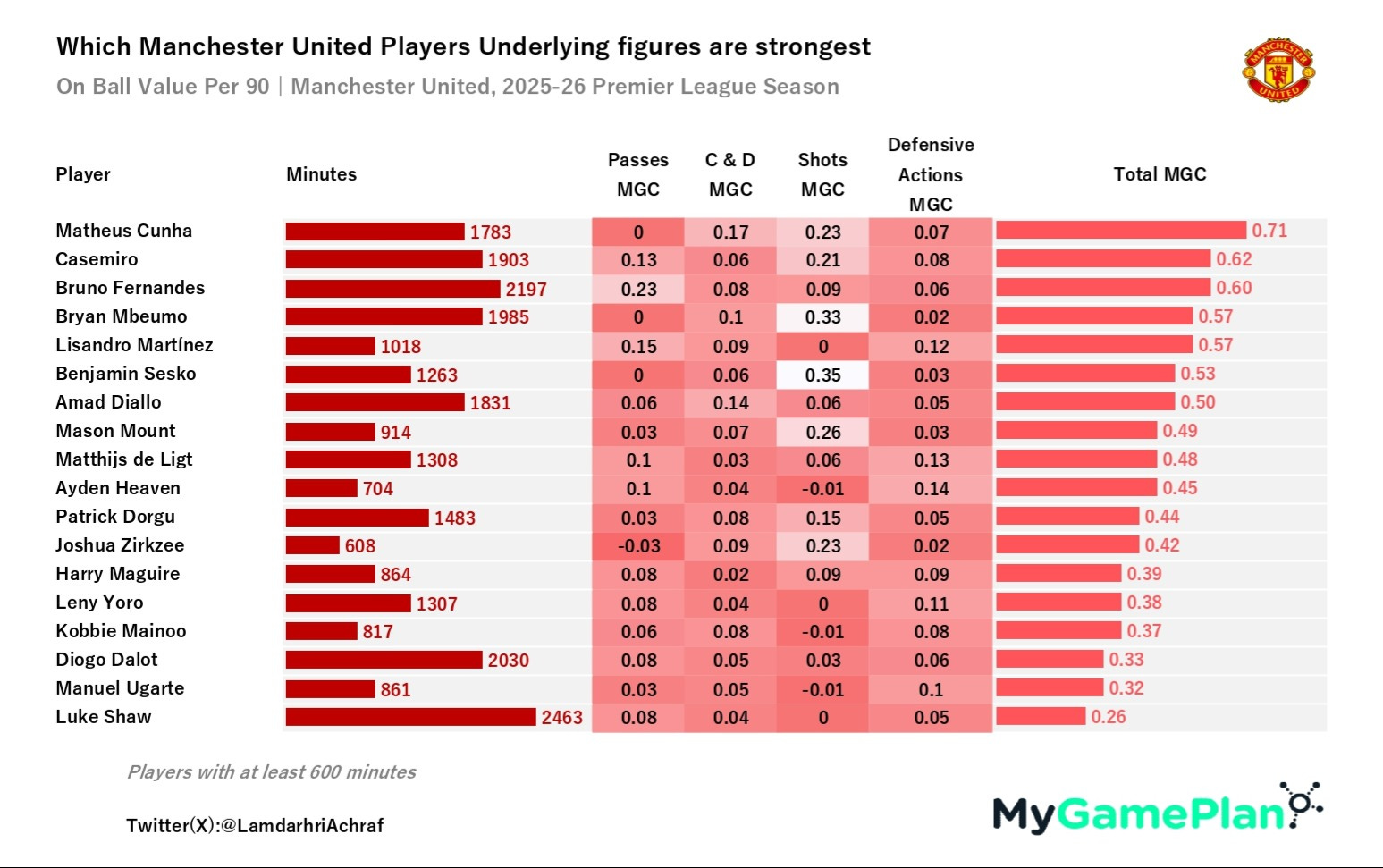
According to MyGamePlan, Lisandro Martinez is second to Bruno Fernandes in terms of the value he adds with his zipped and precise passes. He’s deceptive, as highlighted in this buildup sequence. Orienting his body toward the touchlines baits City to jump onto the flanks. However, he aims to find Bruno in the diagonal gap between Rodri and Rico Lewis.
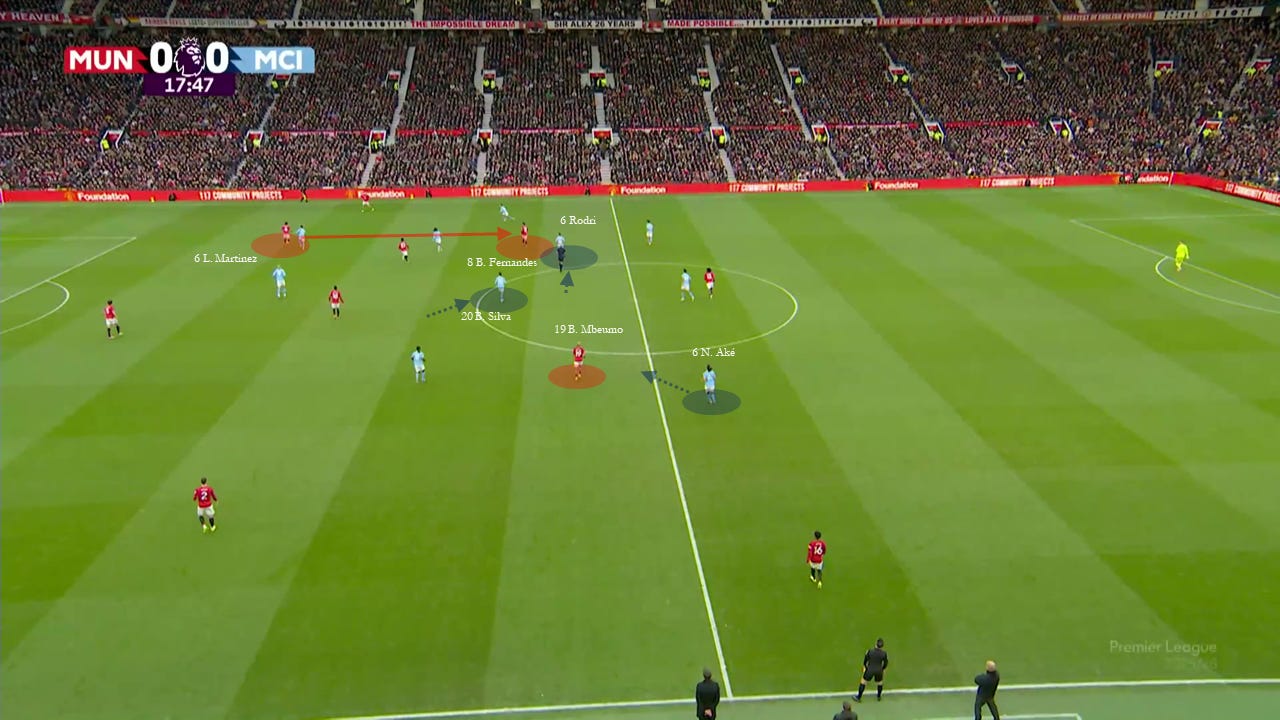
That results in a cascading effect. Bruno invites pressure, which means Mainoo is free. Also, Man City leans toward the ball side, while United can work the ball out of traffic and set Mainoo in a good situation to hit the switch.
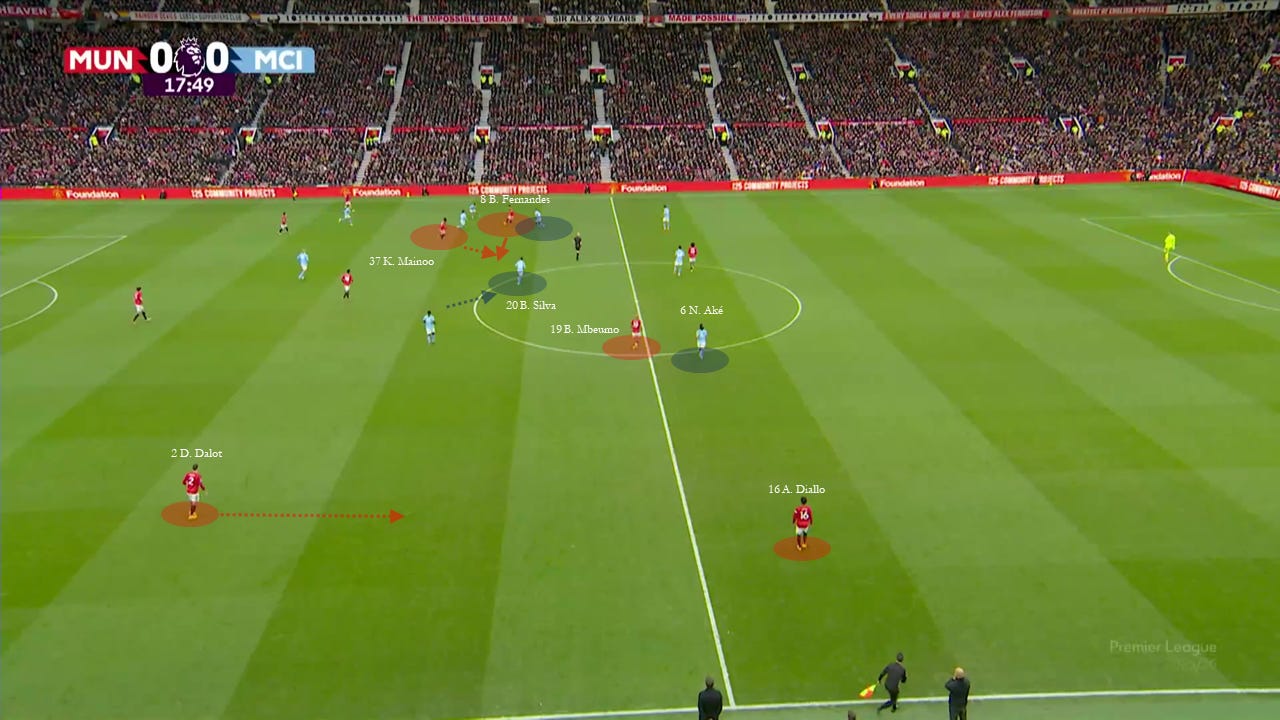
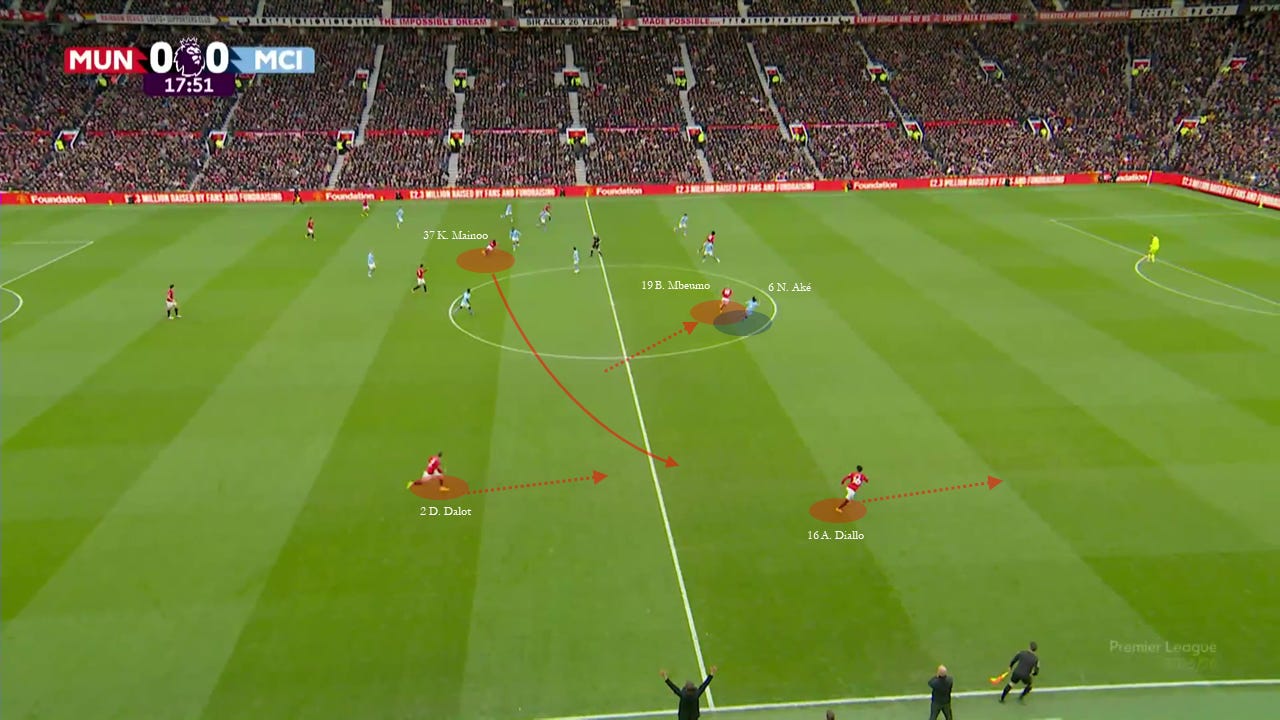
A 3v2 against Aké with Mbeumo forcing him inside pave the road in flowers for Dalot and Diallo to continue forward.
👉 Risk of central progression
There is nothing like attacking through the center, the shortest, fastest, and most qualitative way to create chances. However, everything has its own price. The center is rewarding, but the risk of losing possession is amplified because it’s the most crowded area of the pitch.
Diagonality has been one of the main features of Manchester United under Carrick. Diagonal passes combine the safety of horizontal passes and the progression of vertical deliveries. But preliminary actions remain essential to guarantee continuity of the play, notably scanning.
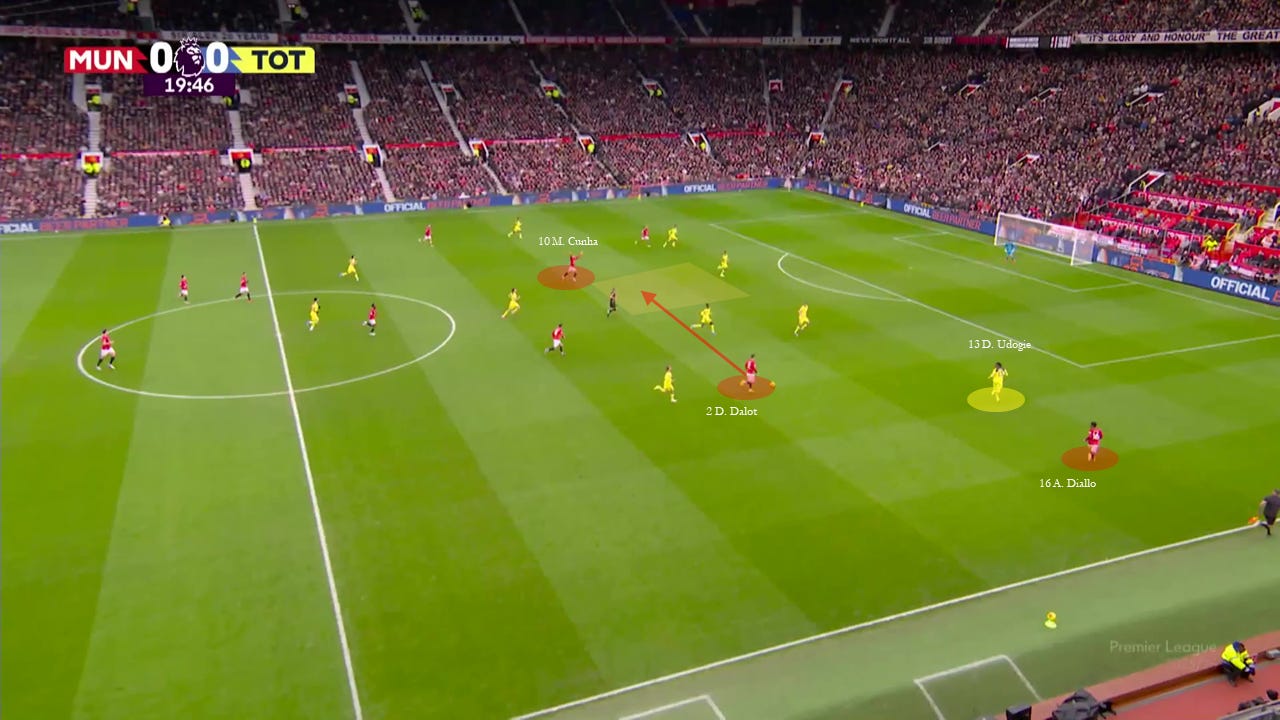
Alongside Lisandro Martinez, Diogo Dalot is one of United's line-breakers either via passes, dribbles, or carries. He often sells a lie by orienting his body toward where he wants the opponents to move, and then he immediately uses their momentum against them to slice through.
In this scene, the Spurs and United’s ball side players swing toward the right side. Dalot spots the gap between Tottenham’s double pivots to slide a diagonal line-breaking pass. Bruno is in the right place and at the right moment to receive. Not only does he encourage Romero to step up, but he also contributes to vacating the space behind for Mbeumo to attack.
Remember Casemiro checking his shoulder when he was forming a diagonal stair with other teammates. So, he composed an image of what happened behind his back and was already aware of his next actions despite being in a crowded zone. It’s the opposite with Bruno Fernandes. He does himself a disservice by not scanning to locate the source of pressure and the movements of his teammates. Suddenly, he finds himself caged in the middle of six Spurs players. Possession loss is inevitable.
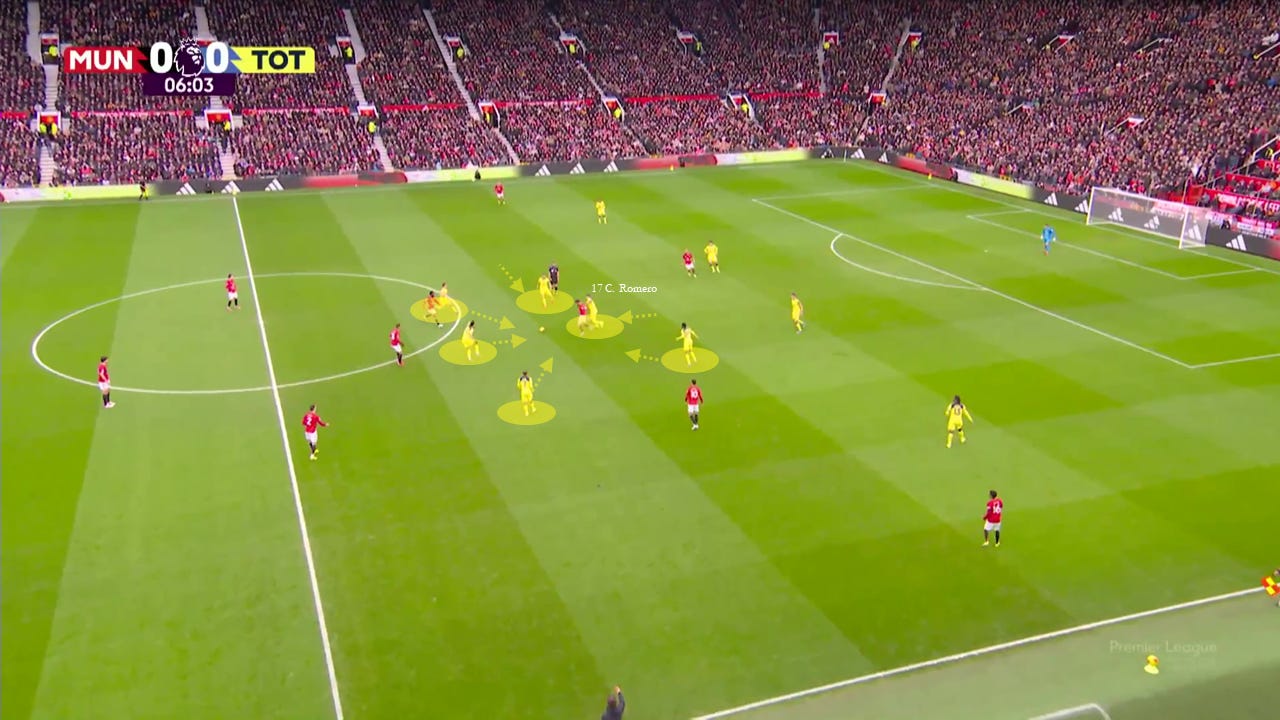
Cunha isn’t the aggressive counter-presser on the pitch. Hence, Pape Sarr dribbles past him, leading to a domino effect. Solanke pins the center-backs, whereas Simons ties Dalot near the halfway line. Meanwhile, Sarr entices Casemiro to commit, which stretches the space between the lines for the former to thread with Simons via a one-two combination and scamper forward.
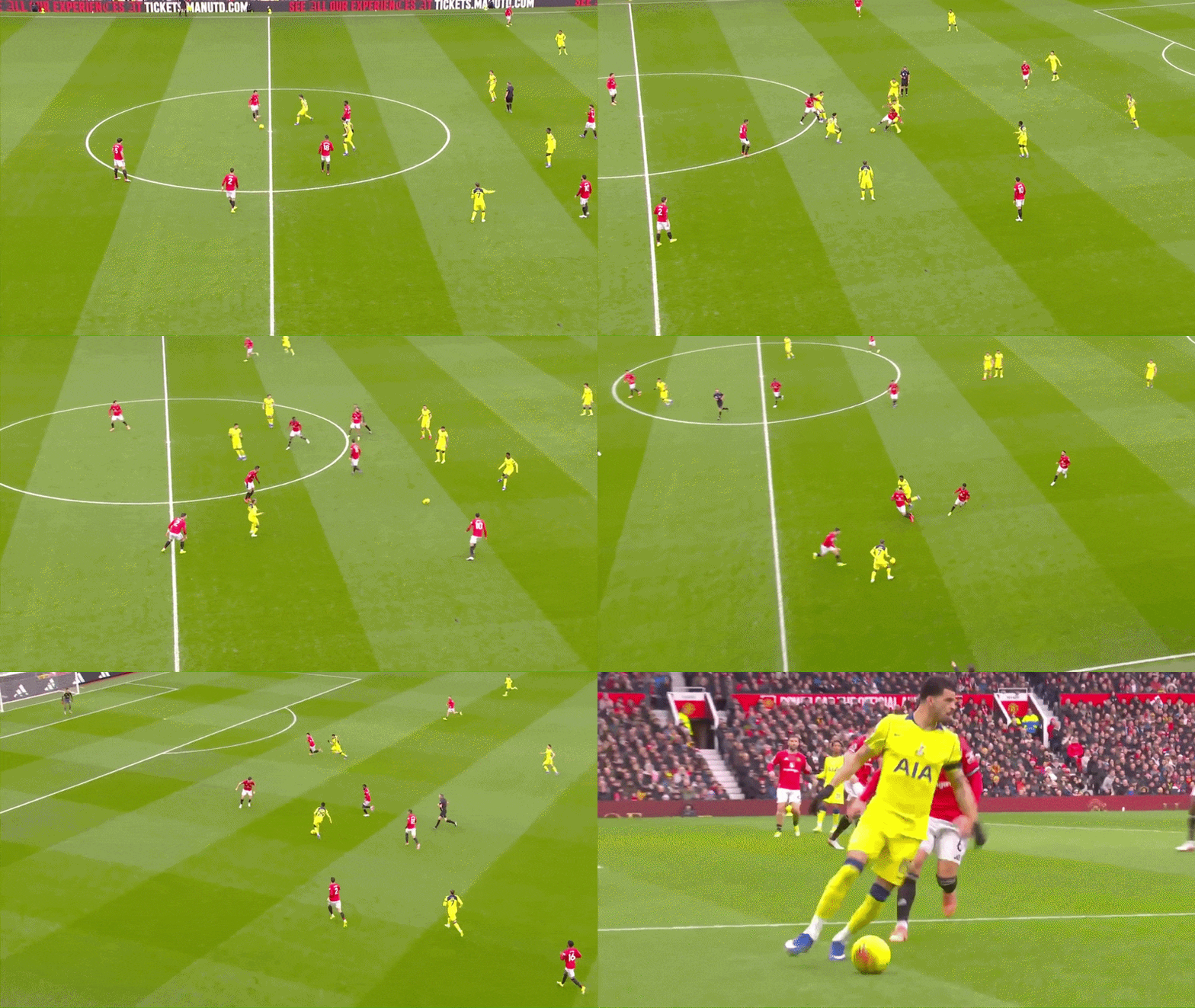
Arsenal, for example, lured the pass into central zones and then trapped the receiver, even if it was rare. In the middle third, Bruno Fernandes was an attractive central option to pick out. Once Licha released the pass, Saliba pounced on Bruno. Zubmendi, Odegaard, and Saka closed off the nearby options, whereas Trossard and Jesus marked the far side players.
Bruno fell into a central trap, as Arsenal were well set in terms of rest attack positions, generating a 7v6 situation to transition.
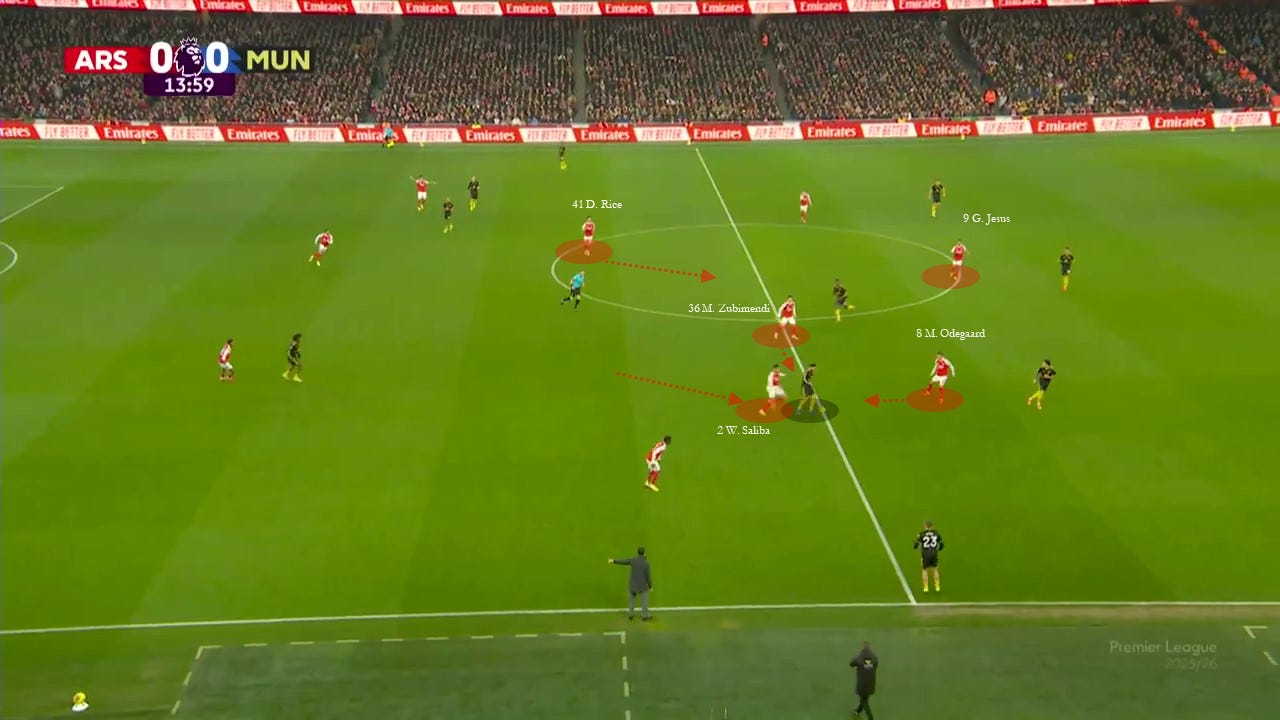
In the process, Odegaard magnetized Mainoo, Bruno, and Casemiro toward him to stretch the space between the lines and release Rice. Resultantly, the Gunners attacked with a 4v3 numerical superiority.
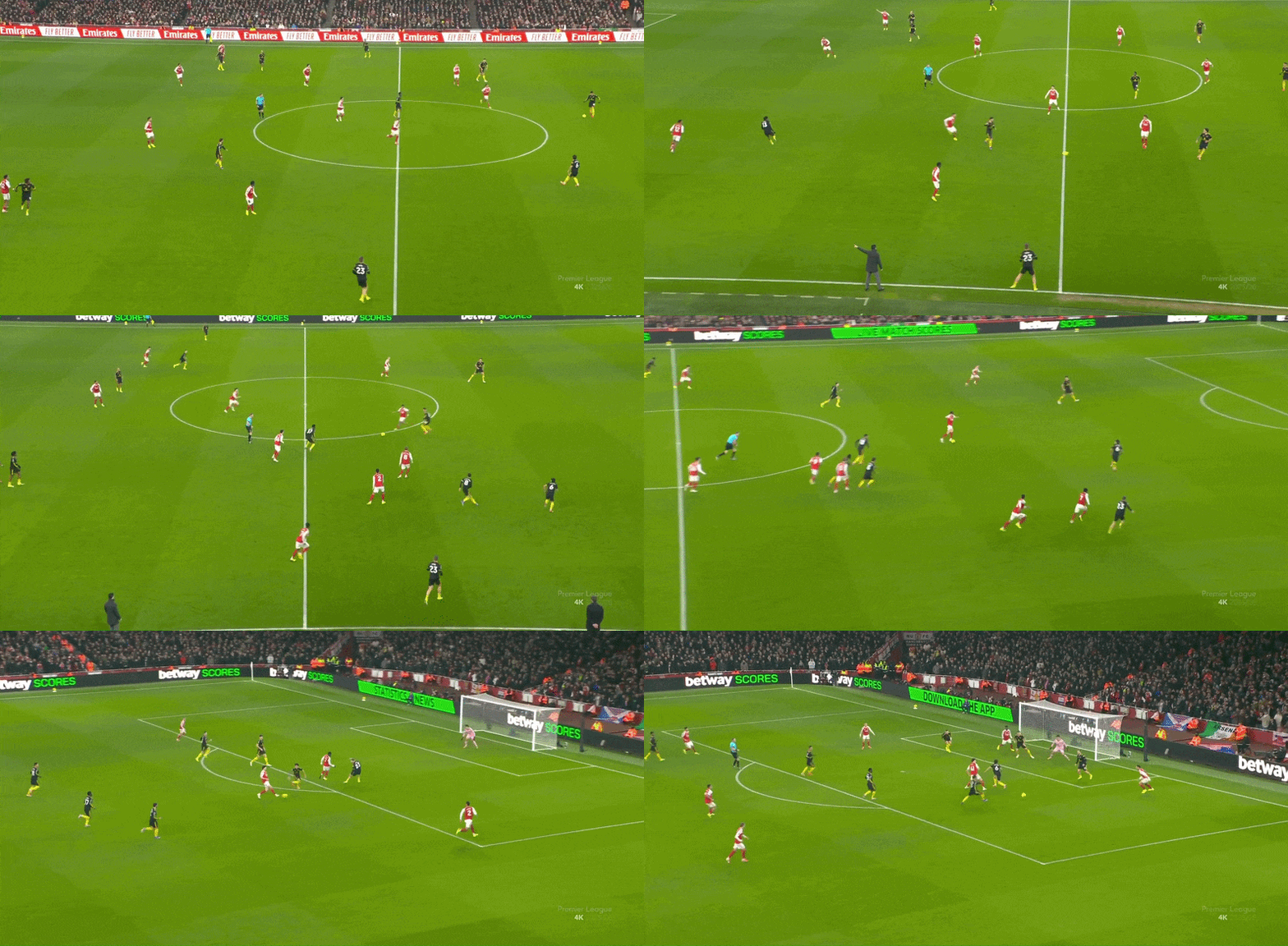
In central zones, taking risks has to be calculated. Every touch, pass, carry, dribble, decision, movement, and shot has to be progressive and safe, with a rest defense behind ready to counterpress, delay the counterattack, or drive the opponents into less dangerous zones.
Michael Carrick is Sir Alex Ferguson’s protégé. In a losing game state, he leans into taking more risks, either to draw a reward or at least try to even if the outcome isn’t the desired result.
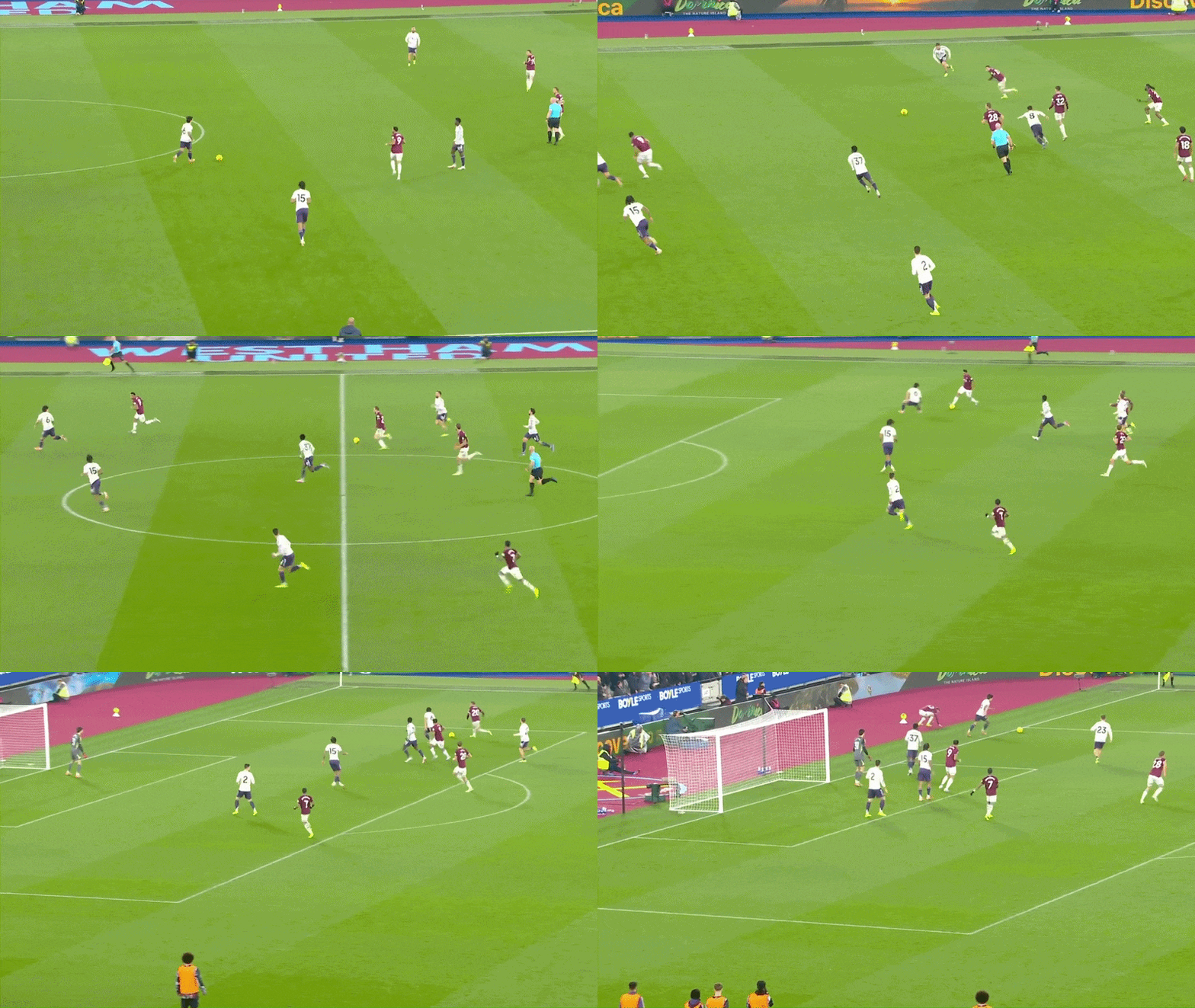
At 75’ against West Ham, Bruno’s pass to Sesko was blocked off by Freddie Potts. Hence, Bowen had a free route behind Luke Shaw to kick off the transition.
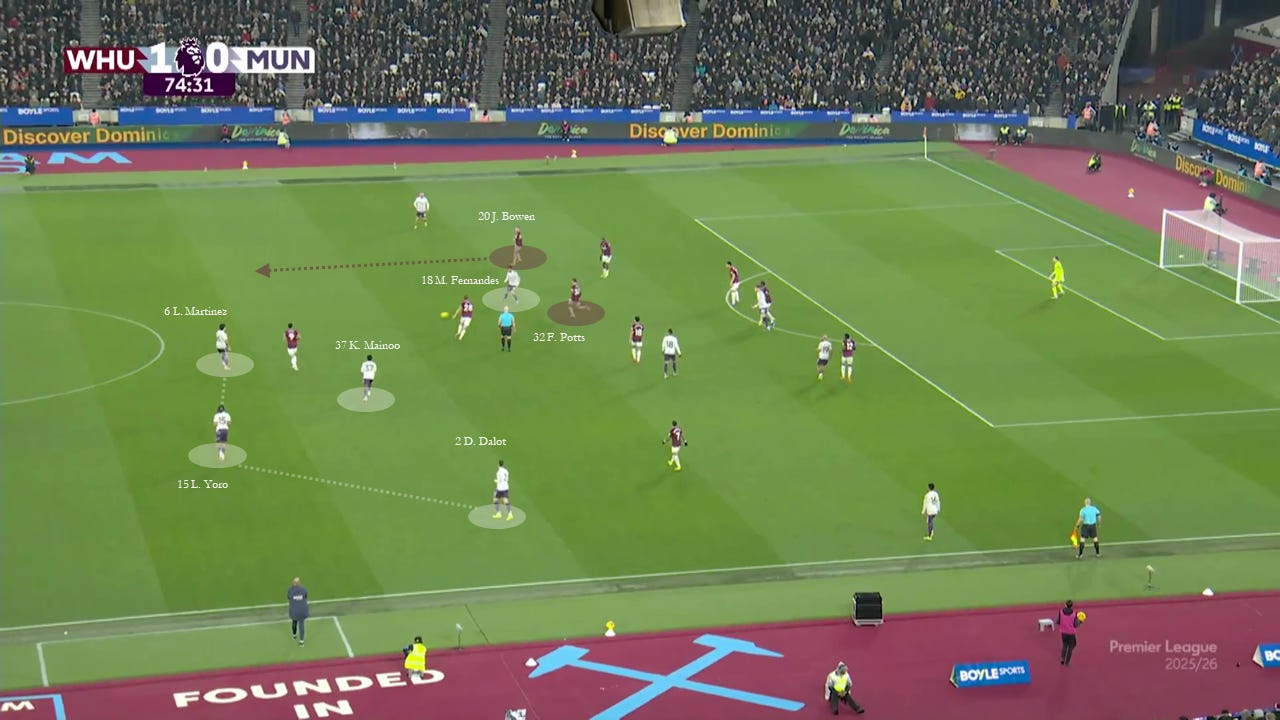
Fortunately, the rest defense was well established, the central channel and half-spaces were well covered, and the opponents were well monitored. A nice switch of roles between Mainoo and Lisandro Martinez saw the latter closing Bowen down near the byline.
👉 Shots from outside the box
Conor O’Neill, Data and Tactics Writer for The Athletic, wrote an article shedding light on how shots outside the box became a main trait in the Premier League 2025-26 season.
Over the past seven seasons, the findings of the study are:
Teams are more reluctant to shoot from outside the box.
There is a slight change in terms of shot locations, but the xG per attempt remained largely the same.
Nevertheless, teams convert more their shots from outside the penalty area. There is a big leap in terms of percentage xG overperformance compared to the previous seven seasons.
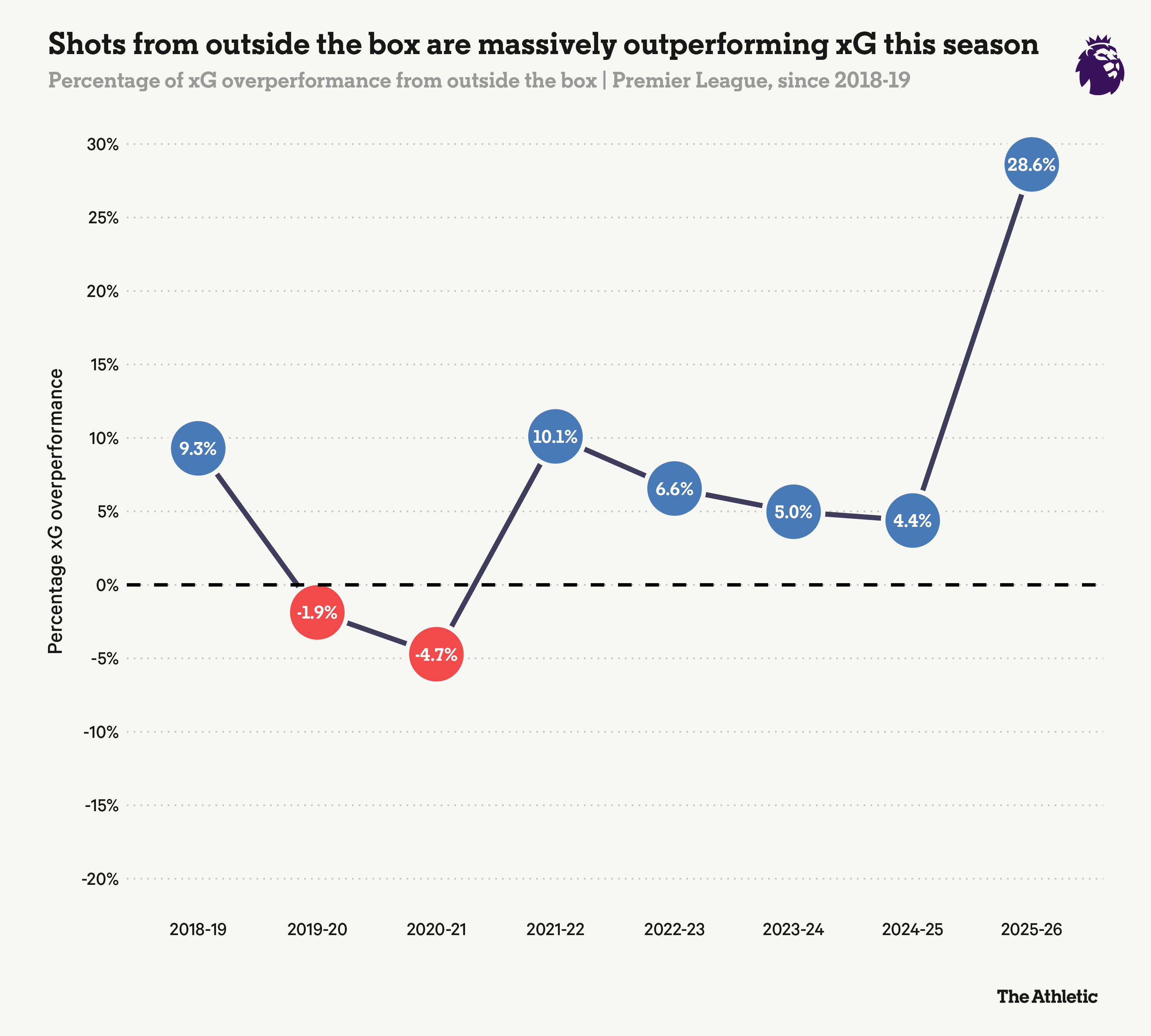
Aston Villa are the leaders of this trend, having netted 13 goals from outside the box, despite an xG of only 4.33. Morgan Rogers has been a headache for goalkeepers this term. According to him, it’s the result of the work put in on the training ground rather than luck:
“If you look at the chances and shots we are hitting, they are good options to take,… we are not taking pot-luck shots, and they are well within our rights to take.”
In other words, Morgan Rogers presents the idea of “if you’re good at something, why not try it?”
Players want to shoot whenever the opportunity presents itself, while coaches and their data department want their cogs to take shots from high-quality areas where the reward is big, and the risk is minimal. Both are right, and both have to come to a middle ground.
From another perspective, blocks are more compact and narrow. Access to high-quality zones has become harder than before (for reasons to discuss later).
Returning to Manchester United, the Red Devils attempt 4.73 shots outside the box per 90 minutes, second to Liverpool, according to MyGamePlan. However, the conversion rate is slightly above the average.
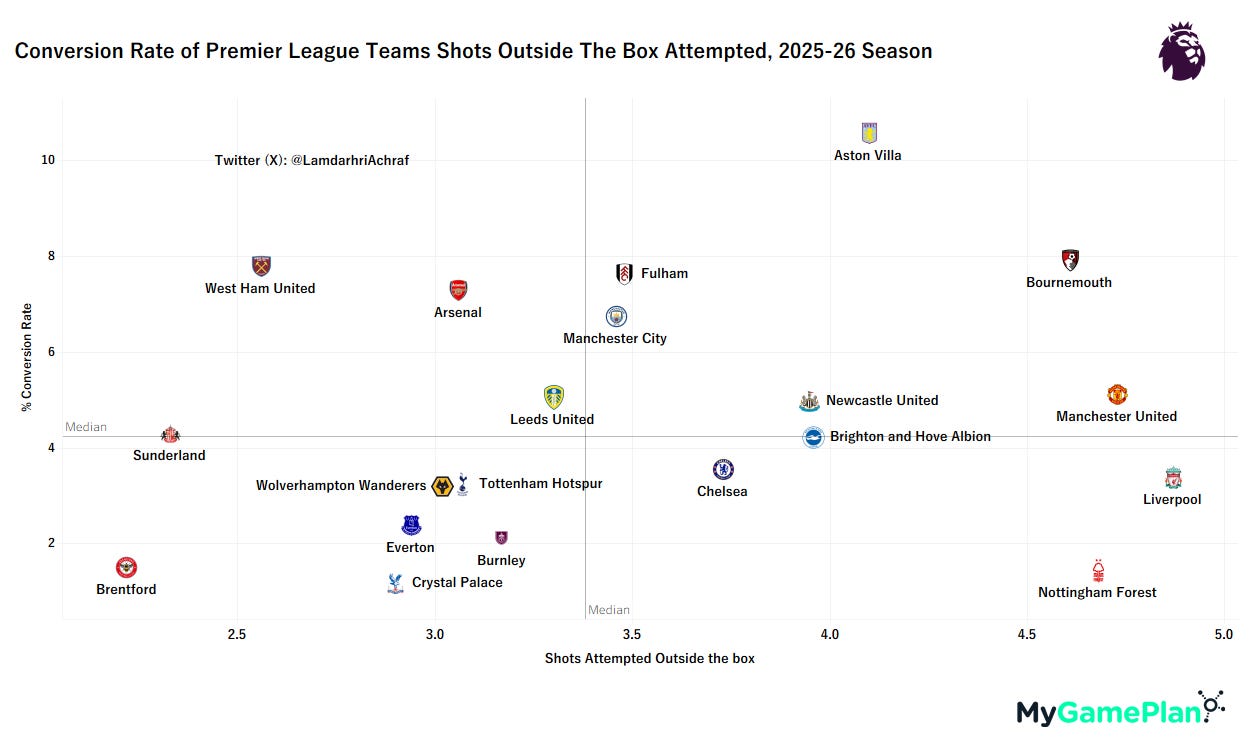
Pulling the trigger at the right time, in the right place, outside the box, seems to be the middle ground for coaches who desire safety and the best shooters.
When having the likes of Cunha, Mbeumo, Amad, Bruno, Casemiro, and Mainoo, it’s worth the risk.
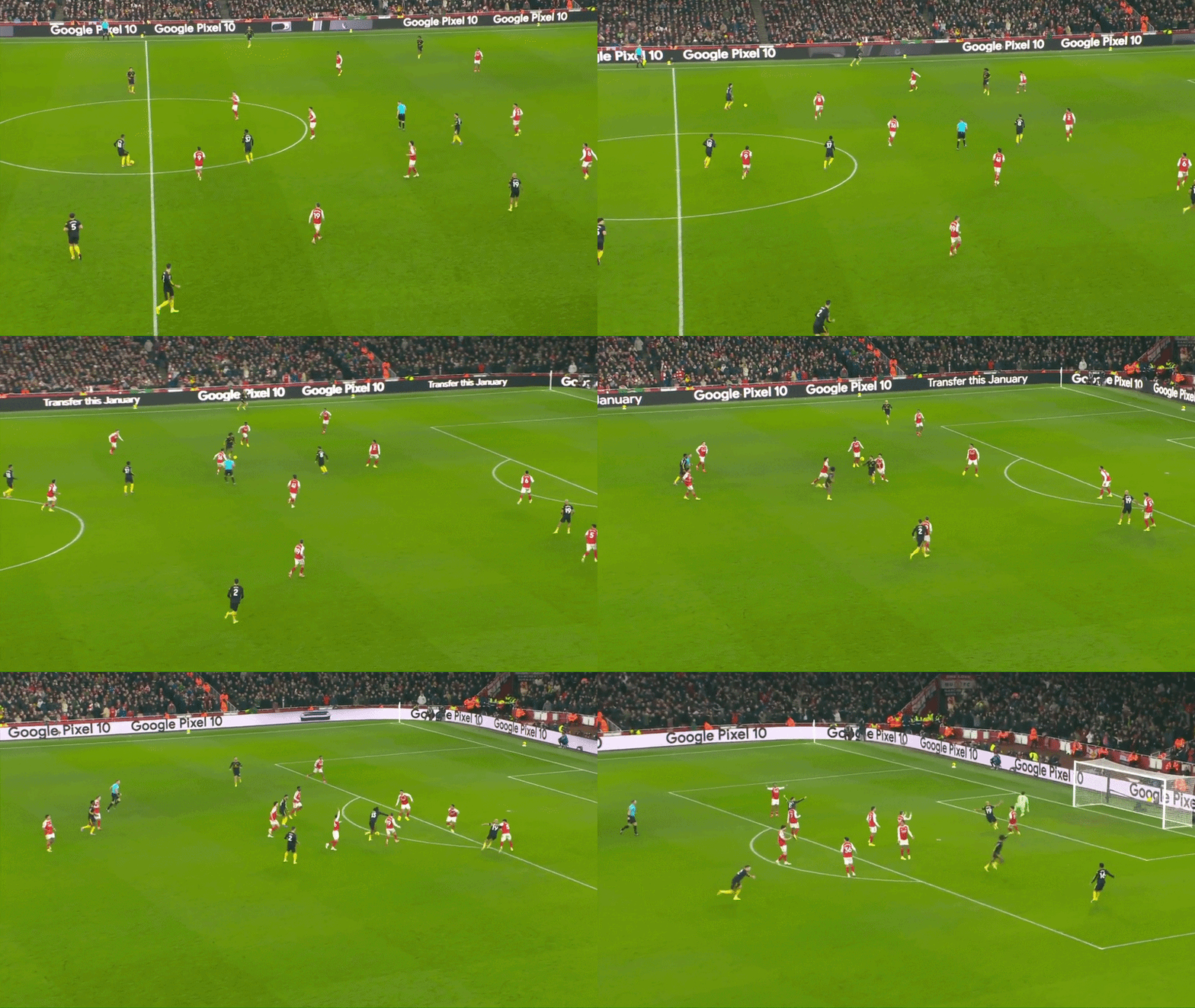
Generating space between the lines is the go-to plan for Manchester United under Michael Carrick. The second and third goals at the Emirates against Arsenal are the prime examples.
It’s fair to say that Manchester United is a well-versed team in exchanging passes from first-time touches in tight zones. The close distances between the players reinforce and increase the odds of skipping past traffic. As usual, Lisandro Martinez breaks Arsenal’s midfield line to find Dorgu inside. Bruno gets closer and combines with the Danish. They burst past Rice and Zubimendi, relying on give & go’s, for Dorgu to fire a shot between Gabriel and Saliba toward the roof of the net.
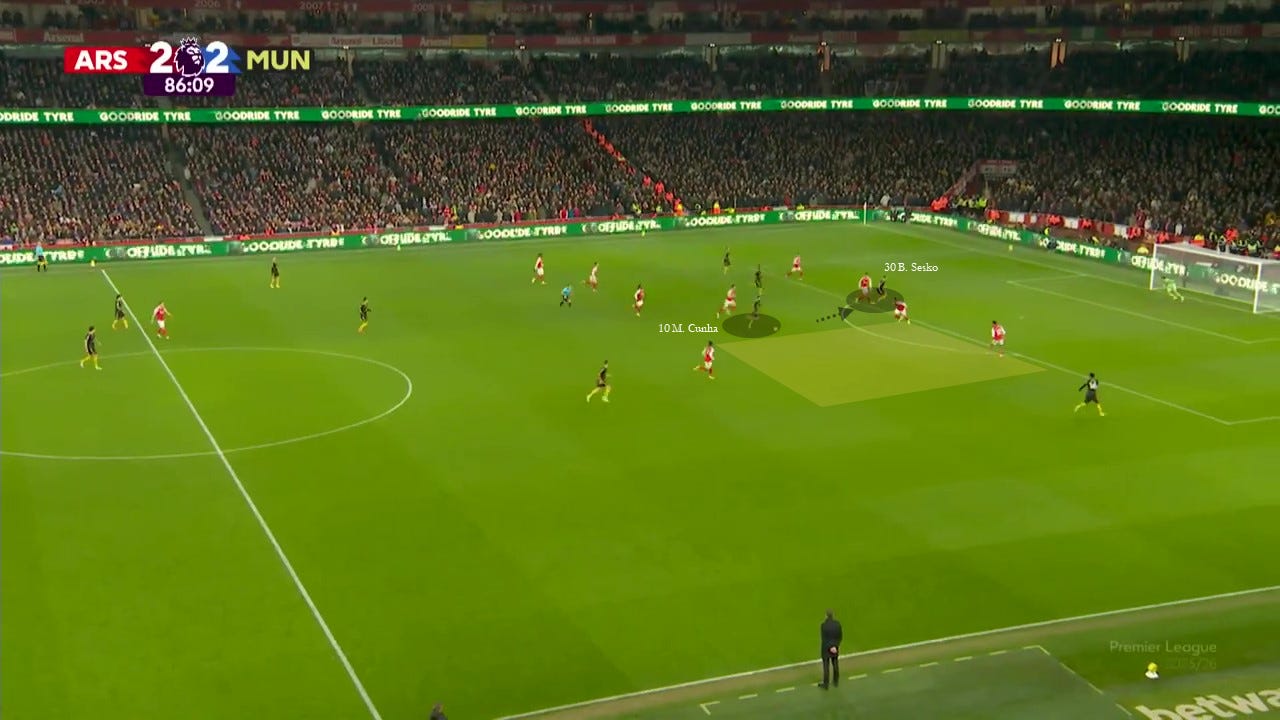
Still four minutes until the end, Lammens launched a long ball to a traffic in the middle third. Sesko, with a good hold-up play and United's close proximity, enabled them to win the second ball. From there, Mainoo and Bruno accessed Cunha between the lines.
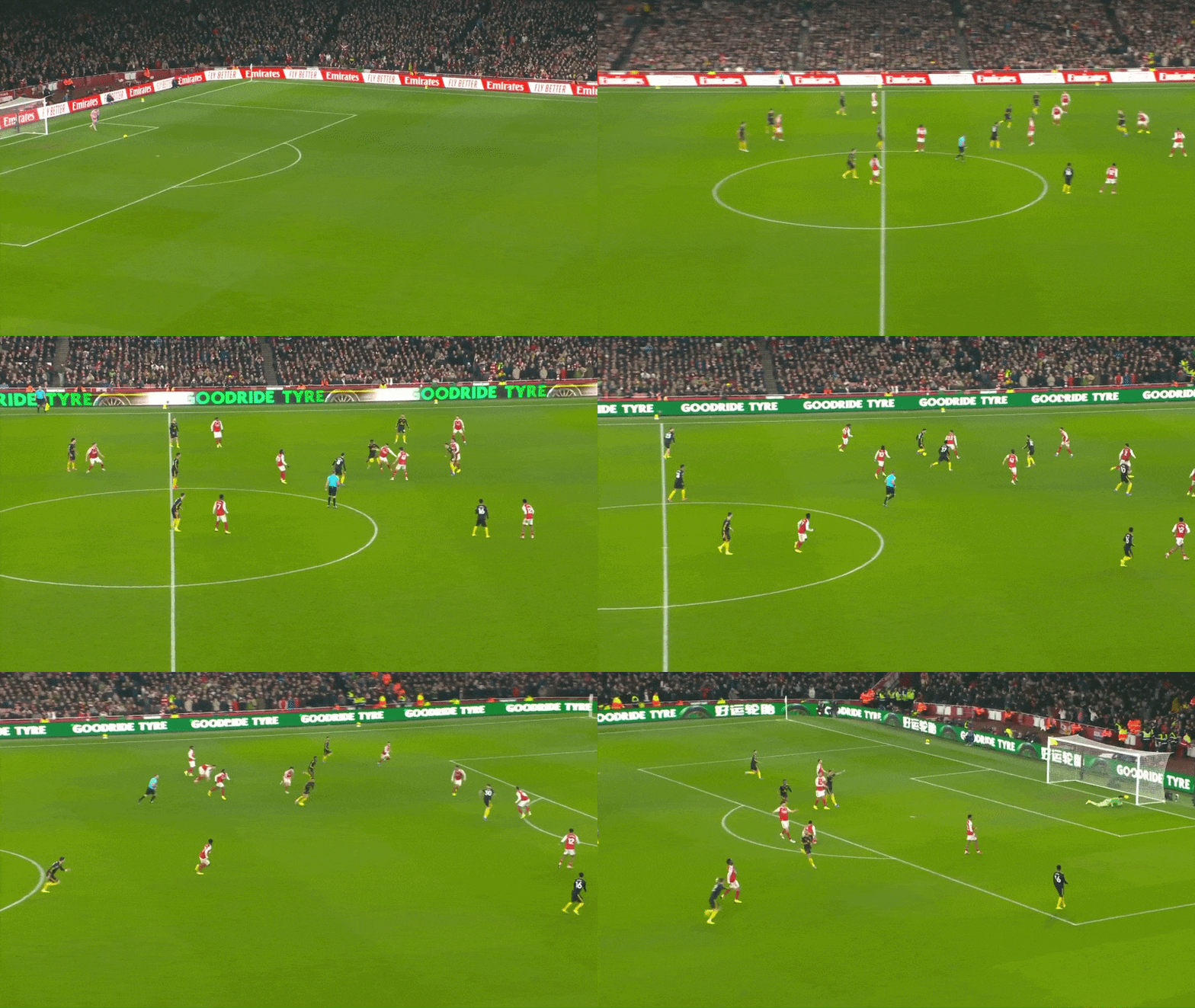
Sesko did a service for the Brazilian via his forward run to push the backline rearward. Hence, Cunha has space and time to pick out his shot accurately.
In the search for a draw against the Hammers, Casemiro, Mbeumo, and Diallo lend a hand for Sesko by pinning the backline, while Bruno entices pressure from the midfield line.
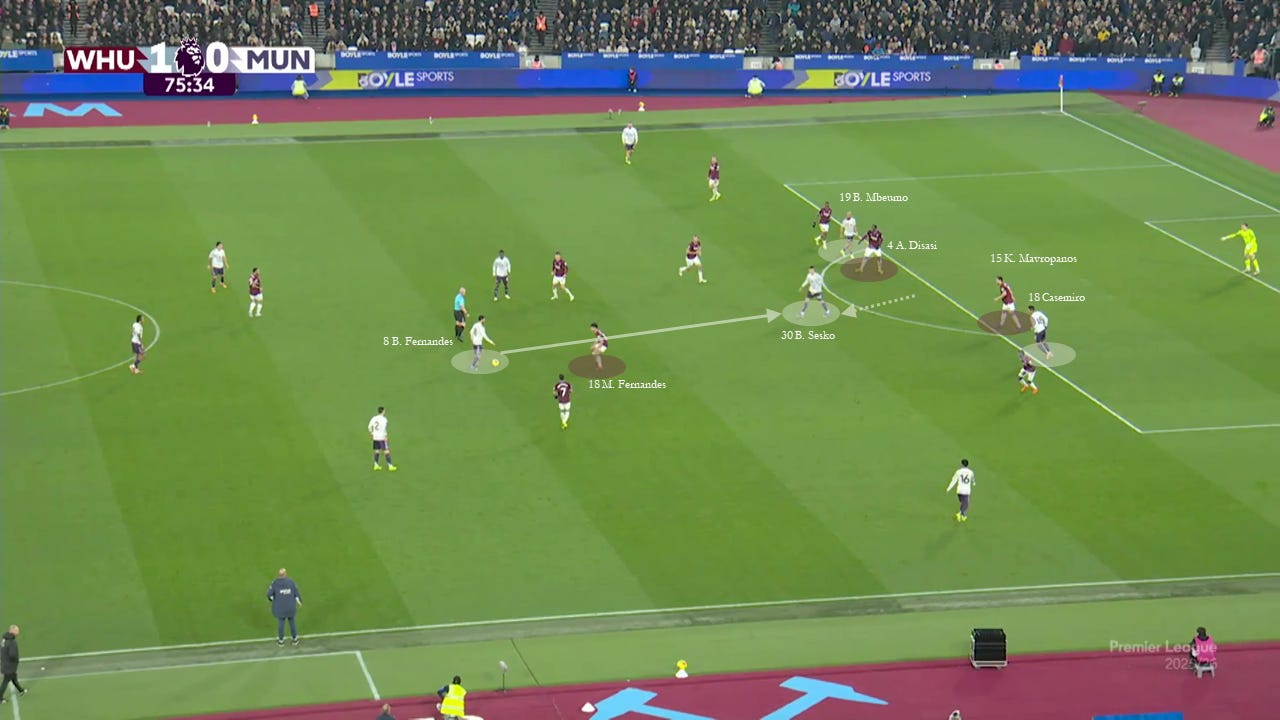
Therefore, the space between the lines is stretched for Sesko to drop, receive, turn, and prepare his shot.
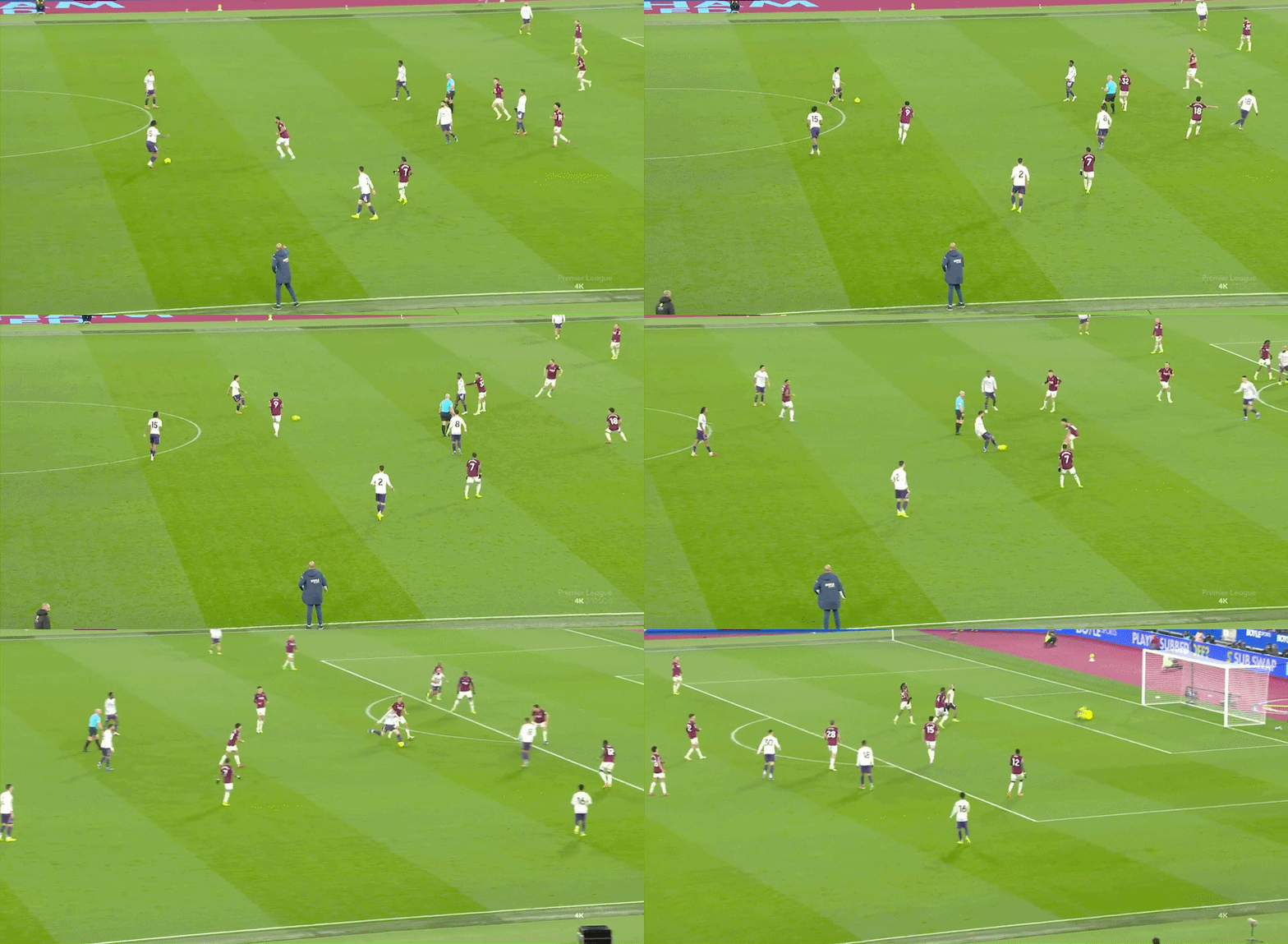
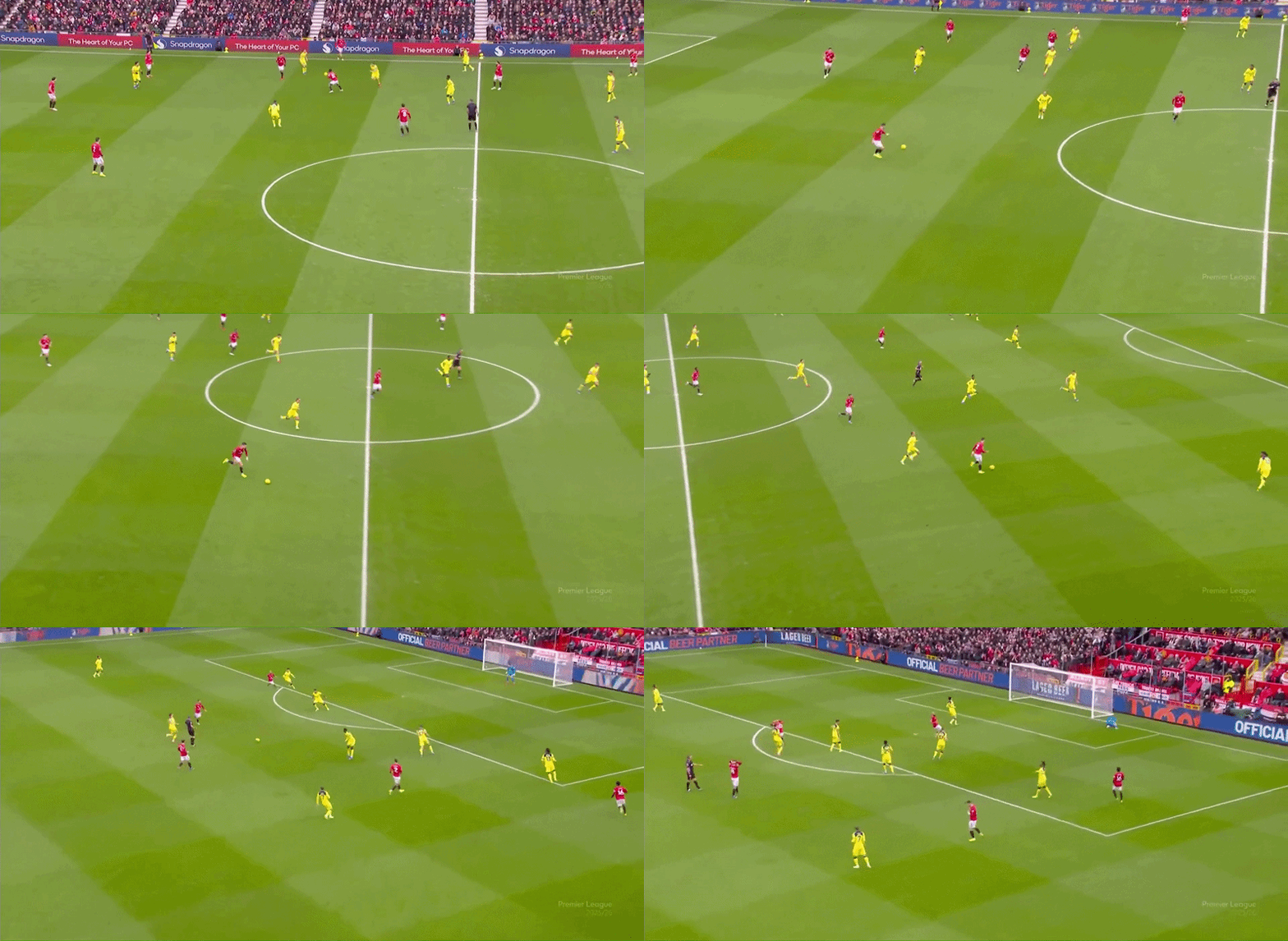
Here is another one that resulted from an overload to isolate situation. United midfielders’ proximity and leaning toward the left side tied Tottenham’s midfielders. The Red Devils found a getaway to exploit the 2v1 advantage on the far side.
Dalot had another alternative, which was capitalizing on the gap between the lines due to the initial situation of the midfielders.
A square pass found Cunha in space to pull the trigger.
💭 Last reflections
Michael Carrick replaced Ruben Amorim in the dugout, and things seemed to click on from day one. Probably, it may be the honeymoon period that follows the departure of the previous head coach. However, what Michael Carrick has done differently from Ruben Amorim is that he returns to basics. He places the players in positions where they are comfortable. The wingers are wingers, the fullbacks are fullbacks, the attacking midfielder is the attacking midfielder, etc
The impact was immediate. Mainoo returned to be a mainstay again. He showed his true essence, marshalling the United midfield. Flair, calm, press resistance, dribbles & combinations in tight areas, awareness & intelligence, etc., are the package the 20-year-old put on display.
Mainoo, alongside Casemiro, means that Bruno Fernandes has the license to slot in behind the striker. Post Amorim (before Everton), Bruno accumulated 27 key passes, 5 assists, and one goal. Under Carrick, Bruno is allowed the freedom to move and interpret free spaces. That maximises his ability with the concepts of central progression, diagonality, and close proximity being introduced. Adding to that, the platforming of Dorgu as a runner with Mbeumo as a natural one serves the Portuguese well in releasing his teammates in spaces behind the defensive lines, either to put them in crossing positions or to isolate them against the goalkeeper.
With Michael Carrick, there is more emphasis on working the ball down the center. The team contains Harry Maguire, Lisandro Martinez, Casemiro, and, to a lesser extent, Diogo Dalot, who can punch zippy passes that cut through opponents. Additionally, you have receivers who collect those deliveries with ease and bomb forward with the capability to navigate through clogged areas, alongside runners who are willing to punish spaces behind or stretch the opponents vertically.
The concept of diagonality and fluidity plays a large part in the current shape of the Red Devils. However, the risk is amplified, especially with the modern tactical landscape in the Premier League, in which control becomes harder to exert. We saw the likes of West Ham and Fulham swim in spaces behind United after a possession loss, something Michael Carrick acknowledged after the last London trip:
“You want those moments where you can open them up. It’s about that balance, against a team so dangerous on transitions and turnovers, with the pace they have, they can attack so fast. As much as you want to progress (the ball), you have to be in a position to manage and control the game.”
In fact, Manchester United counterpress works really well to neutralise counterattacks attempts —remember Cunha shot at the roof of the net against Fulham after an instant jump following a possession loss— however, the rest defense structure has been inconsistent in general.
That leads us to the way United players lose possession. Obviously, in the center, there is minimal space to receive and proceed with the next action. A couple of scans, positioning, and body orientation are preliminaries prior to receiving. First touches, cushioning, and wedging the ball are crucial factors in the success of the central attack. The coordination with teammates and the decision-making enter the equation, as well.
There indeed is a lean toward the center from Manchester United with Carrick. Nonetheless, the players aren’t fully attuned or on the same wavelength, and there is a part of it that lies on Carrick’s shoulders with his choice for the striker position. Against low blocks, pressure is constantly present at the back of the receiver. Mbeumo isn’t the type of striker to expect him to lay the ball off from first-time touches. It takes him longer to play the forward pass, which enables the opposition to close the gaps off that were open milliseconds before. The role suits Cunha, Sesko, and Zirkzee, with Mbeumo running off their shoulders.
Whoever the coach is in the dugout, Manchester United suffer against teams that allow them to have more possession of the ball. Carrick only coached United for five games. The caveat is the small sample size. Also, he had to face Manchester City, Arsenal, and Tottenham in his debut.
Before the Everton game, United's draw against the Hammers was the sixth in eight away trips to teams in the bottom half of the table. Since August 2024, United have won 15 matches when their possession of the ball is 60% or more. In contrast, they were capable of beating teams on 22 occasions with 49% possession or less. There are many factors in the mix: the profiles recruited, who only thrive in large spaces and transitional moments, and the coaches failing to address this problem.
Still, there are many points to discuss concerning Manchester United with Michael Carrick. This piece is already at 9000+ words. Tackling the out-of-possession and setpieces would only make it longer. Thus, I decided to leave these topics for the next Manchester United piece. The diagonality concept was an interesting subject, especially since it’s a rare feature in the Premier League and is the kryptonite to the man-marking and zonal defense meta.
So, Bare With Me ❤️.
NB: the stats are before the Everton game.
If you’re enjoying what we are producing—whether it’s an analysis, scouting, or opinion—Please subscribe, leave a comment, and drop a like. It helps us know that people out there value the work, and it boosts us on the Substack algorithms.
“Sharing knowledge is not about giving people something, or getting something from them. That is only valid for information sharing. Sharing knowledge occurs when people are genuinely interested in helping one another develop new capacities for action; it is about creating learning processes.”~Peter Senge
Many thanks, I found this very interesting. It suggests that the change from Amorim to Carrick is at least as much tactical as a "new manager bounce"